Why We Keep a Quiet Palette — Colour in the Room That Already Has Too Much
The brief arrives, as it often does, with certainty. We want something impactful. A pop of colour. Something that really stands out. The venue is a nineteenth-century manor house. The ceiling is fifteen feet. The walls are hand-painted with botanical murals in sage and umber. The linens are ivory damask. Two hundred guests will arrive in navy, forest green, deep burgundy, and black. Candlelight will sit at every table.
31 min read · Les Fleur Company
The Room Is Already a Composition
Every room, by the time your guests arrive, is a finished piece. The architecture has made its decisions — the wall colour, the ceiling pitch, the floor material, the quality of natural light at four in the afternoon. The lighting designer has settled the temperature of the room. The bride's dress, the bridesmaids' attire, the table linens, the chair covers — each element has drawn from a palette, whether or not anyone named it as such.
To add florals into that space without first reading the existing composition is not creativity. It is noise.
Josef Albers, in his foundational study of colour interaction, demonstrated that colour does not exist in isolation — it is always relative to what surrounds it. A blush rose in a room of ivory and grey-green reads as warm and present. The same blush rose beside a coral ranunculus reads as pale and receding. The arrangement does not contain a colour. It contains a relationship between colours. And those relationships extend beyond the vase, into the room, and outward to everything the room contains.
When we speak of restraint at Les Fleur, we are not speaking of timidity. We are speaking of precision — the decision to read the room before deciding what it needs, and to remove from the palette rather than add to it when the room has already made its argument. Our role is to agree with the room. Not to compete with it.
What a Quiet Floral Colour Palette Actually Means
Quiet does not mean white. It does not mean cream. It does not mean the absence of a colour decision.
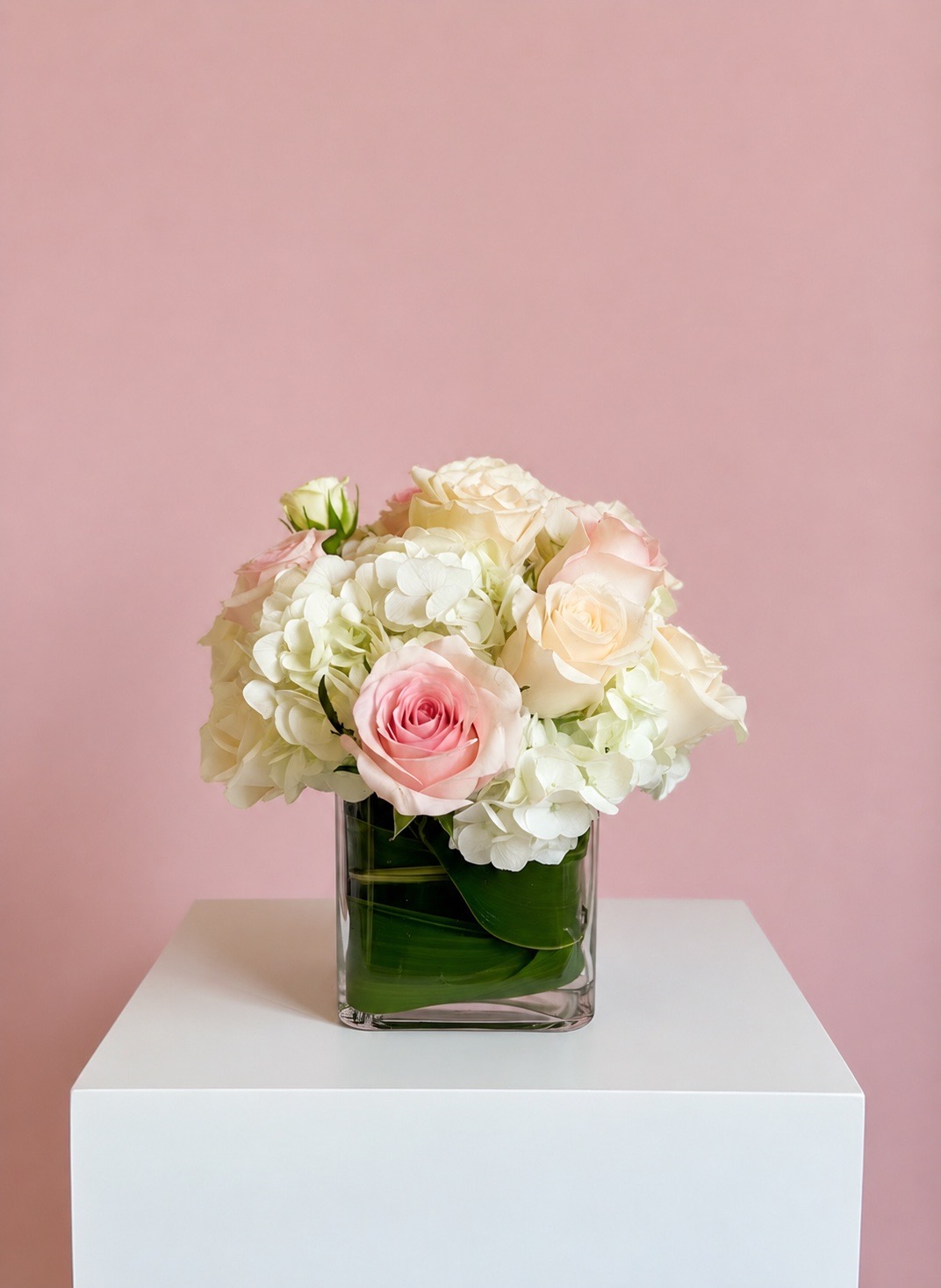
A quiet floral colour palette operates within a narrow tonal value range — the distance between the lightest and darkest tone in the arrangement is deliberately small. Not because there is no variation, but because the variation stays within a close family. A pale Quicksand rose beside ivory lisianthus beside silver dusty miller is not without colour. It is controlled colour. Each stem occupies neighbouring territory on the spectrum rather than staking out a separate claim.
The colours that break a quiet palette are those with high chroma — high saturation. Hot coral, electric violet, traffic-cone orange, true crimson. These are not defective colours. They are colours that make a demand. They say: look here. In a room that already has fourteen places where the eye might rest, adding a fifteenth is not generosity. It is a failure of editing.
A working quiet palette might move through these registers:
The range between these is narrow. The arrangement breathes. It does not ask to be looked at.
The Problem with a Pop of Colour in a Quiet Floral Palette
It is one of the most common requests in a consultation, and it arrives in the friendliest possible spirit. Can we add just a pop of colour? Something to make it feel alive? The word pop is worth examining. It implies contrast — something that breaks the established visual logic in order to create surprise. The idea is that a single vibrant note will lift an otherwise restrained arrangement.
In a room with nothing else competing, a single point of colour can anchor the whole. In a room already composed — already carrying visual weight from architecture, light, fabric, and a hundred guests — the pop does not lift. It disrupts. The eye lands on it and then does not know what to do next, because nothing else in the composition speaks the same language.
The structural problem is this: a quiet palette has an internal logic. The values relate to one another. The silhouette reads as whole. When a single high-saturation stem is introduced — a coral ranunculus, a hot-pink sweet pea, a claret dahlia in an otherwise ivory arrangement — it does not become part of the composition. It becomes the thing the composition has to apologize for. Every other stem now reads as background to this single demanding element, and that was not their role.
This is why the discipline matters. Not because bright colour is wrong, but because a composition either has a consistent internal logic or it does not. The eleventh stem ruins the composition. The pop of colour, in a room already carrying colour, is usually that stem.
When Colour Earns Its Place
There are rooms that want colour. A low-ceilinged restaurant with dark painted walls, a single intimate table, and no competing architectural detail — here, a deep claret ranunculus, a stem of muscari, a Café au Lait dahlia in warm amber can do real compositional work. The colour has space. The room has not already taken everything.
There are also occasions that extend an invitation. A summer garden dinner where the light is oblique and the setting is deliberately simple — reclaimed wood tables, no linens, herbs and grasses used as much as flowers — can carry a looser, more saturated palette: garden roses in pale coral and warm yellow, a stem of scabiosa in soft violet, foxglove in cream moving toward pink. The room invited it. The colour did not impose itself.
The diagnostic question in every consultation is not whether to use colour. It is: what has this room already decided? A marble chapel with white limestone walls is already an argument for restraint. A low-lit converted barn with rough wood and iron chandeliers is an argument for warmth and depth. A glass-walled greenhouse at noon in July is an argument for green, and very little else.
Colour earns its place when the room has left room for it. Reading that room — honestly, before any preference is introduced — is the first act of composition.
The Stems That Hold a Muted Arrangement Together
A quiet floral colour palette is only as strong as its materials. There is no successful muted arrangement without foliage that reads as grey or silver — this is what prevents pale blooms from floating, disconnected, against white linen. Dusty miller is the most reliable anchor: its deeply lobed, silver-grey leaf reads at distance and sits quietly at close range. Artemisia brings a finer, more filament-like texture. Silver-dollar eucalyptus offers mass without visual weight, its round leaves providing a soft counterpoint to the pointed forms of rose and lisianthus.
The flowers within the palette need variation in form even while they agree on value. A tight arrangement of only Mondial roses in ivory beside ivory lisianthus will read as flat — the surface texture is too consistent, the eye has no reason to move across it. Introduce a frothy wax flower stem at the edge, a curling clematis tendril for movement, a loose open garden rose whose petals are less disciplined than the hybrid beside it — now the arrangement has dimension. The palette stays quiet. The arrangement does not read as simple.
It matters, too, to understand that white flowers are not a single white. This is one of the most practically important distinctions in muted floral composition:
An arrangement that places Mondial beside lisianthus beside ranunculus is using the full range of white without leaving the quiet palette. The eye reads variation. The room reads coherence.
Reading the Room Before a Single Stem Is Named
The consultation that produces the best result begins not with preferences, not with a colour swatch, not with an inspiration board curated from four different weddings in four different settings — but with the specifics of the room. What are the walls. What is the floor material. What does the ceiling do at the far end. What direction do the windows face, and what will the light be at seven in the evening in the month you have chosen.
A florist working from composition outward treats colour as the last decision. This is counterintuitive for most clients, who have been trained by the broader industry to begin with colour — "I'm thinking blush and ivory," "I love terracotta," "can we do something a bit moody?" — and build outward from there. Beginning with colour and working outward to the room produces arrangements that match a mood board. Beginning with the room and working inward to colour produces arrangements that belong to a specific evening in a specific space.
Practical questions worth settling before a palette is discussed:
With these answered, the palette often reveals itself. The florist's role is to confirm it, refine it, and make it specific in stem and variety. Not to invent it from outside the room.
The Arrangement That Disappears Into the Room
The highest compliment an arrangement can receive is one the guest almost cannot articulate. Not: "the flowers were so beautiful." Not: "I loved the colour palette." Something more ambient — a sense that the room held together, that the evening cohered, that there was nothing visually competing for their attention when what mattered was the person seated across the table.
This is what a quiet floral colour palette accomplishes at its best. Not to be seen. To belong. To make the room feel like itself, only more so.
The Quicksand rose in its palest blush, on a table with white tapers and ivory linen, in a room with stone walls and the amber wash of early evening — it will not be remarked upon. It will be felt. The guest will carry a sense of something graceful without being able to name its source.
That is the arrangement doing its work. That is enough.
When you begin a consultation at Les Fleur, bring photographs of your venue taken at the time of day your event will be held. Bring the linen swatch if you have it. Note the bridesmaids' attire and the approximate colour range of your guests. Let us read the room first. The palette will follow from that reading — and the arrangement, when it arrives on the evening, will feel as though it was always there.
The arrangement that insists on being noticed has already lost the room.
Considered
What is a quiet colour palette in floral design?
A quiet colour palette keeps all stems within a narrow tonal value range — pale blushes, ivory, soft grey-greens — so the arrangement reads as cohesive and recedes gracefully into its setting rather than demanding attention. It is not the absence of colour but the discipline of keeping those colours in close tonal relationship, so the eye moves across the arrangement rather than snagging on a single dominant note.
Why do florists recommend muted or neutral flowers for wedding receptions?
Wedding reception rooms are already compositionally dense — linens, candlelight, architectural detail, and guests in varied attire all contribute colour simultaneously. High-saturation blooms add another competing visual element rather than cohering with the whole. A muted palette allows the arrangement to feel like part of the room rather than an object placed inside it — which is the difference between a room that holds together and one that does not.
What flowers work best for a muted or neutral floral arrangement?
Quicksand rose (warm blush), Mondial rose (cream-white), white lisianthus, pale garden peony, and white ranunculus form a reliable core. Foliage anchors the palette: dusty miller, silver-dollar eucalyptus, and artemisia provide the grey-green tones that prevent pale blooms from reading as flat or floating. Clematis vine adds movement and texture without introducing new colour. Wax flower offers filament-like detail at the edges of the arrangement.
Can a muted floral arrangement still have visual interest?
Yes — textural variation within a quiet palette creates dimension without breaking tonal restraint. Frothy wax flower against the tight spiral of a Mondial rose, the layered petals of ranunculus beside a more loosely opening garden rose, the silver lobe of dusty miller contrasting with the round leaf of eucalyptus — all of this gives the eye places to travel. The palette stays narrow. The arrangement does not read as simple.
When does a room actually want colour in its floral arrangements?
Rooms with minimal architectural detail, dark walls, or simple table settings can carry colour without it competing. A low-ceilinged restaurant with a single intimate table and no competing pattern invites deeper saturation — claret ranunculus, muscari, deep plum tulip. The measure is always what the room has already decided: colour earns its place where the space has left visual room for it.
How should I describe my venue to a florist so the palette is right?
Bring photographs of the space taken at the time of day your event will be held — wall colour, ceiling height, flooring, and the quality of light in that hour all matter. Note the linen colours, the dress, and the approximate attire of guests. A florist working from composition outward will read these before discussing colour, because colour should follow what the room has already committed to — not precede it.