Crafting a Masterful Floral Composition: 5 Essential Elements for Wedding Bouquets That Hold
A bride once handed a designer a photograph an hour before the ceremony and asked, quietly, why her bouquet looked nothing like the mock-up. The flowers were the same — garden roses, lisianthus, a trail of clematis. The difference was that the mock-up had been composed, and the final bouquet, assembled under time pressure by a second hand, had simply been filled. Every gap got a stem. Every stem got a neighbor. What should have read as considered read as busy. This is the failure point in most wedding florals, and it has almost nothing to do with the flowers themselves. Floral composition for wedding bouquets is a discipline of five specific decisions, made in order, before a single stem enters the hand.
35 min read · Les Fleur Company
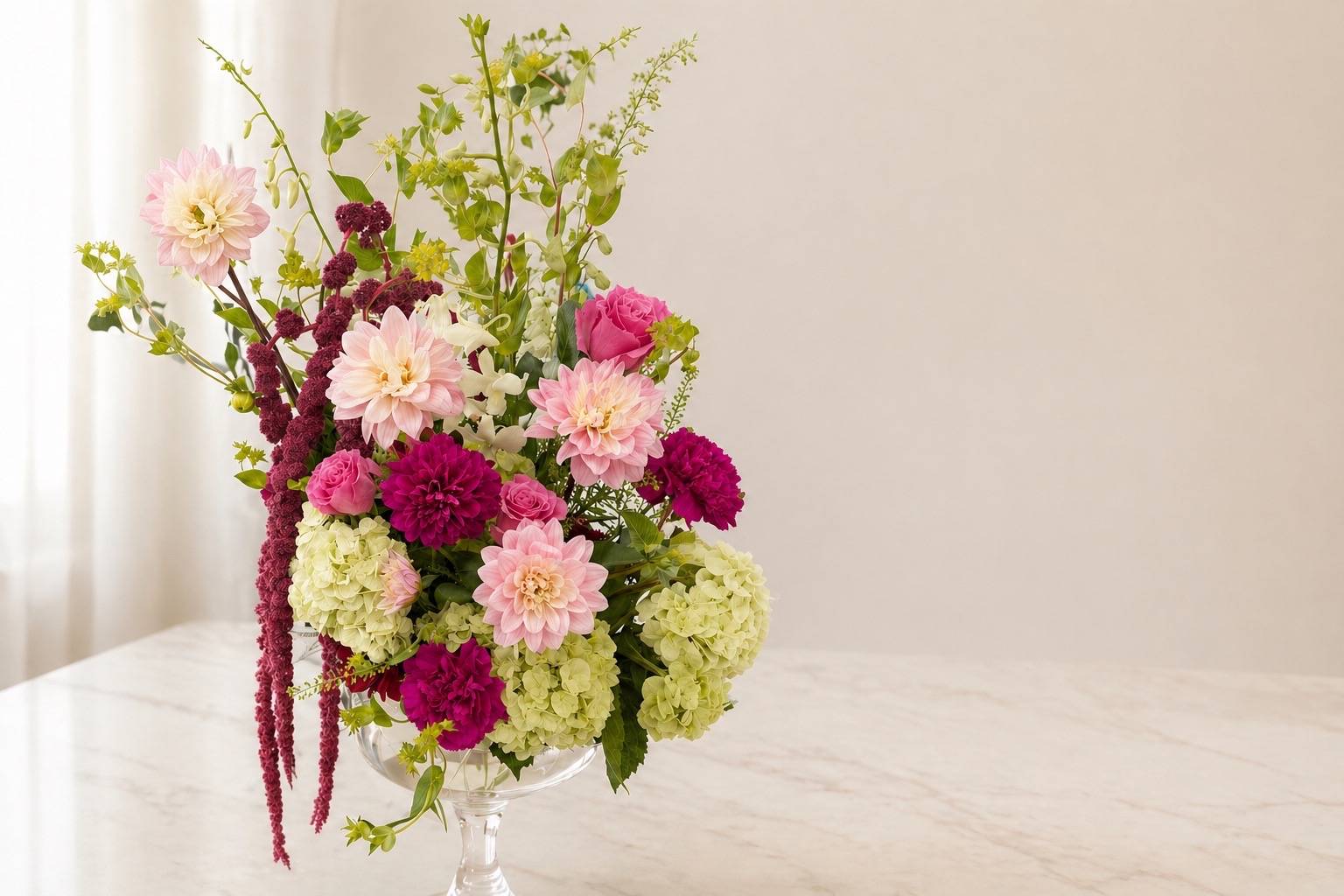
The Bouquet That Falls Apart by Hour Three
Most bridal bouquet failures are not floral failures. They are compositional ones, and they surface predictably: by the reception's third hour, a densely packed round bouquet has bruised its own outer petals, the weight has pulled the hand-tie loose, and what looked full at 2 p.m. looks tired by 7.
The pattern shows up often enough in post-wedding reviews that it is worth naming directly. A bouquet with 45 stems crammed into a 9-inch diameter carries roughly 30 percent more weight than one built at 33 stems with visible air between blooms — and that extra weight is what a bride is gripping, one-handed, through a five-hour day.
The corrective isn't fewer flowers for their own sake. It's a composition built on five elements, decided in sequence, before assembly begins: silhouette, negative space, proportion, color structure, and mechanics. Each is covered in turn below, with the numbers an atelier actually works from.
What Composition Actually Means in Floral Design
An arrangement is flowers placed together. A composition is flowers organized by a governing shape, with restraint applied at every decision point along the way. The distinction sounds semantic until you watch two designers work from the identical flower order — the same 30 garden roses, the same lisianthus, the same eucalyptus — and produce results a client can immediately rank.
Composition treats the bouquet the way a portrait painter treats negative space around a subject: the empty area is doing as much work as the filled area. This is a harder discipline than it sounds, because the instinct under time pressure is always to add — one more stem to fill a gap that, left alone, would have given the eye somewhere to rest.
For a broader framework on how this principle extends beyond the bouquet into full-event florals, see Crafting Custom Floral Arrangements: The Art of Composition for High-End Events.
Element One: Silhouette Before Stems
Silhouette is the single decision every other choice depends on, and it must be made before cutting begins — round, cascade, hand-tied posy, or asymmetric. A designer who starts placing stems without a resolved silhouette is composing reactively, and reactive composition is how a bouquet drifts into shapelessness.
Round silhouettes, the most requested, hold a consistent 9 to 11 inch diameter and depend on a tight, even outer edge — every outermost bloom sitting at roughly the same depth from center. A single garden rose sitting a half-inch proud of that edge reads, in photographs, as a flaw the eye keeps returning to.
Cascade silhouettes invert the discipline: the structure lives in the trailing line — clematis, jasmine vine, trailing amaranthus — worked to a consistent taper rather than an even edge. A cascade that trails 14 inches on one side and 6 on the other reads as unfinished, not organic.
The working rule: sketch or mock the silhouette in greenery alone first — eucalyptus and dusty miller — before introducing a single focal bloom. If the shape doesn't hold in greenery, it won't hold once weight and color are added.
Element Two: The Discipline of Negative Space
Negative space is the element most often sacrificed under client pressure, because a fuller bouquet reads, at a glance, as more generous. But a composition without visible air between stems loses depth — every bloom sits at the same visual plane, and the eye has nowhere to land.
The practical test an atelier uses: hold the finished bouquet at arm's length and identify three points where light passes visibly between blooms. If none exist, the composition has been over-filled. This isn't about starving the design — a 33-stem bouquet can carry full visual weight and still leave room for depth, if the stems are set at varied heights rather than a single flush plane.
Depth also protects the individual bloom. A garden rose given a half-inch of clearance from its neighbors photographs with visible dimension — petal, shadow, form. The same rose pressed flush against two others reads as a smear of color. This is the same logic that governs centerpiece work; see Crafting Botanical Centerpieces: A Guide to Composition for High Elegance for how it scales beyond the hand-held bouquet.
The eleventh stem — the one added after the silhouette and spacing are already resolved, out of habit or nervousness — is the most reliable way a disciplined composition gets undone.
Element Three: Proportion and Scale Against the Body
A bouquet is not composed in isolation. It is composed against a specific bride, at a specific height, in a specific dress silhouette, and proportion has to account for all three or the finished piece will look wrong in every photograph regardless of how well it was built on the table.
The general working ratio: bouquet diameter should run roughly one-third the width of the torso from shoulder to shoulder, held at hip height. A bride at 5'2" carrying an 11-inch bouquet built for a 5'9" frame will look overwhelmed by her own flowers — a mismatch that shows up constantly in bouquets ordered from a photo without a fitting.
Dress silhouette matters as much as height. A structured ball gown can carry a fuller, rounder bouquet without competing for visual space. A slim column gown, by contrast, is often better served by a cascade or loosely gathered hand-tied shape — a dense round bouquet against a narrow silhouette creates a top-heavy read in every full-length photograph.
This is why a mock-up appointment, ideally with the dress or a close approximation on hand, is standard practice rather than an upsell. Proportion decided from a swatch and a photo reference is proportion decided blind.
Element Four: Color as Structure, Not Decoration
Color is often the first decision a client makes and, if left unmanaged, the one most likely to undermine the composition. A palette chosen purely by favorite flowers — this rose, that peony, this ranunculus — tends to arrive at the table with no hierarchy, and a composition without color hierarchy reads as scattered no matter how well the silhouette is built.
The working structure: roughly 60 percent focal bloom in the dominant tone (a Quicksand or Mondial garden rose, for instance), 30 percent supporting texture in a complementary but recessive tone (lisianthus, ranunculus), and 10 percent accent — a single sharper note, often in a deep burgundy clematis or a saturated garden rose, placed deliberately rather than distributed evenly throughout.
That 10 percent accent does specific work: it gives the eye a place to travel to and from, the same function a single dark object performs in a still-life painting. Distribute it evenly instead of placing it with intent, and the accent disappears into the composition rather than anchoring it.
For the fuller mechanics of building a layered palette this way, Color Theory in Wedding Floral Composition: Creating Sophisticated Palettes works through the ratio in more depth than space allows here.
Element Five: Mechanics — the Work No One Sees
Mechanics is the least visible element and the one most responsible for whether a composition survives its own day. A bouquet that photographs beautifully at 2 p.m. and has visibly loosened by the toast has failed on mechanics, not design.
Standard atelier mechanics for a hand-tied bridal bouquet: stems bound with paddle wire at a single consistent point (never floral tape alone, which slips under handling), the binding point wrapped in waterproof floral tape, then finished in ribbon with the pins set at an angle that won't work loose during a receiving line or a series of photographs. Floral foam has no place in a hand-held bouquet — it adds unnecessary weight, cannot be gripped securely, and has been phased out across the industry for handling and sustainability reasons alike.
Stems should be cut to a consistent length before binding — a variance of more than half an inch between stems creates uneven weight distribution that a bride will feel within the first hour, even if she can't articulate why the bouquet feels wrong in hand.
A finished bouquet, tested properly, should survive being held upside down for ten seconds without a single stem shifting. If it can't, the mechanics were rushed, and rushed mechanics are the most common reason a well-composed bouquet fails in real conditions rather than in the studio.
Where Compositions Break: Common Mistakes
The most frequent break point is sequence — designers who select flowers before deciding silhouette, then force the composition to fit whatever was ordered. The fix is procedural: silhouette and stem count are locked before the flower order is finalized, not after.
A second common mistake is treating the mock-up appointment as optional for budget-conscious clients. A mock-up is where proportion errors get caught before 30 stems of garden rose are cut for the wrong scale. Skipping it to save an hour of studio time routinely costs more in wasted stems than the appointment would have.
A third: color chosen entirely from Pinterest boards assembled by three different people — bride, mother, planner — with no hierarchy imposed. The atelier's job in that consultation is not to say yes to every reference but to extract the 60/30/10 structure from a stack of inconsistent images.
A fourth, more subtle mistake: matching the bouquet too literally to the centerpieces. A bouquet held at hip height under a bride's chin reads differently than a centerpiece viewed from four feet away across a table — the same stem count and palette can look sparse in one context and crowded in the other. Composition has to account for viewing distance, not just consistency.
Working the Numbers: Stem Counts and Budgets
A standard bridal bouquet at 9 to 11 inches, built with the ratios above, runs 28 to 37 stems total — roughly 17 to 22 focal garden roses, 8 to 11 supporting stems of lisianthus or ranunculus, and 3 to 4 accent stems. At $8 to $14 per garden rose stem, focal flowers alone typically run $150 to $260 before labor, mechanics, and greenery are added.
Full bridal bouquet pricing, inclusive of labor and mechanics, generally lands between $350 and $650 for a composed round or hand-tied design, with cascade silhouettes running higher — often $500 to $900 — given the additional trailing material and the longer assembly time a cascade's taper requires.
Bridesmaid bouquets, built at roughly 60 percent the scale of the bridal bouquet to maintain proportion in the wedding party photographs, typically run 18 to 24 stems each and $120 to $220 per bouquet. Pricing every bouquet in the party identically, without adjusting scale downward from the bridal piece, is a common budgeting error that produces a wedding party photograph where every bouquet competes with the bride's rather than supporting it.
For a full worked example of how these ratios extend into custom bespoke commissions rather than standard packages, Crafting Signature Florals: A Step-by-Step Guide to Creating Bespoke Bouquets walks the process from consultation through final stem.
A Quiet Note to Close
None of this is visible to a guest at the ceremony. No one counts the stems, checks the diameter against the shoulder width, or notices the paddle wire under the ribbon. That is, in a sense, the point. A composition done with this much discipline does its work without asking to be examined — it simply holds, through the vows, through the receiving line, through the last photograph taken at the end of the night, by which point the only thing anyone remembers is how it looked in her hands.
Considered
What are the elements of a good floral composition for a wedding bouquet?
Five elements govern it: silhouette (the overall shape decided before cutting), negative space (deliberate gaps that give the eye room), proportion (scale relative to the bride's frame and height), color structure (focal, supporting, and accent ratios), and mechanics (the binding work that holds the shape through the day).
How many stems should be in a bridal bouquet?
Most bridal bouquets hold between 28 and 37 stems at a 9 to 11 inch diameter. Fewer than 25 can read sparse unless the design leans intentionally minimal; more than 40 tends to add weight and density without adding visual interest.
Why does my bouquet look messy even with expensive flowers?
Expensive stems do not compensate for an undecided silhouette. If shape isn't set before assembly, and stems are added reactively to fill perceived gaps, the result reads as cluttered regardless of the individual flowers' cost or quality.
Should wedding bouquets use floral foam?
Hand-tied bridal bouquets should not use floral foam; it adds weight, cannot be gripped securely, and has fallen out of favor industry-wide for both handling and environmental reasons. Paddle wire and waterproof floral tape are the standard mechanics for a hand-held bouquet.
How much negative space should a bouquet have?
There's no fixed percentage, but a useful test: if every stem touches another stem with no visible air between blooms, the composition is over-filled. Negative space should be visible at the bouquet's edges and around at least a few focal blooms.
What's the difference between a floral arrangement and a floral composition?
An arrangement is a collection of flowers placed together. A composition is that collection organized by silhouette, proportion, and intentional restraint — the difference between flowers grouped and flowers structured to do specific visual work.