Crafting Consistency: How Atelier Floristry Shapes Wedding Composition Through Storytelling
A bride once brought us three Pinterest boards, a fabric swatch, and a request that made the whole project possible: make it feel like one thing. Not one flower. One thing. She had seen enough weddings where the bouquet looked borrowed from a different event than the centerpieces, where the ceremony arch was garden-romantic and the reception tables were suddenly modern and severe. She wasn't wrong to worry. It is the most common failure in wedding floristry, and it has nothing to do with budget.
38 min read · Les Fleur Company
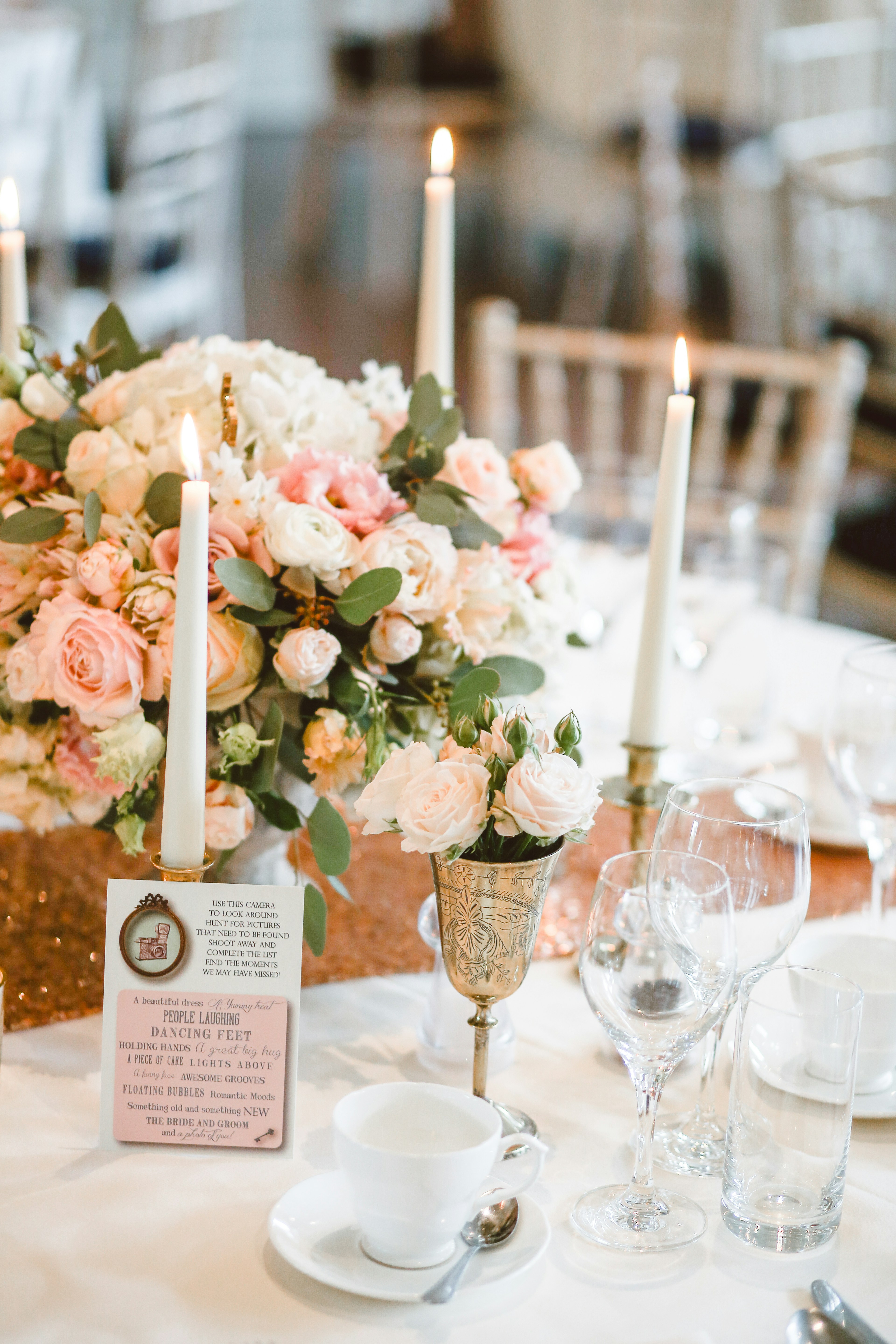
The Problem With a Beautiful Bouquet That Doesn't Belong
Walk into most wedding reception halls and you will find flowers that are individually well made and collectively incoherent. The bouquet was designed by one hand, the centerpieces assembled the morning-of by an assistant working from a supply list, the ceremony arch built by whoever had two free hours. Each piece is competent. None of them are speaking to each other.
This happens because most florists treat a wedding as a series of orders — twelve centerpieces, one bouquet, six bridesmaid bouquets, an arch — rather than as a single composition distributed across a room. The order-list approach produces flowers. It does not produce a story.
An atelier studio starts from the opposite direction. Before sourcing a single stem, the question is what idea the day is built to carry — restraint, abundance, inheritance, a particular garden in a particular season — and every arrangement, regardless of size or placement, answers to that idea. The bouquet and the guest-table bud vase are not different projects. They are the same sentence, resized.
What "Composition" Actually Means in the Atelier
Composition is not a synonym for arrangement. It is the governing discipline underneath one — the decisions about silhouette, color logic, and negative space that get made once and then applied consistently, the way a tailor decides a jacket's line before cutting fabric.
In practice, this means three fixed decisions made at the outset of any wedding: a primary silhouette (loose and garden-gathered, or tight and architectural — rarely both), a restricted color range (usually two dominant tones and one accent), and a material anchor — one or two flowers that appear, in some form, in every single arrangement on the day.
For one autumn wedding, the anchor was Mondial garden roses in a deep blush, paired with dusty miller for its silvered edge. Every arrangement that day — from the fifteen-stem bridal bouquet down to the single-stem bud vases scattered along the rehearsal dinner table — carried both. The scale changed. The idea did not.
This is the part clients rarely see discussed: composition is decided before the first flower is ordered, not adjusted afterward. A studio that starts sourcing before fixing the idea is building backward, and it shows in the final photographs, where nothing quite agrees with anything else.
Storytelling as a Structural Discipline, Not a Mood Board
Storytelling gets treated as decoration — a theme, a color story, a Pinterest aesthetic. In the atelier, it functions as structure. A wedding's floral narrative answers a specific question: what does this family, this couple, this room need the flowers to say without anyone reading a card that explains it.
One recent commission was for a couple marrying in the same garden where the groom's grandmother had been married forty-one years earlier. The story wasn't nostalgia for its own sake — it was a material fact. We sourced Vendela roses because they were the closest match, in color and form, to varieties available in the region in the 1980s, and we kept the arrangements loose enough that they read as garden-grown rather than florist-composed.
That decision governed everything downstream. It ruled out tropical foliage. It ruled out a black-and-white modern palette. It made the negative space in each arrangement wider, because gardens in memory are rarely dense. Storytelling, handled this way, is not an aesthetic layer added at the end — it is the constraint that makes every other decision faster and more defensible.
Clients who arrive with a clear story — even a vague one, like my mother's kitchen table or the coastline where we got engaged — give a studio something to build against. Clients who arrive only with a Pinterest board of unrelated images give a studio nothing but noise to sort through.
The Walkthrough: Building One Narrative Across Twelve Touchpoints
A full wedding typically has ten to fourteen distinct floral touchpoints: welcome signage, ceremony arch or arbor, aisle markers, bridal bouquet, bridesmaid bouquets, boutonnieres and corsages, cocktail hour arrangements, reception centerpieces (often split between low and tall formats), sweetheart or head table, cake flowers, escort card table, and sometimes a late-night lounge refresh.
Treating each of these as a separate decision is how consistency breaks down. Treating them as twelve expressions of one composition is how it holds. The studio's working method is to design the largest and smallest pieces first — the ceremony arch and the boutonniere — because they set the outer bounds of scale. Everything in between gets built by interpolation, not improvisation.
A practical example: for a 160-guest wedding with sixteen reception tables, we do not design sixteen individual centerpieces. We design two centerpiece formats — a low compote and a taller footed urn — and alternate them table to table, both drawing from the identical material list. The room reads as considered rather than repetitive, and the kitchen crew assembling centerpieces on the wedding morning is working from two recipes, not sixteen.
This is also where budget discipline and composition discipline align. A couple spending $18,000 on florals for 160 guests gets more visual cohesion from two well-executed centerpiece formats than from sixteen unique ones stretched thin across the same budget.
Material Consistency — Same Rose, Different Rooms
The material list is where most consistency is won or lost. A studio that sources eight or nine varieties for a single wedding is, whether it intends to or not, telling eight or nine slightly different stories. A studio that commits to three or four is telling one story at different volumes.
Our working list for most weddings holds to this structure:
The discipline is not the list itself. It is the refusal to add a sixth or seventh variety mid-process because a new sample looked appealing at the flower market. Every addition has to answer to the story already fixed at consultation, or it does not make the list.
The Eleventh Stem: Restraint as the Engine of Consistency
Every arrangement has a point past which more flowers stop adding presence and start subtracting it. We call it the eleventh stem — the one added out of habit, or nerves, or a sense that fuller must mean better, that quietly collapses the silhouette the first ten stems built with care.
This matters for consistency because the eleventh stem is almost always the one that breaks the story. It is the extra bloom in a color slightly off the palette, the filler added because a corner looked sparse rather than because the composition called for it. Multiply that decision across twelve touchpoints and a wedding that started as one coherent idea ends up as twelve slightly different ones.
Restraint is not the absence of abundance — a bridal bouquet can hold thirty stems and still be restrained, if all thirty are answering to the same idea. Restraint is the refusal to let any single arrangement wander from the governing composition, regardless of how many stems it takes to fill it.
In practical terms, this means every lead designer on a wedding works from the same reference arrangement, built and photographed at the initial trial, and checks new work against it rather than against instinct alone. It is a small procedural habit. It is the difference between a wedding that photographs as one event and one that photographs as several.
Common Mistakes Couples and Planners Make
The most frequent misstep is sourcing decisions by committee — a bridesmaid's favorite flower here, a mother-of-the-bride request there — without checking each addition against the fixed story. A single well-placed exception can work. Six of them dissolve the composition entirely.
The second is booking multiple vendors for different touchpoints — one florist for the bouquet, a separate rental company for centerpieces, a third party for the arch — assuming cost savings without accounting for the coordination this requires. We have walked into venues where three vendors, none of whom had spoken to each other, produced three unrelated color stories on the same day.
The third is waiting too long to fix the material list. Garden roses in specific varieties — Mondial, Vendela, Quicksand — are grown to order for weddings and need to be reserved with growers eight to twelve weeks ahead for a firm date, longer during peak wedding months of May through October. A couple who finalizes their floral story six weeks before the date has already lost access to the varieties that would have made the composition work.
A fourth, smaller mistake: choosing flowers for the engagement photo rather than the actual venue. A palette that reads well against a beach backdrop can go flat against the stone and dark wood of a reception hall. The story has to be tested against the room it will actually occupy, not the room in the inspiration photo.
A Sample Consultation: How the Studio Builds the Throughline
Our first meeting with a couple runs roughly ninety minutes and is structured less like a sales call and more like an intake. We ask about the room before we ask about flowers — its light, its existing color, its architecture. We ask what object or place, if any, the couple wants the day to feel like. We ask what they are willing to leave out.
From there we build a one-page composition brief: the fixed silhouette, the two or three anchor materials, the color range expressed in three tones rather than a swatch book, and a rough scale map showing where the composition goes largest (the arch, usually) and smallest (boutonnieres). This brief, not a line-item flower order, is what governs every subsequent decision.
A trial arrangement follows four to six weeks later — one centerpiece and one bouquet corner, built to scale, so the couple can see the story in physical form before sixteen tables' worth of flowers are committed. This is also where we catch the eleventh-stem instinct before it reaches the wedding day itself.
Couples occasionally arrive wanting to skip this stage in favor of speed. We do not recommend it. A composition built without a trial is a composition built on assumption, and assumption is where consistency breaks down first.
Heritage and Composition — Why the Story Has to Hold Up in Photographs Decades Later
Wedding photographs get looked at for longer than the wedding itself lasts. A composition that leans on a single season's trend — a color popular for eighteen months, a texture fashionable for one wedding cycle — dates within a few years of the ceremony. A composition built on enduring material and clear structure does not.
This is where composition and heritage meet. Garden roses, eucalyptus, lisianthus, peony — these are not trend flowers. They have been used in wedding floristry for generations, which means arrangements built around them photograph the same in a twentieth-anniversary album as they did on the wedding morning. The rose that keeps its shape, dried or pressed, is also the rose that keeps its relevance in a photograph.
We have clients who bring in their mothers' pressed bridal bouquets, decades old, as reference points — not for nostalgia, but as proof of what holds up. Every one of them shares the same qualities: restrained color range, a clear silhouette, negative space instead of density for its own sake. The flowers that were fashionable in their year have faded from those photographs entirely. What remains is the composition underneath.
This is the argument for building weddings on discipline rather than trend — not an aesthetic preference, but a practical one, made by anyone who has watched a decade-old wedding album age well or badly.
Working With Your Florist to Protect the Composition
A couple's most useful tool in this process is a single question, asked early and asked again at every fitting or planning meeting: what is the one idea every arrangement is built to carry. If the florist cannot answer it in one sentence, the composition has not been fixed yet, and it is worth pausing before ordering anything.
Beyond that, a few concrete habits protect the work:
The Society of American Florists and the American Institute of Floral Designers both publish consumer guidance on vetting a florist's design process, and it is worth a read before signing a contract — the questions they recommend asking align closely with the ones above.
None of this guarantees flowers. It guarantees a composition — one idea, carried without interruption from the welcome table to the last centerpiece struck at midnight, still legible in a photograph forty years from now.
Considered
What does floral composition mean for a wedding?
It means the deliberate arrangement of color, shape, and negative space across every floral element of a wedding — bouquet, ceremony arch, centerpieces — so they read as one visual statement rather than a collection of unrelated arrangements. Composition is a discipline of restraint, not abundance.
How do florists keep wedding flowers consistent across different spaces?
By fixing a small palette of two or three anchor varieties and one consistent silhouette at the consultation stage, then adjusting only scale and density per room. The ceremony arch and the sweetheart table should feel like the same sentence spoken at different volumes, not two different stories.
Why do wedding florists limit the number of flower varieties used?
Because more varieties dilute the story. A composition built on garden roses, lisianthus, and a single greenery note holds together in a photograph; a composition pulling from a dozen varieties reads as noise. The eleventh stem, added for abundance, is usually the one that ruins the arrangement.
How far in advance should a couple book an atelier florist for a wedding?
Nine to twelve months out for peak season dates (May through October), and at least six months for off-peak dates. This gives the studio time to source specific rose varieties, run trial arrangements, and build the consultation into a full design document rather than a rushed order.
What is the difference between a florist and an atelier floral studio?
A florist typically fulfills an order list. An atelier studio designs a composition — one governing idea expressed through material choice, silhouette, and placement across the entire event — and then executes it with the same discipline a tailor brings to a single garment.
Can wedding flowers hold up in photographs viewed years later?
Yes, if the composition is built on restraint rather than trend. Arrangements heavy with one-season novelty stems date quickly; arrangements built on enduring varieties like garden roses and eucalyptus, arranged with clear silhouette and negative space, photograph the same in year one and year twenty.