What We Mean by Atelier — The Work Behind the Arrangement
A client arrives for a consultation. She has seen the work online — a ceremony arch in late afternoon light, Mondial roses trained across a cedar frame, clematis trailing through the structure, the whole thing reading as something that simply grew there over time. She asks how long it takes to make something like that. An hour, maybe two on the morning of? The arch took nine hours of hands-on construction, not counting the sourcing conversation that began seven weeks before, the three-day conditioning process, or the five a.m. start on the wedding morning.
28 min read · Les Fleur Company
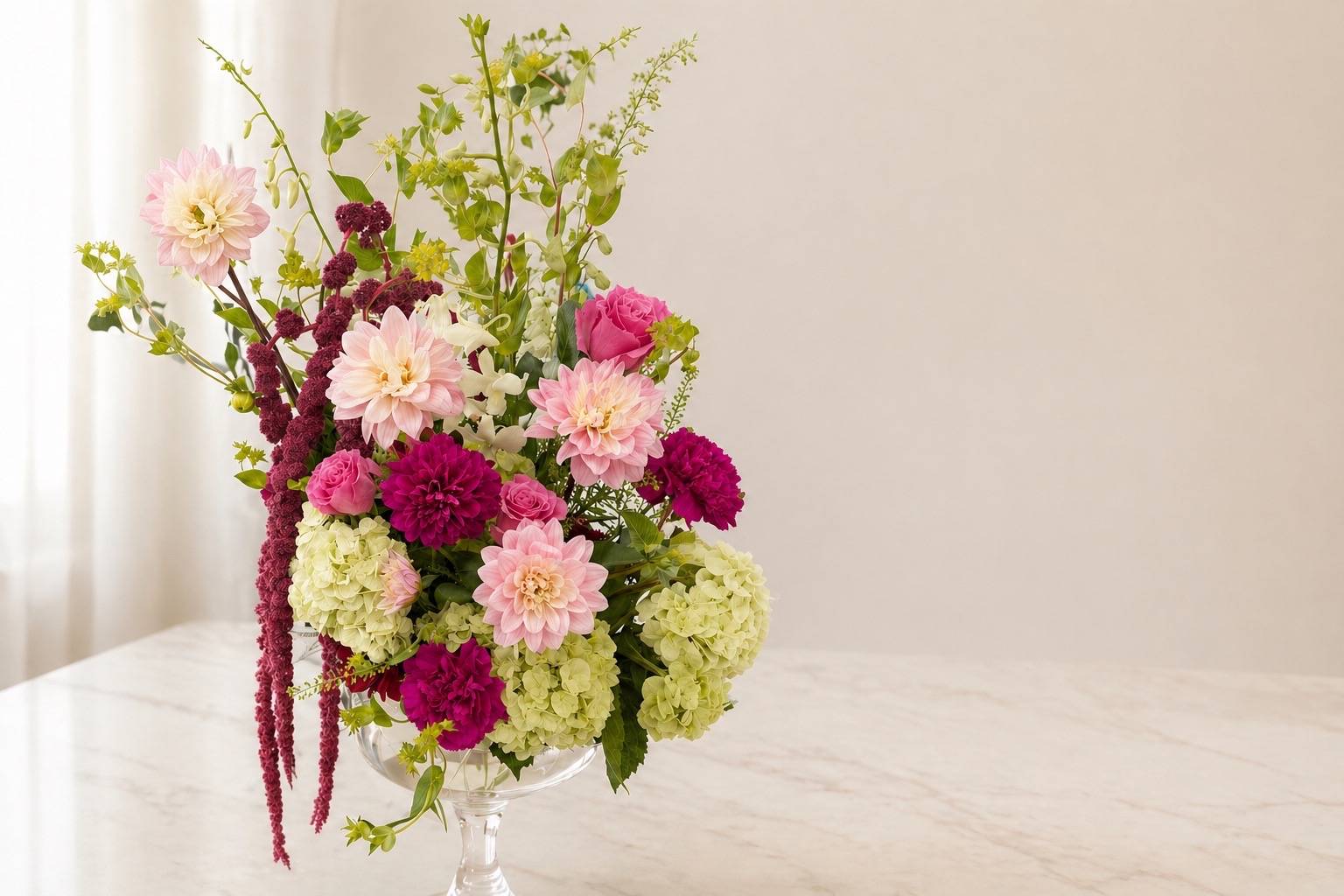
What the Word Atelier Actually Means
The word has been adopted widely enough in the wedding industry that it has begun to lose definition. An atelier is not a studio with a considered name and a curated Instagram presence. It is a specific model of making: work done by hand, at depth, with materials chosen for each commission rather than sourced for what is available. In the traditional sense — drawn from couture, from silversmithing, from the ateliers of furniture-makers — it describes the room where craft and composition are held to the same standard as the finished object.
Applied to a floral atelier, this means the arrangement you see on the day of an event is not the beginning of the work. It is the end. The sourcing decisions, the conditioning hours, the construction sequence, the morning-of timeline — this is the actual work. The arrangement is its conclusion.
When Les Fleur uses the word, it is not a register. It is a description of process.
Sourcing as the First Design Decision
The atelier process begins not at the worktable but at the sourcing call. For a commission with specific material requirements — a particular blush garden rose, a lisianthus in a precise ivory, a clematis variety that trails rather than sits upright — that conversation typically starts six to eight weeks before the event date. For harvest-dependent materials like dried honesty, smokebush, or specific grass varieties, the window is longer.
This lead time is not logistical caution. It is part of the design work itself. A Quicksand rose and a generic blush spray rose are not interchangeable. The Quicksand carries a warm, dusty blush-nude that reads differently at noon than it does under candlelight — the evening shifts it toward pale ivory; the afternoon shows its warmth. A generic blush rose carries a flat, consistent pink that reads the same in every condition. These are different materials. They produce different arrangements. The decision between them is a compositional decision, and it is made during sourcing, not on the build day.
The sourcing stage establishes:
The arrangement that reads as effortless in a photograph is frequently the one with the most involved sourcing conversation behind it.
Conditioning — The Work Before the Work
Conditioning is the stage most invisible to the client and most foundational to the outcome. A flower that arrives at the studio after overnight freight is not a workable flower. The stems have begun to dry. The vascular tissue has contracted. If placed directly into an arrangement, the flower will open too fast, drink poorly, and decline before the event reaches its midpoint.
Conditioning addresses this at the cellular level. For most garden roses — Mondial, Vendela, Quicksand — the protocol is consistent: stems are cut at a 45-degree angle under water, which prevents air from entering the vascular tissue and blocking hydration. They are placed immediately into clean, cold water with a professional hydration solution and held in a cooler between 34°F and 38°F for a minimum of 24 hours, and often 36 to 48. The rose needs to drink before it can be worked. A rose that has not fully hydrated will not hold its form in an arrangement, and it will not perform across the length of a reception.
Lisianthus conditions faster — typically 12 to 18 hours — but requires that the lowest buds be stripped to direct the stem's hydration toward the upper blooms. Dusty miller is conditioned in warm water rather than cold; the temperature helps move hydration through the heavier leaf structure. Clematis vine conditions in shallow water to avoid submerging its finer stems. Each material has its own protocol, and the conditioning stage is where those protocols are executed in sequence.
The practical consequence: in an atelier context, arrangement construction does not begin on the event day. It begins 48 to 72 hours before. By the time a stem is placed in a vessel, it has already received two to three days of attention.
Construction — The Hours Inside the Arrangement
A single low compote for a dinner table of ten takes between 45 minutes and one hour to build correctly. This is not slow work. It is the pace the material requires. Each stem is cut by hand to the length the specific composition needs — not to a standard length. Foliage is stripped from the lower third of every stem before placement. The construction follows a sequence: structural base first, establishing the silhouette and the negative space; primary flowers next; secondary texture; accent or trailing material last. The sequence matters because once a stem is in and the stems around it have been placed, the structure is set.
A ceremony arch — the kind that reads as naturalistic, loose, and unconstructed in photographs — typically requires six to ten hours of construction depending on scale, plus two to three additional hours of on-site installation. A seven-foot arch built with 400 to 500 stems is constructed in sections: the frame is assembled and stabilized, the mechanical water source is secured, and flowers are placed in a sequence that accounts for weight distribution, visual sight line, and how the piece will read both in person and under a camera. The naturalistic quality is the product of a precise construction order. It looks the way it looks because of the sequence, not despite it.
There is a version of this work that moves faster. An arch can be built in three hours using bulk materials and an abbreviated process. The results are visible in the finished piece: the materials sit rather than move; the structure reads as decorated rather than composed; the stems neither relate to each other nor to the frame. The atelier process exists specifically to prevent those outcomes — and the difference between the two is a matter of hours, not magic.
The Morning-of Timeline
A wedding day in the atelier begins between four and five in the morning. Not as a romantic quality of the craft, but because the arrangement that needs to be in place by eleven a.m. requires a construction and installation sequence with a fixed minimum duration that cannot be compressed without consequence.
By 4:30 a.m., the conditioned materials come out of cold storage and begin a 30-to-45-minute acclimatization period at room temperature. Cold flowers are stiff; they do not respond to the cut the way a flower at room temperature does. The acclimatization period is not optional — it changes how the stem sits and how the bloom will continue to open across the day.
By 5:00, construction begins on the pieces that travel most safely — ceremony arrangements, altar pieces, flanking processional work. These are completed, wrapped in water-source materials, and loaded before attention moves to the pieces requiring on-site construction: ceiling installations, structural arches, anything that cannot safely survive transport in a finished state.
By 8:00, the team is on-site. Pre-built pieces are placed and adjusted for the specific room conditions — light, sight line, the distance from which they will be read by guests. An arrangement that photographs correctly from directly behind the table does not always read correctly from forty feet away at the aisle. Every piece is evaluated from the guest's perspective, not the maker's.
By 10:30, the room is complete. The last task on-site is removal: clipped stem ends, stripped foliage, any trace of the process. What remains is the arrangement. The work has receded.
What "By Appointment" Actually Means
The studio takes commissions by appointment. This is sometimes read as an access mechanism — a signal of scarcity or position. It is neither. It is a structural requirement of how the work is made.
A commission that begins in the consultation is being built from the sourcing call outward. The material selections, the construction hours, the conditioning timeline, the scale — all of these are determined in direct relationship to the client and the specific occasion. There is no catalogue. There is no standing inventory of standard arrangements in predetermined sizes. There is no such thing as the standard wedding package at an atelier, because there is no standard wedding.
What the appointment produces is a brief: the occasion, the room and its light conditions, the available seasonal materials, the required scale, and what the composition needs to accomplish in that specific space. From the brief, sourcing is confirmed. A conditioning schedule is established. Construction is mapped backward from the event time to determine when the build day begins and how many hands the work requires.
The consultation is the first step in the making. It is where the process starts, not where arrangements are selected from a menu.
What You Are Commissioning
When a client commissions atelier floral work, they are not purchasing an arrangement. They are commissioning a process — one that begins six to eight weeks before the event and ends when the team steps back from the room and removes the evidence of their presence.
The arrangement is the visible record of that process. The sourcing decisions determine whether the materials carry the right tone in the specific light of the specific room. The conditioning hours determine whether the flowers perform across a full day of service or decline by the second course. The construction sequence determines whether the arch reads as composed or merely decorated. The morning-of timeline determines whether everything is in place by the time the first guest arrives.
None of these outcomes are accidental. They are the result of specific decisions made at specific points across a specific timeline. The work is that timeline, not simply the arrangement at its conclusion.
A client who understands this comes to the consultation with a different set of questions. Not: what will the flowers look like? But: what does this room need to do, and what does this occasion ask for? The arrangement follows from the answers. Everything else is the work that makes the answer possible.
The arrangement is always the last thing made.
Considered
What does atelier mean in florals?
In florals, atelier refers to a specific model of making — work done by hand at depth, with materials chosen for each commission rather than sourced for convenience. It describes a process that begins with sourcing weeks before an event and ends when the arrangement is placed and the team steps back. The arrangement is the conclusion of the work, not the beginning.
What is the difference between a florist and a floral atelier?
A florist typically works from standing inventory with standard arrangements available at consistent price points. An atelier builds each commission from the sourcing call outward — selecting specific varieties, establishing a conditioning timeline, and constructing to a brief drawn from the specific occasion, room, and light conditions. There is no catalogue. Each commission begins from a consultation.
How long does it take to make a wedding floral arch?
A ceremony arch using 400 to 500 stems typically requires six to ten hours of construction, not counting the conditioning period (24–48 hours beforehand) or the on-site installation (two to three hours). The naturalistic, unconstructed quality that reads well in photographs is the result of a precise construction sequence — it is not a shortcut to that outcome.
When should I book a floral atelier for my wedding?
For a full commission — ceremony, reception, and tablescape — the sourcing conversation should begin six to eight weeks before the event date. For specialty or harvest-dependent materials like specific clematis varieties, smokebush, or dried grasses, longer lead times may be required. The consultation should happen before that window opens, not inside it.
How are wedding flowers conditioned before an event?
Conditioning begins when flowers arrive at the studio, typically 48–72 hours before the event. Stems are cut at a 45-degree angle under water to prevent air bubbles entering the vascular tissue, then held in cool water (34–38°F) with a professional hydration solution. Each variety has a different protocol — garden roses condition differently than lisianthus, which conditions differently than dusty miller.
What happens at a floral design consultation?
The consultation produces a brief: the occasion, the room's dimensions and light conditions, the seasonal materials available, the required scale, and what the composition needs to accomplish. From that brief, sourcing is confirmed, a conditioning timeline is established, and construction is scheduled backward from the event time. It is the first step in making, not a presentation of options.