Crafting Custom Floral Compositions for Bespoke Wedding Ateliers
A bride sends a Pinterest board with forty-two images and a note: "something like this, but more me." It is the most common brief in the business, and it is nearly useless on its own. The board tells you what caught her eye scrolling at midnight. It does not tell you what will hold a room at four in the afternoon in September, or what her dress does to a bouquet's undertone, or what her mother will say when she sees the centerpieces from the head table looking back.
38 min read · Les Fleur Company
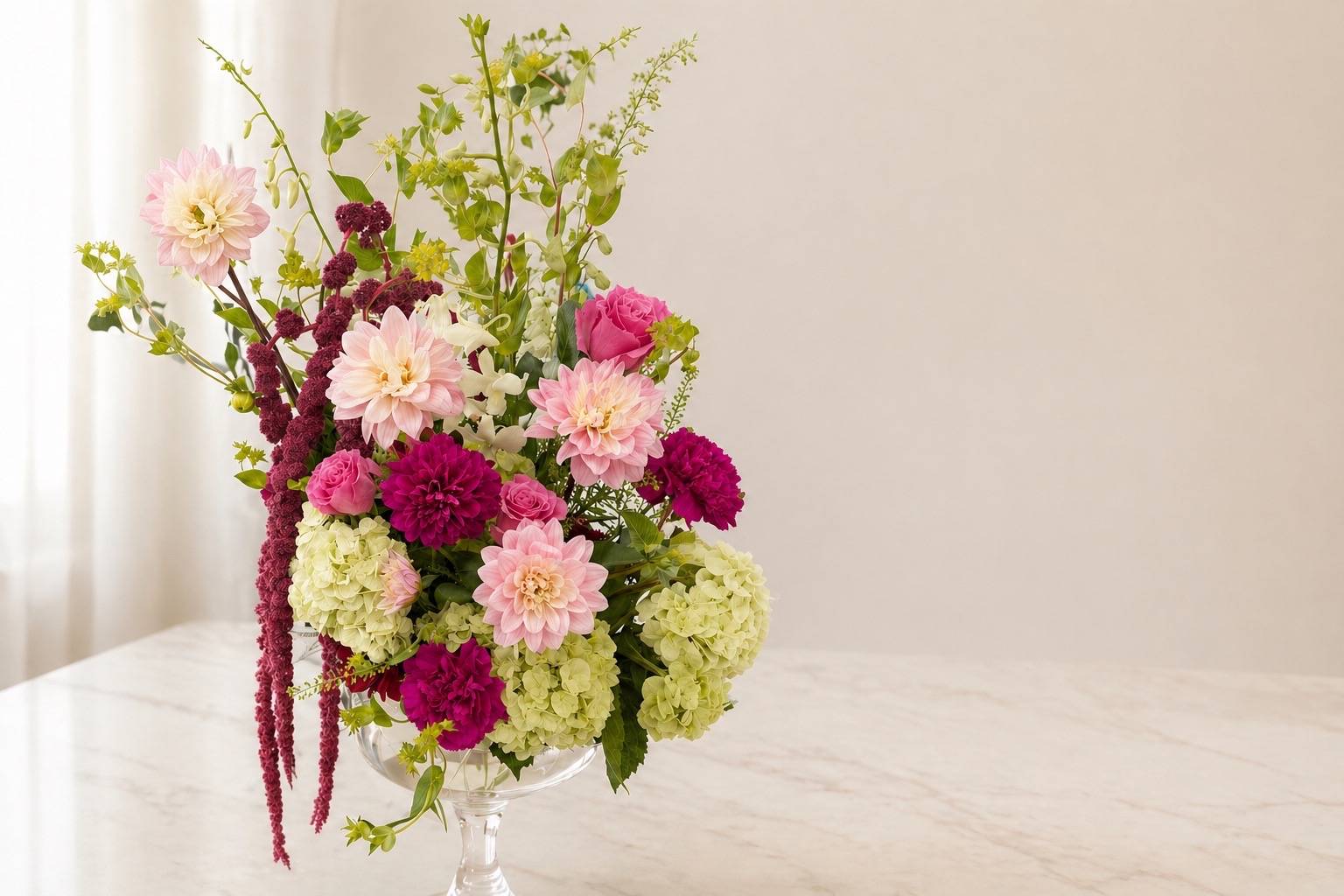
The Wedding Flower Problem No One Names
A bride sends a Pinterest board with forty-two images and a note: "something like this, but more me." It is the most common brief in the business, and it is nearly useless on its own. The board tells you what caught her eye scrolling at midnight. It does not tell you what will hold a room at four in the afternoon in September, or what her dress does to a bouquet's undertone, or what her mother will say when she sees the centerpieces from the head table looking back.
This is the gap a bespoke atelier exists to close. Not by producing prettier arrangements than the wholesale package down the road, but by treating the wedding as a single design problem with a hundred small constraints — venue light, dress fabric, walking distance from ceremony to reception, a grandmother's allergy, a budget that has to stretch across twelve tablescapes and one bouquet that has to survive six hours of photographs.
Composition work at this level is closer to structural design than decoration. It has a discipline to it, and the discipline is what a client is actually paying for, whether she names it that way or not.
What Bespoke Actually Means in the Atelier
The word gets used loosely across the industry, so it is worth being precise. Bespoke, in the atelier sense, means the design originates from the client and the occasion — not from a pre-built package with swap-in flower options. It means a working consultation before a single stem is ordered, mechanics engineered for the specific venue rather than a generic setup, and material sourced against that date rather than pulled from whatever the wholesaler has on the floor that week.
It also means the atelier is willing to say no. A client who wants garden roses in January in a region with no greenhouse access will hear the honest cost and lead time of flying them in, or a proposal for a variety in the same tonal family that will perform better and cost less. A studio that says yes to everything is running a sales operation, not a design practice.
Bespoke work is slower by design. A standard package florist can turn around a proposal in days because the menu is fixed. A bespoke atelier typically takes two to three weeks to return a full proposal — mood direction, stem breakdown, mechanics notes, and pricing — because each element is being built rather than selected from a list.
The Consultation — Reading a Client, Not Just a Pinterest Board
The first meeting runs sixty to ninety minutes, and the flowers are the last thing discussed. A designer worth the fee spends the first half hour on the venue — its light at the ceremony hour, its ceiling height, its existing color in stone or wood or wallpaper — before asking what blooms the client likes.
Questions that matter more than "what's your favorite flower": How many guests, and how many tables. What is the dress fabric and neckline, since a structured bodice reads differently against a loose, garden-style bouquet than against a tight, architectural one. Is there a family flower — a rose a grandmother grew, a peony from a childhood garden — worth including even off-trend. What happens to the ceremony flowers after the ceremony; repurposing arch florals into reception pieces changes the entire mechanical plan.
The board still matters. It is read for pattern, not literal instruction — density preferences, color temperature, whether the client is drawn to line work (delphinium, snapdragon) or mass (peony, garden rose). A good consultation ends with the designer able to describe the wedding's mood in one sentence, without needing the board in front of them.
Budget is discussed directly and early, in ranges, not estimates disguised as promises. Vague budget conversations are the single largest source of friction later in the relationship.
Material Sourcing — Growers, Seasons, and the Six-Week Window
Sourcing is where the bespoke promise is either kept or quietly broken. Standing wholesale stock is bought in bulk, weeks ahead, for generic use — it is reliable but limited to what moves in volume. Bespoke work requires pre-ordering specific varieties, in specific colors, from specific growers, which means placing orders six to eight weeks before the wedding date, and locking the final variety list three to four weeks out once growers confirm what will actually be in bloom.
This is not bureaucracy. Garden roses like Mondial, Vendela, and Quicksand are grown in limited runs, and a farm's allocation for a given week can sell out to other studios if an order sits unplaced. Domestic growers — many listed through the Association of Specialty Cut Flower Growers — offer varieties simply unavailable through standard wholesale channels, but they require lead time and, often, minimum order commitments.
Season dictates more than availability; it dictates cost. Peony season runs roughly six weeks in late spring across most of North America, and demand inside that window drives prices up even before a wedding premium is added. A client requesting peonies for a November wedding is requesting an imported, out-of-season stem at a 30 to 50 percent premium over in-season pricing, with less certainty on bloom quality on arrival.
Part of the atelier's job is translating that reality honestly, and offering the in-season alternative — garden roses in a matching blush, or ranunculus with a similar layered petal structure — before the client commits to a number she'll resent paying.
Building the Composition — Silhouette, Discipline, the Eleventh Stem
Composition begins with silhouette, not flower selection. Before any bloom is chosen, the designer decides the shape the piece needs to occupy — a loose, asymmetric cascade for a bouquet meant to move with the walk down the aisle, or a tight, rounded hand-tie for a client who wants control and symmetry. The silhouette is the structural decision everything else answers to.
Stem count follows from silhouette, and it is fixed early, not discovered by adding flowers until the piece looks full. A bridal bouquet built for a loose, garden silhouette generally runs 24 to 32 stems. Go past that and the composition stops reading as considered and starts reading as abundant for its own sake — what a mentor of mine used to call the eleventh stem problem: the one addition that ruins a shape that was already complete.
Negative space is treated as a material, the same as any bloom. A composition with no visible air between elements has nowhere for the eye to rest, and reads as busy in every photograph regardless of how fine the individual stems are. The best bridal work I have seen holds back — one dominant bloom family, a secondary textural note, and enough restraint that the dress, not the bouquet, remains the subject of the photograph.
This is the hardest thing to teach a new designer: knowing when to stop cutting stems from the bucket.
The Mechanics — Structure Before Beauty
Every visible composition rests on an invisible one. Mechanics — the wire, tape, chicken wire, water tubes, and floral foam alternatives that hold a piece together — are decided before aesthetic choices, because a structurally weak design fails regardless of how well the flowers were chosen.
For hand-tied bouquets, most ateliers now favor a spiral-stem technique secured with waxed cotton cord rather than wire, both for the cleaner finish and for sustainability — floral foam has fallen out of favor across the trade for its environmental footprint, and reputable studios have largely moved to reusable mechanics: chicken wire cages, pin frogs, and water-tube systems for installations.
Ceremony arches and large installations require engineering conversations most clients never see — weight distribution across a structure, wind load for outdoor sites, and a rigging plan reviewed with the venue coordinator in advance. A designer who skips this step is gambling with a structure standing over the couple during vows.
Standard mechanics timeline for a full wedding build: foliage and greening work begins 48 to 72 hours before the event, since foliage holds condition longer than bloom; focal flowers are added 12 to 24 hours out; and anything requiring cold storage is pulled and finished the morning of, on-site or at the studio, depending on drive time and temperature. A studio without walk-in cooler space is working at a real disadvantage on large productions — it is one of the first questions worth asking when evaluating an atelier.
Color, Texture, and the Case for Restraint
A trained eye works in tonal families before it works in named colors. Rather than choosing "blush, ivory, and sage," a designer thinks in terms of warm neutrals against a single saturated note — dusty miller's silvered grey against a Café au Lait dahlia, or eucalyptus's cool green cutting a warm garden rose palette.
Texture does more work than color in most compositions. A bouquet built entirely from one bloom size and shape reads flat in photographs regardless of how carefully the colors were matched. Layering matters: a mass bloom like peony or garden rose for volume, a textural element like scabiosa pod or astilbe for movement, and a line element like clematis vine or jasmine to break the outer edge.
Restraint is where composition separates itself from arrangement. It is tempting, especially for a newer designer eager to prove range, to include every texture and color a client mentions in the consultation. The stronger move is almost always fewer varieties, held with more discipline — three to five bloom types in a bridal bouquet is a common ceiling among ateliers with a defined point of view, rather than eight or nine competing for attention.
Clients rarely ask for restraint by name. They recognize it when they see the finished photographs and the bouquet still looks composed at hour six of the reception, not wilted into a shapeless mass.
Timeline and Production — What a Wedding Week Actually Looks Like
The visible part of the job — delivery, install, the walk down the aisle — is the smallest fraction of the labor. A full bespoke wedding program runs a design team somewhere between 30 and 60 total labor hours across the week, split roughly as: 8 to 12 hours of sourcing and prep coordination, 15 to 25 hours of hands-on construction, and 6 to 10 hours of delivery, install, and on-site adjustment.
A typical week for a Saturday wedding: material arrives Tuesday or Wednesday and is processed immediately — stems cut, hydrated, and moved into cold storage. Foliage work and any structural mechanics for installations begin Thursday. Friday is reserved for centerpieces and anything that can be built ahead and held in cooler space overnight. Saturday morning is bouquets, boutonnieres, and anything requiring same-day freshness, followed by a install call typically four to six hours before ceremony start.
On-site, a lead designer walks the room once installations are placed, checking sightlines from the guest tables and the ceremony seating — a centerpiece that looks correct from a workbench can block conversation across a round table, and that only becomes obvious standing at chair height in the actual room.
Weather contingencies are built into the plan for any outdoor element: a backup indoor arch configuration, cold-storage buffer time if a heat delay pushes the ceremony, and a materials cushion of roughly 10 percent over the design count to cover breakage or condition loss in transit.
Pricing a Bespoke Program — Numbers Clients Rarely See
Minimum spends for a full bespoke program generally fall between $8,000 and $25,000, and the range has less to do with flower cost than most clients assume — labor and sourcing complexity drive the number far more than the wholesale price of the stems themselves.
Rough figures that hold across most markets: bridal bouquets run $450 to $900 depending on stem count and variety rarity; centerpieces for a standing arrangement, not including rental vessels, run $185 to $400 each; a ceremony arch installation starts around $1,800 and climbs quickly with scale and structural complexity. A boutonniere or corsage, small as it looks, still carries 15 to 20 minutes of hand labor and typically prices at $28 to $45.
Where clients get surprised is delivery, setup, and breakdown fees, which are frequently quoted separately and can add 10 to 15 percent to a proposal's total — a line worth asking about at the first meeting rather than discovering in the final invoice.
The honest conversation an atelier owes a client: a $3,000 total budget for a 150-guest wedding cannot fund bespoke, hand-sourced work at the sourcing and labor levels described above. That budget is better served by a studio operating on standing wholesale stock with efficient, repeatable designs — which is a legitimate way to do the work, just a different one than what a bespoke program is built to deliver.
Preservation and the Life After the Aisle
The heritage question — what happens to the work after the day it was built for — is one most florists never raise, and one considered clients increasingly ask first. A bridal bouquet represents six to ten hours of design labor and, often, the only flowers from the day a bride will want to see again in five years.
Preservation options worth arranging before the wedding, not after: pressing, which flattens bloom for framing and holds color reasonably well in low light for years; freeze-drying, which retains three-dimensional form and is the closest to the bouquet's original shape, at a cost typically running $400 to $900 depending on size; and resin casting, which suspends the bouquet or select stems in clear resin, offering the most permanence but the least flexibility once set.
Timing matters more than clients expect. A bouquet needs to reach a preservationist within 24 to 48 hours of the wedding, while the bloom still holds enough structure to survive the process. An atelier that arranges pickup or overnight shipping to a preservation partner as part of the original proposal is doing the client a real service; one that leaves it to a rushed phone call the Monday after is not.
What stays with a client longest is rarely the largest arrangement in the room. It is the bouquet she carried, pressed flat under glass a year later, holding its color in a hallway she passes every morning.
Considered
How far in advance should I book a bespoke wedding florist?
Nine to twelve months out for a Saturday in peak season (April through October). This isn't calendar-holding for its own sake — it's the window an atelier needs to secure grower allocations for garden roses and specialty varieties, which are pre-ordered by the stem months ahead.
What does 'bespoke' actually mean when it comes to wedding flowers?
It means the composition is designed against the room, the dress, the season, and the client — not selected from a package tier. A bespoke process includes a working consultation, custom mechanics for the venue, and material sourced for that specific date rather than pulled from standing wholesale stock.
How many stems are in a typical bridal bouquet?
Most considered bridal bouquets hold 24 to 32 stems, depending on bloom size and desired density. Garden roses and peonies, being large-headed, sit at the lower end; a bouquet built with smaller-headed material like lisianthus or clematis can carry more stems without losing shape.
Why do custom florals cost more than standard wedding packages?
Labor, not blooms, drives the cost. A single centerpiece can take 45 to 90 minutes to construct once mechanics, foliage prep, and placement are counted, and a full wedding program runs a design team 30 to 60 hours across the week. Custom sourcing of out-of-catalog varieties adds further cost and lead time.
Can I request flowers that aren't in season?
Some varieties can be flown in year-round through global growers, but expect a price premium of 20 to 40 percent and less certainty on final quality. An atelier worth its fee will tell you honestly when a substitution in the same tonal register will serve the composition better than forcing an out-of-season stem.
What happens to the flowers after the wedding?
A bespoke atelier typically offers a preservation option — pressing, drying, or resin casting of the bridal bouquet — arranged before the wedding date so the bouquet can be collected or shipped to a preservationist within 24 to 48 hours of the event, while the material is still fresh enough to hold form.