What to Expect in a High-End Floral Design Studio: The Process From Concept to Creation
The inquiry arrives — a wedding date, a venue name, sometimes a single image saved from somewhere online. The client knows what she wants in the way that most people know what they want: vaguely, emotionally, and without a working vocabulary for the materials that will bring it into being. This is not a problem. It is, in fact, exactly where the work begins in a high-end floral design studio.
30 min read · Les Fleur Company
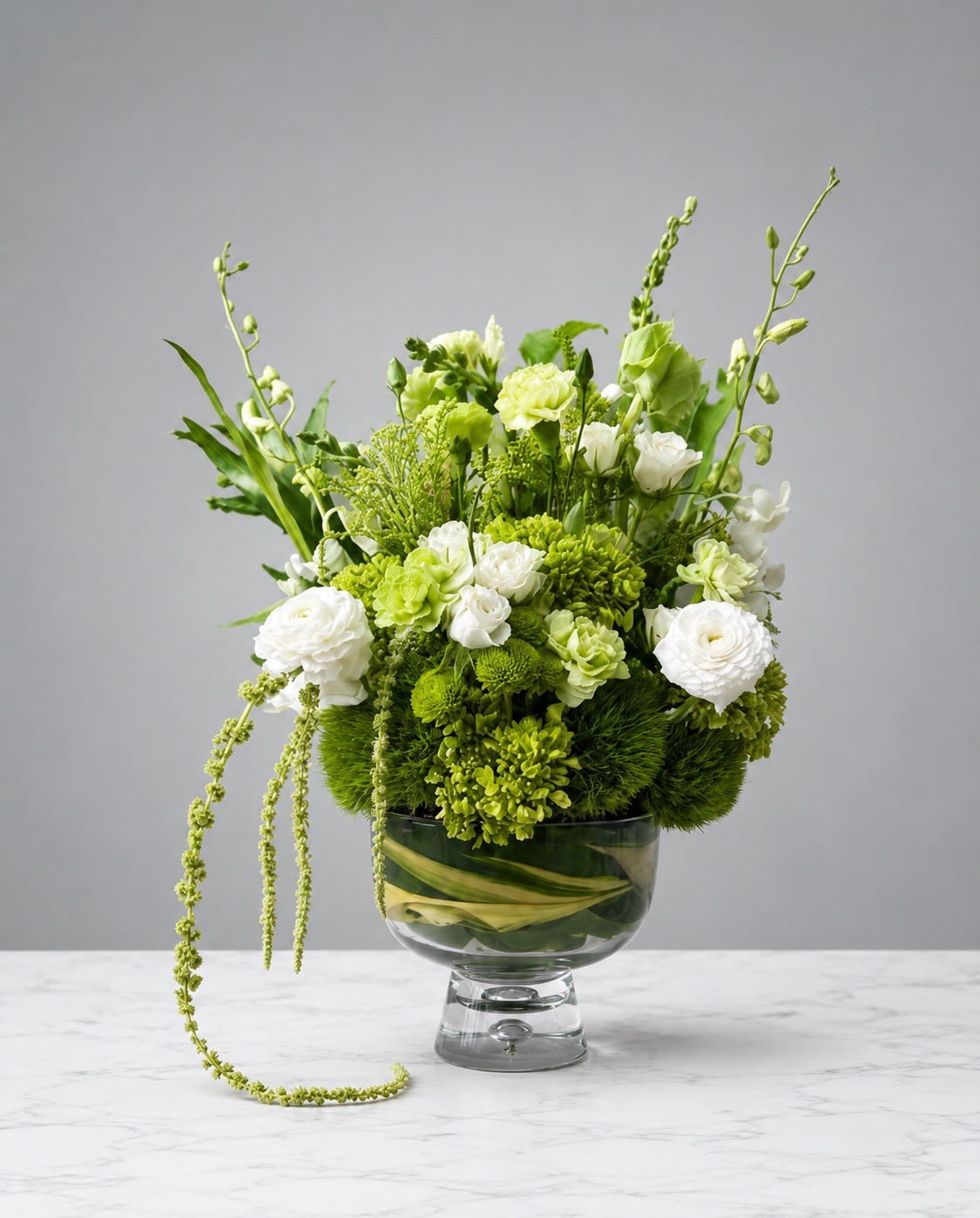
The First Conversation: What a Floral Design Studio Is Actually Listening For
An initial consultation at a high-end floral design studio is not a sales call. It is a diagnostic. The studio is listening for the quality of light in the venue, the time of year, the weight of the occasion — not for a list of preferred flowers. A client who arrives saying she loves garden roses and soft whites is giving the studio something to start from. A client who can also describe the ceiling height, the direction the reception room faces, and whether the dinner runs until nine or midnight is giving the studio something to work with.
A skilled studio director will ask about the ceremony first. Not the reception, not the centerpieces — the ceremony. The ceremony structure determines the silhouette of everything else. Where the couple stands, which direction they face, whether there is an arch or a chuppah or bare architecture — these decisions cascade into every subsequent arrangement. The ceremony arch sets a scale. The reception centerpieces either answer it or depart from it deliberately. Nothing in a well-designed event is accidental.
Expect to be asked about the feeling of the room, not just its dimensions. A 40-foot reception hall with 18-foot ceilings and bare limestone walls asks for something entirely different than a tented garden dining room with borrowed light from the west. A good studio will have seen both and will speak to them without prompting. The conversation is also an assessment — of how the client receives information, what she responds to, and where she is most willing to be guided.
What to bring to a first consultation:
The budget conversation is not awkward in a professional context. It is a material fact, the same as knowing the ceiling height or the season. A studio that avoids asking is a studio that cannot plan honestly. A studio that accepts any budget without pushback is a studio that has not done the math on what the work actually requires.
Reading the Room: How Studios Develop a Floral Design Concept
After the first conversation, the studio goes quiet. This is the period most clients underestimate. The concept development phase — the stretch between consultation and proposal — is where the actual design work happens, and it is almost entirely invisible to the client.
A studio working at the atelier level is not scrolling through saved images for inspiration. It is pulling seasonal availability calendars from its growers, looking at lead times for garden roses in the Vendela or Quicksand variety, checking whether a particular lisianthus crop will be at peak quality during the event week. It is also studying the venue — through site visits or archived documentation — to understand how natural light moves through the space in the relevant season. A palette that reads beautifully at noon will need to hold in candlelight four hours later. These are not the same palette.
Concept development might take anywhere from one week to three, depending on the complexity of the event. For a large-scale wedding with fourteen distinct arrangements — ceremony arch, escort card table, twelve reception centerpieces of varying height — the studio is holding all of those simultaneously, checking that the palette and silhouette read coherently as a guest moves from room to room. Nothing should feel like it belongs to a different event.
The best studios think in sequences. They consider how the work will be experienced as a guest moves through the evening — from the ceremony garden into the cocktail hour, from cocktail into dinner. The design is choreography as much as composition. A piece that anchors a thirty-foot corridor and a piece that sits at a four-top table twelve inches from a candle are solving entirely different problems, and both need to belong to the same evening.
The Proposal: Materials, Quantities, and the Logic of Cost in a High-End Floral Design Studio
A proposal from a high-end floral design studio is not a price list. It is a document that explains the reasoning behind every decision — why a particular arrangement is scaled the way it is, why a specific variety was selected, what the arrangement will ask of the space it inhabits. A client reading a well-written proposal should understand not just what she is receiving, but why those specific choices serve the occasion.
Proposals at this level typically include:
Costs in a serious atelier reflect three things: the materials themselves, the expertise required to work with them, and the time — often measured in days, not hours — required to bring the work to completion. A single ceremonial arch constructed from ranunculus, garden roses, and trailing clematis might represent twelve to sixteen hours of labor across sourcing, conditioning, design, and installation. The price reflects that, not the retail value of the stems alone. A studio that prices only for materials is not accounting for what the work actually costs to produce at a standard worth maintaining.
Clients who receive a proposal and compare it to what they might spend at a market stall are measuring the wrong thing. The comparison is closer to commissioning a painting than purchasing a print. Both involve paint. Only one is made for a specific wall in a specific room, by a hand that has studied how light falls across that particular surface.
Sourcing and the Seasonality That Actually Matters
A studio working with integrity sources its materials with intention. This means knowing which growers produce specific varieties at peak quality, understanding that a Mondial garden rose from a trusted specialty grower will arrive in better condition than an unnamed pink rose from a mass-market distributor, and building seasonal calendars that reflect what is genuinely available — not what the client saw in a June wedding that was photographed in May.
Seasonality matters in florals for two reasons: quality and availability. Peonies hold a genuine window — late spring through early summer in most northern growing regions. A client requesting peonies for a late-October wedding is not being unreasonable; she is asking the studio to locate a reliable cold-storage source or to suggest alternatives — ranunculus, double lisianthus, full garden roses — that carry a similar spirit without the seasonal constraint. A studio that simply says yes without flagging the supply reality is doing the client a disservice.
The varieties that distinguish considered work from commodity work are rarely the showiest ones. Dusty miller for texture and silver-grey movement at the edge of an arrangement. Lisianthus for ruffled depth without the weight of a peony. Lavender to add a vertical register that most compositions lack. Clematis trailing from an arch to soften what would otherwise be a rigid silhouette. These are the choices that hold up in photographs taken at midnight by available light — the materials a trained eye selects not for their individual drama but for what they contribute to the whole.
According to the Society of American Florists, relationship-based procurement from trusted growers is among the most significant quality differentiators between retail flower operations and design-forward studios. The infrastructure behind a finished arrangement is rarely visible to the client sitting across the table — and that invisibility is part of the craft.
The Atelier at Work: What Creation Actually Looks Like
In the two to three days before an event, the atelier becomes a different kind of place. Flowers arrive from multiple sources — some from local growers, some from regional auction, some from specialty farms — and the conditioning process begins immediately. Stems are cut at an angle, hydrated in clean water, and held at precise temperatures appropriate to each variety. This is not housekeeping. It is the foundation of every arrangement that follows. Flowers that are not properly conditioned will not hold through an eight-hour reception, regardless of how skillfully they were arranged.
Conditioning alone can account for a full working day on a large event order. Garden roses need time to open to the right stage — not tight bud, not fully blown, but the particular moment of fullness that reads well at close range and holds its structure through dinner and dancing. Ranunculus require similar patience and temperature management. Eucalyptus and dusty miller are more forgiving and can be prepared further in advance, which is why experienced studios batch their conditioning schedule rather than treating all materials the same.
The design work itself typically begins the day before delivery. A studio working on a full wedding will have a lead designer and one or two assistants building arrangements in sequence — ceremony pieces first, reception centerpieces next, accent pieces and personal florals last. The order is not arbitrary. Ceremony arrangements are often the most structurally complex and require the most time when the designer's eye is freshest. Personal florals — bouquets, boutonnieres, hair pieces — are built last and stored carefully overnight.
The eleventh stem is a real problem. In composition work, there is a point at which adding more material collapses rather than builds an arrangement. A trained designer knows that point — often by feel, not by count — and stops. The arrangement that has nothing left to remove is finished. The one that keeps receiving stems because more feels like more is not design; it is accumulation. Restraint is a skill that takes years to develop and is one of the clearest markers of atelier-level work.
Installation: The Work the Client Never Sees
Installation is the least glamorous and most consequential part of what a studio does. Arrangements travel in water-filled vessels, secured in climate-managed vans. They arrive at venues hours before guests do — sometimes before the catering team has finished laying linen, sometimes before the lighting technicians have stopped rigging. The studio works around all of it, without being in the way, and leaves arrangements precisely where the floor plan says they belong.
A full wedding installation might involve two to four people working for four to six hours in a venue being simultaneously set by multiple other vendors. A good studio anticipates this. It has walked the space in advance. It knows which entrance receives deliveries, where the freight elevator is, which tables are set first and which are finished last. It coordinates with the event planner — not around her. Studios that arrive without this preparation create problems for everyone in the room.
After the event, the studio returns. Arrangements are either distributed to guests, donated to local hospitals or care facilities, or broken down and composted responsibly. Personal florals — bouquets, boutonnieres — are returned to the couple. Rental vessels are retrieved. The venue is left exactly as it was found. This post-event process is invisible in how most clients imagine floral services, and it represents a significant portion of the studio's total labor cost on any given event.
The arrangement does not end when the last guest leaves the room. It ends when the studio does.
How to Work Well With a High-End Floral Design Studio
Working well with a studio at this level requires something most client relationships do not ask for: trust extended early. The process is long — a serious studio typically begins conversations with wedding clients eight to twelve months before the event date, with the proposal and deposit finalized six to nine months out. This is not bureaucracy. It is the timeline that allows for considered sourcing, honest planning, and the material decisions that distinguish finished work from rushed work. Studios that book six weeks out are not running the same process.
Clients who engage a studio and continue to revise the concept past the agreed revision window create genuine production problems. Not because studios are inflexible, but because sourcing decisions are time-sensitive and cannot be undone. Variety selection, vessel rental reservations, installation staffing — none of these can be renegotiated at the last moment without cost to the quality of the work or the budget, usually both. The design conversation has a natural closing point, and working within it produces better results than extending past it indefinitely.
The clients who receive the best work are almost always the ones who communicate what they care about most, release what they care about least, and allow the studio to make the intermediate decisions. This is not passivity. It is a specific kind of collaboration — and it is the working relationship that produces arrangements worth remembering. The client who says she trusts the studio's eye for texture receives better texture than the client who specifies every stem.
Professional organizations like the American Institute of Floral Designers have long positioned the client consultation as the critical foundation of event floristry — the moment where material decisions begin, not end. The studio already works this way. The process exists to make it easier for both parties to arrive at something true to the occasion.
The work, at its best, does not ask to be noticed. It simply occupies the space — holding a particular quality of light, a mood, a specific moment in an evening — and disappears into the occasion it was made for.
Considered
How far in advance should I book a high-end floral design studio for my wedding?
Most studios at the atelier level begin conversations with wedding clients eight to twelve months before the event date, with proposals and deposits finalized six to nine months out. Peak spring and fall dates can be committed as early as twelve to eighteen months ahead. Waiting until four to six months before risks losing studio availability entirely, particularly for Saturdays in high-demand seasons.
What is included in a floral design studio proposal?
A professional proposal includes a written concept narrative, arrangement-by-arrangement descriptions with estimated dimensions and vessel notes, key variety callouts, and a full cost breakdown covering design fees, labor, installation, and post-event breakdown. It should also outline the revision policy and a timeline from deposit through delivery and retrieval.
How is the cost of high-end floral design calculated?
Cost reflects three things: materials sourced from specific growers at specific quality grades, design expertise, and labor — often measured in days across conditioning, building, installation, and breakdown. A single ceremonial arch can represent twelve to sixteen hours of total labor. The price reflects custom commissioned work, not the retail value of individual stems.
What flowers are typically used in atelier-level floral design?
Studios at this level favor varieties chosen for texture, movement, and holding quality: garden roses in varieties like Mondial, Vendela, and Quicksand; lisianthus, ranunculus, clematis, dusty miller, lavender, and eucalyptus. Seasonal peonies appear in late spring. Selections prioritize what each material contributes to the composition as a whole rather than individual showiness.
What happens to wedding flowers after the event?
Studios typically distribute arrangements to guests who want them, donate to local hospitals or care facilities, or compost the material after breakdown. Personal florals — bouquets and boutonnieres — are returned to the couple. Rental vessels are retrieved during post-event breakdown, which is a significant portion of a studio's labor cost and is included in professional installation pricing.
How should I prepare for a first consultation at a floral design studio?
Bring the venue floor plan if available, a shortlist of reference images (even if you cannot articulate why they appeal to you), the date and time of day for both ceremony and reception, a working guest count and table configuration, and an honest budget range. Studios cannot propose responsibly without a budget figure — it is a material fact, not an awkward disclosure.