Mastering Floristry Composition: The Atelier's Working Method
A bride sat across the worktable in March with a folder of forty-two saved images — peony, ranunculus, sweet pea, astilbe, delphinium, three shades of garden rose, and a note that said 'all of it, if we can.' We could not, and we said so. The centerpiece that came out of that consultation carried nineteen stems across five varieties, not eleven across three. It looked, on delivery, like a very good grocery bouquet — expensive, dense, and forgettable by the second course.
32 min read · Les Fleur Company
The Afternoon a Centerpiece Fell Apart
A bride sat across the worktable in March with a folder of forty-two saved images — peony, ranunculus, sweet pea, astilbe, delphinium, three shades of garden rose, and a note that said 'all of it, if we can.' We could not, and we said so. The centerpiece that came out of that consultation carried nineteen stems across five varieties, not eleven across three. It looked, on delivery, like a very good grocery bouquet — expensive, dense, and forgettable by the second course.
That arrangement taught the apprentice who built it more than any lecture could. Composition is not addition. It is the decision, made early and held under pressure, about what a piece needs and what it can do without. The failure was not the roses or the astilbe on their own. It was the absence of a governing idea — no silhouette, no hierarchy, no room for the eye to land.
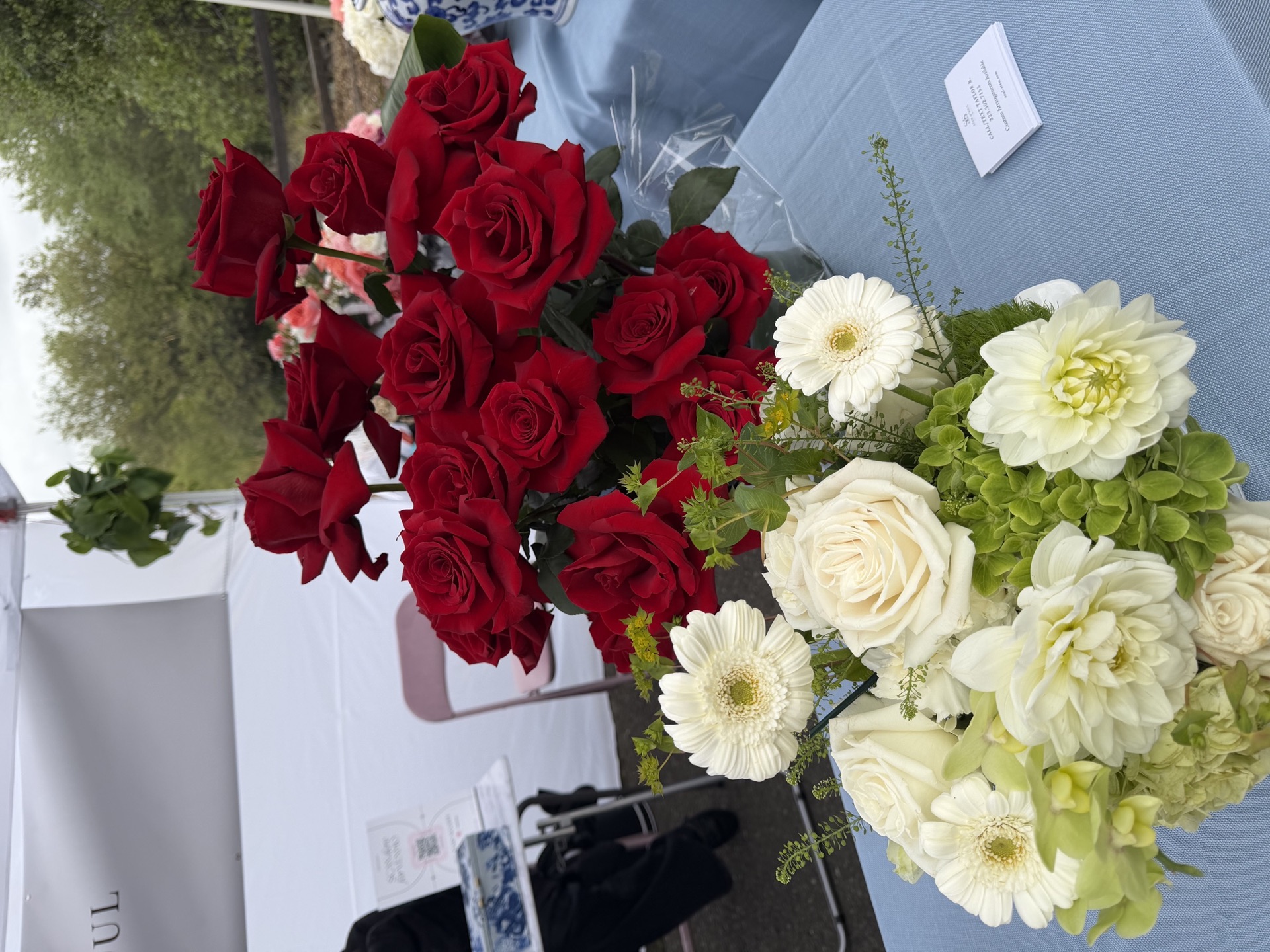
At Les Fleur we have rebuilt that centerpiece, mentally, a hundred times since. The version that works uses eleven stems, one variety of garden rose as the frame, lisianthus for volume, and enough negative space around the base for the mechanics — the compote, the linen, the candlelight — to do their share of the work. Composition is the difference between those two arrangements, and it is learnable. Not talent. Method.
This piece is that method — the one we teach every apprentice who sits at our bench before we let them near a client's flowers.
What We Mean by Composition
Composition, in floristry, is the arrangement of stems in relation to each other and to the space the piece will occupy — height, width, depth, and the negative space between them. It borrows more from painting and architecture than from botany. A florist who understands color theory but not proportion will produce something bright and shapeless. A florist who understands proportion will produce something that reads as inevitable, as though the stems could not have gone anywhere else.
Four principles govern the work at our bench: silhouette, focal hierarchy, rhythm, and restraint. Silhouette is the outer shape the piece traces against a room — round, cascading, asymmetric, architectural. Focal hierarchy is the order in which the eye is meant to travel: primary bloom, supporting bloom, filler, foliage. Rhythm is the repetition of line or color that carries the eye through the piece rather than stopping it. Restraint is the willingness to leave a stem out of the vase.
None of these are decorative choices made at the end. They are structural decisions made before the first stem is cut, in the same way an architect decides load-bearing walls before choosing paint. Design education from the American Institute of Floral Designers makes this distinction plainly: principles are not applied to flowers after the fact — they are the reason flowers hold together as a single object rather than a handful of separate ones.
Start With the Silhouette, Not the Flowers
Every arrangement at Les Fleur begins with a shape, sketched in three lines on a scrap of kraft paper, before a single stem is chosen. The shape answers one question: what will this look like from six feet away, in low light, after the first hour has passed and no one is looking at it directly. That is the real test of a wedding centerpiece — not the photograph taken at 4 p.m., but the impression it leaves at 9 p.m. across a candlelit table.
We work from three silhouette families. The compact round, roughly 1.3 to 1.5 times the height of the vessel, suited to long tables where sightlines matter more than drama. The asymmetric cascade, weighted two-thirds to one side, suited to arbor pieces and installations viewed from below. The architectural line, built on branching material like flowering quince or curly willow, suited to a single statement piece at an entrance or altar.
Choosing the wrong family for the setting is the most common early mistake we correct. An apprentice will build a lush round arrangement for a narrow console table, and it will crowd the space rather than anchor it. The fix is not fewer flowers — it is a different frame. Once the silhouette is fixed, the stem count and variety list follow almost automatically, because the shape tells you what each stem is for. Flowers chosen before the shape is set are flowers chosen for their own sake, and they compete with each other rather than working toward one object.
Negative Space Is Not Empty Space
Negative space is the most misunderstood term we teach. New florists hear it as an instruction to leave gaps, and they leave gaps in the wrong places — low in the arrangement, where they read as missing stems rather than intentional air. Negative space, used correctly, sits at the edges and between the primary blooms, where it frames the flower rather than interrupting it.
Think of it the way a jeweler thinks of the setting around a stone. A garden rose in the Mondial variety, deep and velvet-red, needs air around its face to register as singular rather than as one red shape among many. Crowd it with lisianthus on every side and the eye cannot isolate it — the rose becomes texture instead of subject.
We ask apprentices to build one arrangement and then remove 20 percent of the stems without changing the silhouette. The piece almost always improves. What is lost is rarely missed; what remains reads with more weight, because it no longer competes for attention. This is uncomfortable for a florist paid by the stem, and it is the discipline we insist on regardless. A wedding client is not buying volume. She is buying a composition that will still look composed after the flowers have opened another two days and settled into their vase.
Negative space is not the absence of decision. It is the most deliberate decision in the piece.
Choosing Material by Line and Weight
Color is the first thing a client names and the last thing we select for. Line and weight come first, because they determine whether the arrangement holds together as a shape once color is added.
We sort material into three functional categories at the bench, not by bloom type but by role:
A common error is choosing focal material first, out of enthusiasm, and building frame and transitional stems around it afterward. This produces a piece with a strong center and a weak edge — heavy in the middle, thin at the silhouette, which reads as unfinished no matter how expensive the peonies were. We build in the opposite order: frame first, to set the shape; transitional second, to establish rhythm; focal last, placed with the fewest stems that will carry the composition.
Weight matters as much as line. A single Quicksand rose, dense and warm-toned, can carry the visual weight of three lisianthus blooms. Placing it low and off-center, rather than dead-center, keeps the arrangement from reading as static — a technique borrowed directly from ikebana's use of asymmetric balance, and one worth studying regardless of the final style.
The Eleventh Stem: Knowing When to Stop
Eleven is not a superstition at our bench. It is the number we return to most often for a standing centerpiece, because it is large enough to hold a room and small enough to force hierarchy. Every stem past eleven has to justify itself against the ten that came before it, and most of the time it cannot.
The eleventh stem — the one added out of habit, or because the bucket still had roses in it, or because a client asked for 'more' without specifying what — is almost always the one that ruins the composition. It duplicates a focal point that already existed, or it fills a negative space that was doing work by staying empty. The arrangement does not become fuller. It becomes louder, and a louder arrangement is not the same as a better one.
We train new florists to treat every stem after the tenth as a question rather than a default: does this stem do something the current eleven do not already do. If the answer is no, it goes back in the bucket. This is the hardest habit to build in florists who came up in high-volume shops, where speed and stem count were the only metrics that mattered. It is also the habit that separates arrangements clients remember from arrangements clients simply paid for.
Restraint, applied consistently, is what a considered client is actually purchasing — whether she can name it or not.
Working in Odd Numbers and Uneven Weight
The rule of odd numbers is old enough to predate floristry as a trade — it shows up in Japanese ikebana, in classical painting, in garden design — and it holds because even numbers create visual pairs that the eye resolves too quickly and then stops looking. Three stems, five stems, seven stems: the eye keeps moving, searching for the pattern, and that searching is what holds attention on the piece.
We apply this at every scale, not just to the count of focal blooms. Three garden roses, not two or four. Five stems of lavender worked through the base, not six. An asymmetric grouping of eucalyptus at one edge, heavier than its counterpart on the other side, rather than a mirrored pair. Symmetry reads as formal and static; asymmetry, held under control, reads as composed and alive.
Weight distribution matters more than most apprentices expect on their first arrangements. A heavy bloom placed at dead center, with lighter material evenly spaced around it, produces a piece that looks correct in a photograph and inert in a room. Shift that same heavy bloom slightly off-center, and let the lighter material trail unevenly to one side, and the arrangement gains a sense of motion — as though it were caught mid-gesture rather than assembled and set down.
This is why we ask every apprentice to build the same design twice: once by formula, once by eye, and to compare which one a stranger in the studio points to first. The eye rarely picks the symmetrical version.
Mistakes We Correct Most Often at the Bench
After eleven seasons and something close to four hundred weddings, the same five mistakes account for most of what we correct in apprentice work:
None of these require better flowers. They require a slower first pass and a willingness to pull stems back out once they are placed — the single habit that improves an apprentice's work faster than any other instruction we give. Guidance from the Royal Horticultural Society on flower arranging echoes the same order of operations: structure and proportion checked before color and abundance.
A Working Method, Step by Step
The method we teach breaks into six stages, and we ask apprentices to time themselves through each one until the sequence becomes automatic rather than effortful.
Forty minutes, most days, for a standing centerpiece — longer for an installation, shorter once the sequence is internalized. The order matters more than the timing. Florists who place focal blooms first consistently overcrowd their arrangements, because there is no frame yet to tell them when the piece is full.
We do not expect an apprentice to compose with restraint on the first attempt, or the twentieth. We expect the sequence to be followed until judgment catches up to it — which, at our bench, has taken most florists a full wedding season to trust without checking the steps.
The centerpiece from that March consultation still lives in a photograph on our studio wall, kept as a reminder — not of the wedding, but of the version we did not build. The client never asked why hers turned out differently. She only said it looked like it belonged there.
Considered
What is composition in floristry?
Composition in floristry is the deliberate arrangement of stems by silhouette, hierarchy, negative space, and proportion, rather than by color or volume. It determines how the eye moves through an arrangement and whether the piece reads as a single cohesive object rather than a collection of separate flowers.
How many stems should a wedding centerpiece have?
Most standing centerpieces at Les Fleur use around eleven stems — enough to hold a table without overcrowding it. Stem count depends on vessel size and silhouette, but every stem beyond ten should justify its place rather than be added by habit.
What is negative space in a floral arrangement?
Negative space is the intentional air left around and between focal blooms so each stem reads individually rather than blending into surrounding texture. It sits at the edges and between primary flowers — not low in the arrangement, where it can look like a missing stem instead.
Why do odd numbers work better in floral design?
Odd-numbered groupings avoid the visual pairing the eye resolves too quickly with even numbers. Three, five, or seven stems keep the eye moving across a composition, which is why the principle recurs in ikebana, painting, and classical garden design.
What is the rule of the eleventh stem?
It is the working principle that the stem added beyond a composition's real needs — often out of habit rather than purpose — is usually the one that overcrowds the piece. Every addition past a core stem count should be tested against what it adds that is not already there.
How do florists decide which flowers to use together?
Material is sorted by role before color: frame stems set the outer silhouette, transitional stems carry rhythm between sections, and focal stems anchor the visual center. Choosing focal blooms first, before the frame is set, is the most common cause of an unbalanced arrangement.