The Art of Layering Florals for Timeless Wedding Arrangements
A bride once brought us a photograph from a wedding two towns over — a long table, white linen, and centerpieces that had clearly cost someone real money. Garden roses, ranunculus, a scattering of lisianthus. And yet the picture read flat. Every stem sat at nearly the same height, the same depth, facing the same direction. From three feet away it looked like a very expensive bunch someone had set down rather than composed.
35 min read · Les Fleur Company
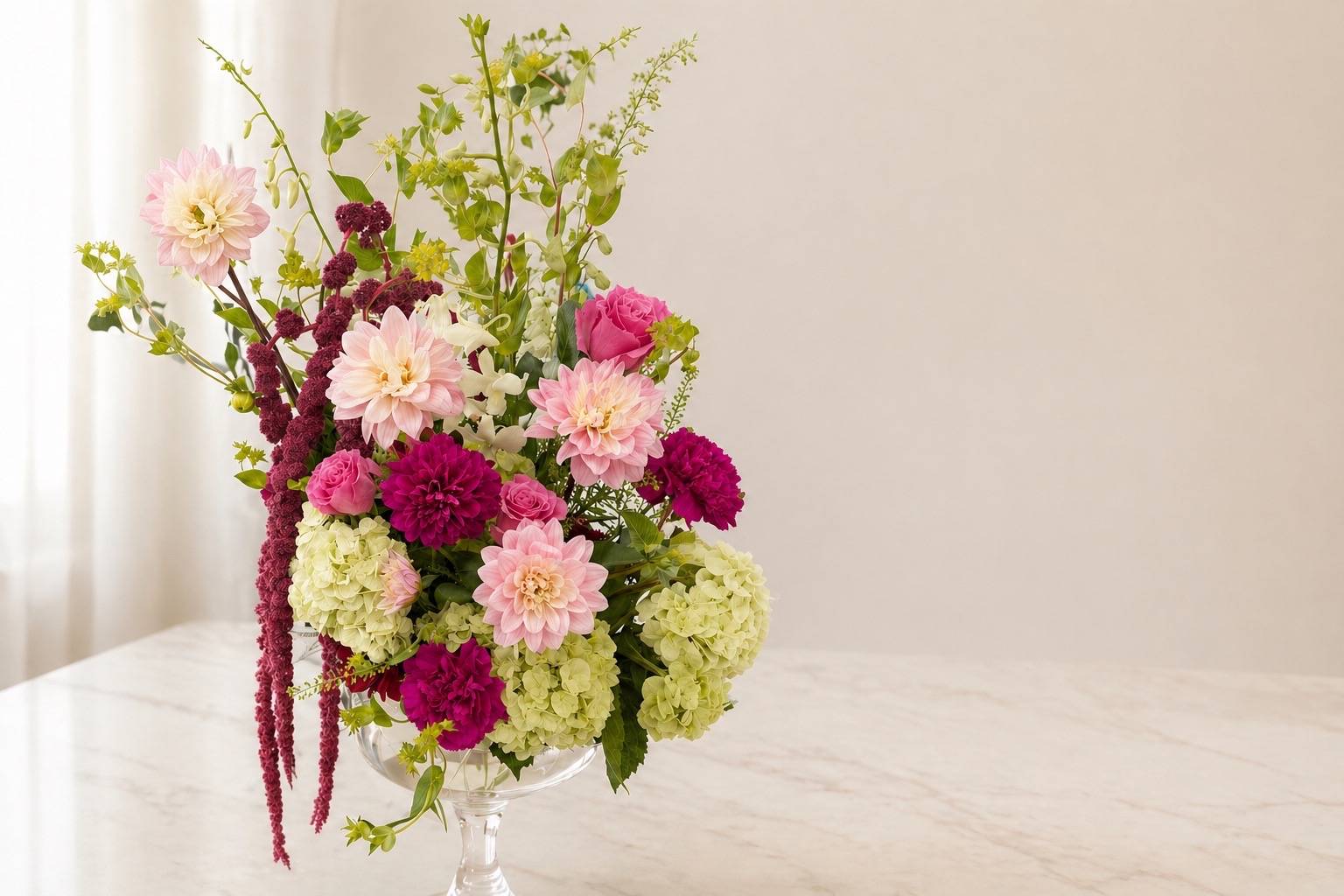
When a Centerpiece Falls Flat
A bride once brought us a photograph from a wedding two towns over — a long table, white linen, and centerpieces that had clearly cost someone real money. Garden roses, ranunculus, a scattering of lisianthus. And yet the picture read flat. Every stem sat at nearly the same height, the same depth, facing the same direction. From three feet away it looked like a very expensive bunch someone had set down rather than composed.
This is the failure we see most often when a client arrives with reference images pulled from wedding boards. The palette is right. The flower budget is often generous. What is missing is depth — the sense that the arrangement has a front, a middle, and a back, built in sequence rather than assembled all at once. That sequence is what layering florals for wedding arrangements actually accomplishes, and it is a technique, not a flower list.
Layering is not about adding more stems. It is about deciding which stems do which job, and placing them in an order that lets the eye travel through the piece rather than land on it all at once. A dozen well-layered stems will outperform four dozen flat ones, in photographs and in the room.
What Layering Florals Means, Precisely
In the workroom, we think of an arrangement in three depths. The base layer is structural — foliage, vine, or branching material that establishes the silhouette before a single focal bloom goes in. The mid layer introduces texture and secondary color, filling the space the base has defined without yet drawing attention to itself. The focal layer is the smallest of the three and carries the fewest stems — the roses, peonies, or garden varieties the eye is meant to rest on.
This is different from the common approach of grouping by type — all the roses together, then the filler, then the greenery tucked around the edges. That method produces an arrangement built outward from a center. Layering builds an arrangement through depth, with each layer placed at a different angle and height, so that shadow falls between the layers rather than around the whole.
The distinction matters most under event lighting. A grouped arrangement photographs reasonably in daylight and disappears under candlelight, because there is no shadow structure to catch the flame. A layered arrangement holds its shape in both conditions, because the depth was built in rather than implied by color contrast alone.
The Base Layer: Foliage as Architecture
The base layer is rarely what a client remembers about an arrangement, and that is by design. It is also the layer most often skipped by less experienced hands, because it does not photograph well on its own and can feel, in the moment of building, like wasted material.
We reach for eucalyptus for its silvered underside and the way it bends without snapping, dusty miller for the matte gray it lends against saturated blooms, and trailing clematis vine when a piece needs to move past its own container rather than sit inside it. These are placed first, before any focal bloom enters the vessel, and they determine the outer edge of the composition — how wide it reaches, how far it drapes, where the shadow will fall once the mid layer goes in.
A base layer built correctly takes up more time than its visual weight would suggest. On a standard reception centerpiece, we will spend twelve to fifteen minutes on foliage alone before touching a focal stem — roughly a third of total build time on a piece that might take forty minutes start to finish. Rush this stage and the whole arrangement leans on the mechanics of the container rather than the structure of the material, and it shows within the first hour of a warm room.
The test we use in the workroom: strip the arrangement of every bloom and look at what remains. If the foliage alone holds a recognizable silhouette, the base layer has done its job. If what remains looks like scaffolding with nothing to say for itself, the piece will collapse visually the moment a single rose drops or a petal browns at the edge.
The Mid Layer: Where the Narrative Lives
If the base layer is architecture, the mid layer is the material that gives an arrangement its particular character — the layer most responsible for making one wedding's flowers look different from another's, even when the focal blooms are identical.
This is where lavender earns its place, not as a filler but as a textural note that reads differently depending on whether it is massed in a cluster of five stems or scattered as single accents throughout the piece. It is where dusty miller reappears at a different density than in the base, where a handful of astilbe or scabiosa pods might sit, and where any stem with an irregular, non-uniform shape does its most useful work.
The discipline here is restraint on repetition. A mid layer with six different textures reads as busy no matter how harmonious the color story. Two, occasionally three, textural elements are enough to carry an entire arrangement — the temptation to add a fourth almost always comes from wanting to use up leftover stock rather than from what the composition needs.
We tell junior designers to build the mid layer at forty-five degree angles from the base foliage, never parallel to it. Parallel placement flattens the two layers into one visual plane and undoes the depth the base layer just established. The angle is what keeps the eye moving through the piece rather than settling on its surface.
The Focal Layer: Restraint at the Center
The eleventh stem ruins the composition. This is not a figure of speech in the workroom — it is closer to a working rule. Most focal layers we build hold between five and nine stems, rarely more, and the difference between a composed arrangement and an overcrowded one is frequently a single bloom.
Garden roses do the heaviest lifting here — Mondial for its density and old-world curl, Vendela for a cooler, more restrained cream, Quicksand for the warmth of its blush-to-apricot fade as it opens across a multi-day event. Peony, when the calendar allows it, is placed last of all, because its bloom continues to open after it is cut and needs room the other focal stems do not.
The mistake we correct most often in consultation is a client's instinct to add. More roses, one more peony, another lisianthus to fill a gap that, on inspection, was never actually empty — it was negative space doing its job. We ask clients to trust the gap. An arrangement with visible space between its focal stems reads as considered. An arrangement with no space at all reads as anxious, regardless of how much the flowers themselves cost.
Focal stems are also placed at varying heights within their own layer — never a uniform plane — so that even the smallest count of blooms creates its own internal depth rather than sitting as a flat cluster at the arrangement's center.
Texture Before Color
Clients arrive with a palette. Blush, ivory, a note of terracotta. Rarely do they arrive with a texture plan, and yet texture is what determines whether that palette reads as composed or merely coordinated.
Two arrangements can share an identical color story — the same roses, the same lisianthus, the same ivory ranunculus — and look entirely unrelated once texture enters the equation. One built with smooth, dense petal structures throughout will read as formal, almost architectural. The same palette built with airy, irregular textures — scabiosa, astilbe, a loose spray of clematis — will read as gathered, as though pulled from a garden that morning.
We resolve texture before color in every consultation, asking first whether a client wants a piece that reads as structured or one that reads as gathered, because that answer determines material selection well before we discuss which shade of blush. Color is the layer that gets noticed first and discussed most, but texture is the layer that determines whether the arrangement holds together as a single composed object once the eye moves past its color.
Light interacts with texture more than with hue. A matte surface like dusty miller absorbs candlelight rather than reflecting it, which is why arrangements built for evening receptions lean more heavily on textural variety than daytime arrangements do — the eye needs more surface variation to read depth once direct light is gone.
Common Mistakes We See in Client Photographs
Most layering failures are not failures of taste. They are failures of sequence — the right materials, assembled in the wrong order or at the wrong density. A few patterns come up often enough to name directly.
Each of these is correctable at the design stage, before a single stem is cut, which is why we spend as long on the mechanical plan as on the material selection itself.
Seasonal Material and the Discipline of Availability
Layering is sometimes described as though it were purely a matter of technique, independent of what is actually in season. In practice, the two are inseparable — availability shapes which materials are doing which job in a given month, and that shaping is part of what keeps an arrangement from feeling generic.
A June wedding built around peony and garden rose will lean on those blooms for the focal layer and use lavender, just then at its most fragrant, in the mid layer. A December arrangement has no peony to reach for, so the focal layer shifts toward denser garden rose varieties and winter-hardy ranunculus, while the mid layer leans more heavily on textural foliage — eucalyptus, dusty miller — to carry visual interest that a summer piece would get from bloom variety alone.
We do not treat this as a limitation to work around. A wedding built entirely from what is in season, layered with intention, tends to look more distinctive a year later than one built from imported stock chosen purely to match a mood board. The material itself carries information about the moment it was cut, and that shows in the final composition whether or not a guest could name why.
Clients planning a date more than eight months out are asked, early, to hold their palette loosely rather than fix it to a specific bloom that may not be reliably available. A palette described in terms of tone — warm ivory, muted terracotta — survives a season change. A palette described as "exactly this peony" does not.
Holding Through an Eight-Hour Day
A wedding arrangement is not judged at the moment it leaves the workroom. It is judged at the end of a reception, after cocktail hour in a warm tent, after dinner service, after however many hours a client's day actually runs. Layering has a structural role in that longevity that is separate from its visual effect.
Stems placed at varied angles distribute weight more evenly through a container's mechanics than stems bunched at a single point, which reduces the strain on any one section of floral foam or chicken wire. A base layer built with sturdy foliage also acts as physical support for the focal layer above it — literally holding heavier blooms like peony or garden rose at the angle they were placed, rather than letting gravity pull them flat over several hours.
We hydrate every stem for a minimum of four hours before it enters an arrangement, longer for anything cut within twenty-four hours of the event, and we account for room temperature when selecting which blooms go in the focal layer versus which are held in reserve for late-day touch-ups. A piece built for an outdoor July reception is layered differently — sturdier stems in more exposed positions — than the same palette built for a climate-controlled ballroom in the same month.
None of this is visible to a guest at the table. It is, however, the difference between an arrangement that looks the same in the last photograph of the night as it did in the first, and one that has visibly wilted by the toast.
Commissioning the Work
Most of what makes a layered arrangement work happens before the wedding day — in the ordering, the hydration schedule, the hours spent deciding which eleven stems become nine. None of it is dramatic. It is closer to drafting than to performance.
We ask new clients fewer questions about color than they expect, and more about how the room will be lit, how long the reception runs, and whether the piece needs to travel once it is built. Those answers shape the layering plan more than any swatch does.
A composed arrangement does not announce itself across a room. It holds its shape, catches its shadow correctly under whatever light the evening provides, and lets the rest of the day proceed without asking anyone to notice it was built in layers at all.
Considered
What does layering florals actually mean?
It means composing an arrangement in distinct depths rather than a single plane. A base layer of foliage establishes structure and shadow, a mid layer introduces texture and movement, and a focal layer — kept deliberately spare — carries the eye. Each layer is placed in sequence, not blended together.
How many types of flowers should be in a layered wedding arrangement?
Three to five varieties is typical for a considered piece — one structural foliage, one or two textural stems, and one or two focal blooms such as garden roses or peony. More than that tends to compete rather than compose, regardless of how well the colors coordinate.
Why does my centerpiece look flat in photographs?
Flat centerpieces are almost always missing a base layer. Without foliage or trailing material establishing depth and shadow underneath the blooms, every stem sits at roughly the same height and the arrangement reads as a bunch rather than a composition, particularly under flash photography.
Do layered arrangements cost more than standard centerpieces?
Often modestly more, since they require more stem varieties and more labor hours in the workroom. The difference is usually in craft time rather than flower cost — a layered piece can take twice as long to build as a clustered one of similar size.
Will a layered arrangement wilt faster during a long wedding day?
No, if built correctly. Layering is a structural technique, not a fragility risk. Properly hydrated stems, correct floral foam or mechanics, and stable temperature handling matter far more to longevity than how many depths the arrangement contains.
Can layering work for a small budget wedding?
Yes. Layering is a technique, not a flower count. A dozen stems arranged in three deliberate layers will read as more composed than three dozen stems arranged flat, which makes it one of the more efficient techniques for a modest budget.