Crafting a Timeless Bouquet: Atelier Floral Design
A bride called the studio four days before her wedding, holding a photograph of a bouquet she'd seen eleven months earlier on a stranger's wedding day. The flowers in the photograph were long dead. What she was really asking for was the structure — the way the bouquet held its shape in every photograph from the ceremony to the last dance, hours after a lesser arrangement would have gone soft at the edges. That is the question a timeless bouquet actually answers, and it has almost nothing to do with which bloom is fashionable this season.
30 min read · Les Fleur Company
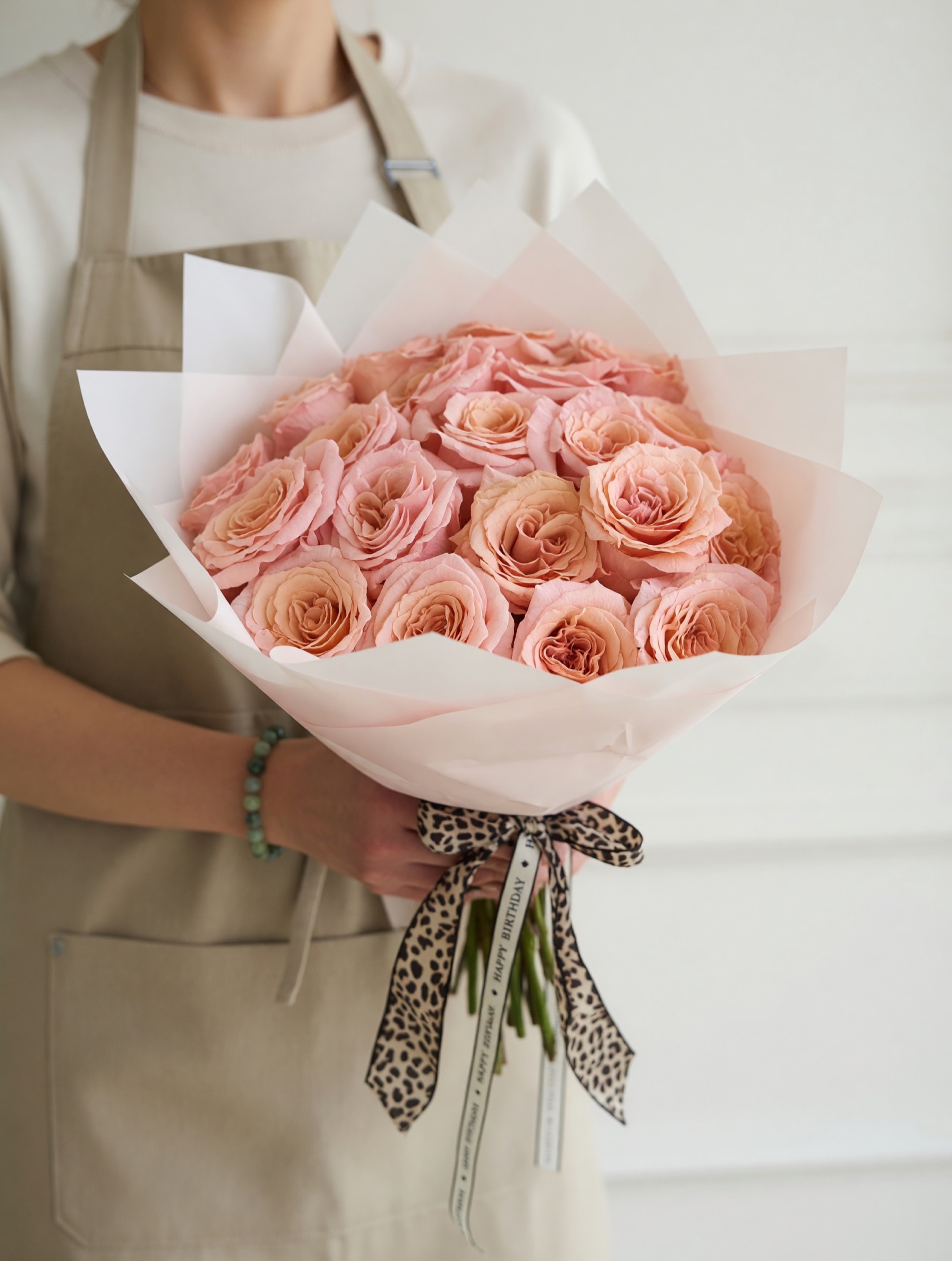
The Eleventh Stem: Where a Bouquet Goes Wrong
Every arranger we've trained has made the same mistake early on: adding one more stem because the bouquet felt slightly unfinished. Almost without exception, that tenth or eleventh stem is the one that ruins the composition. It crowds the silhouette, closes the negative space that was giving the bouquet its shape, and turns a considered arrangement into a dense one.
We teach restraint as a technical skill, not a taste preference. A bouquet built around thirty-six stems of garden rose, lisianthus, and clematis has room to breathe; the same bouquet at forty-seven stems reads as crowded in every photograph, no matter how good the individual blooms are. Composition is decided by what gets left out as much as by what goes in.
This is the principle behind nearly every bouquet that leaves our workroom, and it is detailed further in our piece on five essential elements of a timeless floral composition. The short version: a bouquet is not a container to be filled. It is a silhouette to be protected, stem by stem, often against the arranger's own instinct to add one more.
What We Mean by Atelier
The word gets used loosely across the floral industry, so it is worth being specific. An atelier is a workroom where process is visible and repeatable — where the same conditioning protocol, the same sourcing standards, and the same structural techniques are applied to every arrangement, not just the ones a client will inspect closely.
In practice, this means a bridal bouquet and a boutonniere built on the same morning go through an identical conditioning sequence, even though only one of them will be photographed four hundred times. It means a junior designer's hand-tie is checked against the same spiral-stem standard as the lead designer's. The craft is in the consistency, not in any single flourish.
We've written at length about the specific techniques this requires — stem hydration windows, binding points, structural wiring for high-heat venues — in our notes on atelier technique. What matters for a client evaluating a studio is simpler: ask what happens to the flowers in the six hours before arranging begins. If the answer is vague, the bouquet is being built on hope rather than process.
The Conditioning Room: Hours No One Sees
Flowers arrive at the studio dehydrated from transit, their stems often cut days earlier at the farm. Before any arranging happens, every stem is re-cut at a forty-five degree angle under water, stripped of foliage that would sit below the waterline, and rested in a temperature-controlled room for four to six hours — sometimes overnight for varieties like peony or garden rose that are slower to open.
This step is invisible in the finished bouquet and is the single biggest determinant of whether it survives a full wedding day. A rose conditioned properly will hold turgid petals through twelve hours of handling. A rose arranged straight from the shipping box will often go soft by the second hour, regardless of variety or price point.
We treat this room, not the arranging table, as the actual start of the composition. A few specifics from our own protocol:
None of this is glamorous. All of it is why a bouquet built here still looks composed at the end of the night rather than at the start of it.
Sourcing by Name, Not by Season Alone
A client who asks for "blush roses" is describing a color. A client who asks for Quicksand garden roses is describing a stem strength, a bloom size, a bloom-open rate, and a vase life — all of which determine how the bouquet will behave by hour eight of a wedding day. We push every client toward the second kind of conversation, even when it takes longer.
Mondial is a deep red garden rose with a heavy, cupped bloom that holds its form under heat better than most reds on the market. Vendela is a creamy ivory rose, tighter-petaled, that opens slowly and reads as composed rather than full for days longer than a standard hybrid tea. Quicksand shifts from apricot to blush as it opens, which means a bouquet built with it photographs differently at 11 a.m. than it does at 6 p.m. — something we tell every bride before she commits to it for an outdoor ceremony.
Sourcing decisions like these are made eight to twelve months out for a wedding of any scale, particularly for brides planning destination events in places like Lake Tahoe, where availability and transport time narrow the field of what can arrive in usable condition. A rushed order six weeks out does not get to choose between Mondial and a generic substitute. It gets whatever the wholesaler has on the truck that week.
Line, Mass, and the Discipline of Negative Space
A composed bouquet is built around three decisions: where the line runs, where the mass sits, and how much space is left unfilled. Line is carried by trailing elements — a single stem of clematis or a loose branch of eucalyptus that extends past the bouquet's main body and gives it movement in a photograph. Mass is the visual weight, usually garden roses or peony, clustered to anchor the eye. Negative space is everything the arranger chose not to fill.
Negative space is the hardest of the three to defend, because it is the easiest thing for a nervous arranger to fill in at the last minute. A bouquet with proper negative space photographs with depth — light moves through it. A bouquet with none reads flat, however expensive the flowers inside it.
We've found that clients rarely ask for negative space by name, but they recognize it instantly when they see it beside a denser alternative. The difference is explained in more technical terms in our piece on harmony in floral composition, which walks through how line, mass, and space interact across different bouquet shapes — cascading, round, hand-tied posy — each of which handles negative space differently.
The Hand-Tie: Mechanics Before Aesthetics
Most of our bridal bouquets are built using a spiral hand-tie, where each stem crosses the next at a single binding point low on the stems, rather than straight down as in a simpler Western-style tie. The spiral lets a bouquet stand unassisted in a vase of water and distributes weight evenly enough that a bride can carry it one-handed through a receiving line without it rotating or drooping to one side.
The technique is slower — a thirty-six stem bouquet takes a trained designer twenty-five to forty minutes to spiral correctly, compared to twelve to fifteen minutes for a wired, frame-based arrangement. But a wired bouquet, however precise it looks on the table, moves stiffly in the hand and can shed blooms if a wire loosens mid-reception. A hand-tied bouquet moves the way flowers actually move.
Binding point placement is itself a composition decision. Tie too high and the bouquet looks pinched at the waist. Tie too low and the stems splay, widening the silhouette beyond what was intended. We check binding height against the bride's hand size and the bouquet's overall scale before a single stem is cut to its final length — a detail that sounds minor and is, in practice, the difference between a bouquet that looks tailored and one that looks assembled.
What a Considered Bouquet Costs, and Why
Clients reasonably want to understand what they are paying for beyond stem count. A fair breakdown, based on what actually goes into a bridal bouquet at this level: sourcing and procurement (often fifteen to twenty percent of the line item, covering named-variety imports and farm-direct ordering), conditioning labor (four to six hours per delivery at a skilled hourly rate), design and construction time (twenty-five to forty minutes of hands-on arranging for an experienced designer, more for a trainee), and structural materials — binding twine, stem tape, preservative — that rarely show up as a line item but are chosen with the same care as the blooms.
A bouquet priced primarily on stem count alone is usually one where conditioning and sourcing have been compressed to protect margin. The flowers may look identical in a studio photograph taken at noon and fail by the reception.
We price bouquets the same way for a private estate wedding as for a gala in El Dorado Hills — by the hours of process behind the arrangement, not by the occasion's prestige. A client asking for a lower price point is better served by a smaller, equally disciplined bouquet than by the same silhouette built with shortcuts in the conditioning room.
Mistakes We See, and What We Do Instead
The most common request we decline, gently, is a bouquet built entirely around a single reference photograph without regard for season or venue heat. A cascading bouquet photographed in a 65-degree spring courtyard will not hold the same way at a 90-degree summer reception. We reconstruct the reference toward varieties suited to the actual day, rather than forcing the original toward conditions it was never built for.
A second mistake, usually made by less experienced studios, is over-wiring delicate blooms to prevent drooping rather than addressing the conditioning that caused the drooping in the first place. Wire masks the symptom. It does not fix a dehydrated stem.
A third: adding stems to make a bouquet look more substantial in a static photograph, which is the eleventh-stem problem again, dressed up as generosity. We would rather hand a bride a thirty-two stem bouquet with real negative space than a forty-four stem bouquet that reads as crowded the moment she lifts it off the table.
Clients planning events in San Francisco often arrive expecting a denser, more maximalist silhouette, shaped by trend photography. We walk through the restraint argument early, before sourcing begins, because it is far harder to remove stems from an approved design than to build the case for fewer stems from the start.
Built to Be Looked at in Forty Years
A bridal bouquet is one of the only pieces of a wedding day that gets photographed more than the couple themselves. It appears in the ceremony photos, the formal portraits, and — decades later — in the anniversary photo a daughter pulls out of a drawer. The varieties and structure chosen on the day decide whether that future photograph still reads as composed or whether it reads as dated.
This is the quiet argument for heritage-minded design: choosing garden roses, lisianthus, and eucalyptus over novelty blooms and trend colors that anchor a bouquet to a specific year. A bouquet built this way does not announce itself as timeless. It simply avoids the choices that would date it.
We have made this case at length in our piece on atelier couture and curated floral arrangements, and it is the standard we hold every bridal bouquet to, regardless of the client's initial brief. A bride rarely asks for a bouquet that will still look composed in forty years. It is our job to build one anyway.
The bouquet that photographs honestly at the end of the night is rarely the one with the most stems in it.
Considered
What makes a bouquet timeless rather than trend-driven?
A timeless bouquet relies on disciplined silhouette and durable varieties — garden roses, lisianthus, eucalyptus — rather than seasonal color trends or novelty blooms. The structure is built to hold its shape and read honestly in photographs taken years later, not just at the altar.
How long does it take to condition flowers for a bridal bouquet?
At the studio, conditioning typically runs four to six hours per delivery — stems re-cut at an angle, stripped of lower foliage, and rested in temperature-controlled water before any arranging begins. Skipping this step is the most common cause of a bouquet wilting before the reception ends.
Why do florists specify flower varieties by name instead of just color?
Naming a variety — Mondial garden rose versus a generic 'blush rose' — specifies stem strength, bloom size, and vase life, which determines how the bouquet will hold structure. Color alone doesn't tell a florist how a stem will behave by hour eight of a wedding day.
How many stems are in a typical luxury bridal bouquet?
Most considered bridal bouquets at the studio run between thirty and fifty stems, depending on silhouette and bloom size. The number matters less than the restraint behind it — a bouquet built for negative space often uses fewer stems than one built for density.
What is a hand-tied bouquet and why does the technique matter?
A hand-tied bouquet is built with a spiral stem structure, each stem crossing at a single binding point so the bouquet can stand unassisted in water and hold weight evenly through hours of handling. It is slower than wiring blooms into a frame, but it moves and photographs the way a hand-carried bouquet should.
How far in advance should a bride order a custom bouquet?
For a fully considered, sourced-to-order bouquet, most studios ask for eight to twelve months of lead time, particularly for weddings requiring imported garden roses or out-of-season varieties. Rush orders under six weeks limit variety selection and often mean substituting what is available rather than what was composed.