Reviving Traditional Florals: A Guide to Heritage-Inspired Wedding Bouquets
A bride came into the studio last spring with a photograph in a plastic sleeve, corners soft from handling. Her grandmother, 1962, holding a loose knot of garden roses and lisianthus tied with a ribbon that had gone the color of tea. She did not want a copy. She wanted the feeling of that photograph carried into a room that had not been built yet — a barn with steel trusses, forty minutes outside the city. That gap, between an image from one era and a room from another, is where heritage-inspired wedding bouquets actually get made. Not by matching stems to a photograph. By understanding what the photograph was doing structurally, and rebuilding that logic for the day in front of you.
26 min read · Les Fleur Company
What "Heritage-Inspired" Actually Means at the Bench
Say the phrase to most couples and they picture a color palette — dusty rose, sage, cream. That is part of it, but not the operative part. The construction is what separates heritage-inspired bouquets from the domed, tightly wired bridal bouquets that became standard from the 1950s onward, when floral foam gave florists a mechanical shortcut to a uniform round shape.
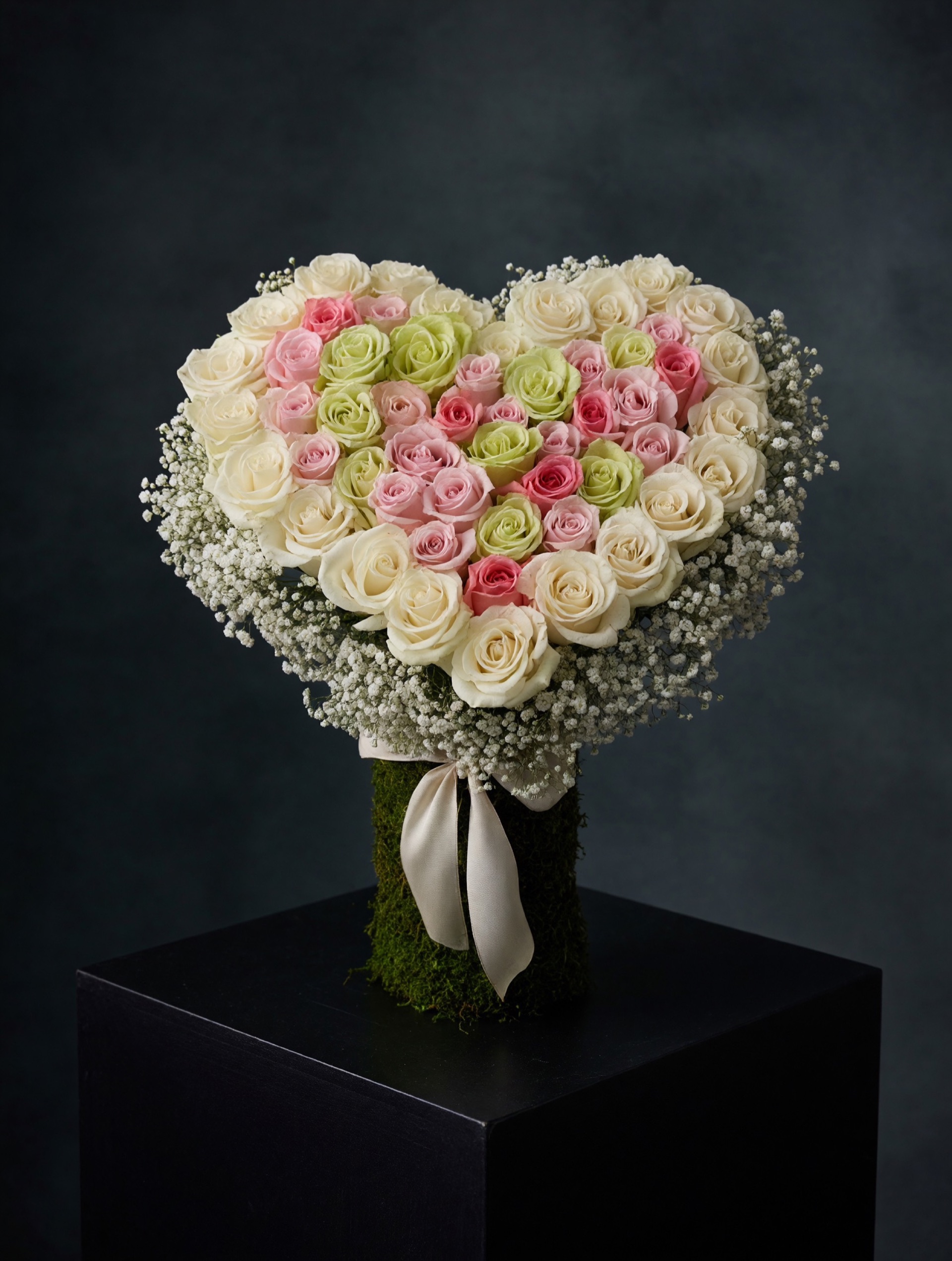
Heritage work is hand-tied. Stems are gathered at a single spiraled point, bound with twine, and left long enough to show — no wire armature forcing each bloom into an identical plane. The silhouette is looser, slightly asymmetric, with negative space between blooms rather than a solid wall of petal. That negative space is not an oversight. It is what reads as garden-grown rather than manufactured.
We tell couples: if you can see where every stem enters the bouquet, and the shape has a front and a slight lean rather than a perfect sphere, you are looking at heritage construction. If every bloom sits at the same height with no visible stem, you are looking at foam work, regardless of which varieties were used. The word heritage-inspired should describe method before it describes mood board.
Matching Florals to the Venue's Age
The single most common error is choosing heritage florals because a wedding album called for them, then installing them in a room that argues with the choice. A heritage bouquet in a glass-and-steel event space reads as considered restraint against a modern backdrop — the contrast does the work. The same bouquet layered into a fully dressed period house, competing with existing millwork, wallpaper, and brass fixtures, can read as one more decorative element in a room that already has too many.
Before ordering anything, walk the venue, or study its photographs closely, and ask what the room is already doing. A stone chapel with bare walls has room for florals to carry more visual weight. A ballroom with existing ornamentation needs restraint — fewer, larger heritage-toned arrangements rather than florals scattered across every surface.
For outdoor heritage weddings — orchards, working farms, walled gardens — the florals should read as an extension of what is already growing there, not an import. We often ask to see photographs of the property in the relevant season before finalizing variety selection, so the bouquet does not compete with, say, a hedge already in bloom twenty feet away.
The Material Vocabulary of an Old Garden
Certain flowers carry the heritage register on their own; others do not, regardless of arrangement style. Garden roses — Mondial, Vendela, Quicksand — read differently than standard hybrid tea roses because of petal count and form. A garden rose has 40 to 100 petals arranged in a loose cup, opening fully rather than holding a tight point. That openness is what a 1960s or Edwardian photograph is showing you. A standard florist rose, however beautifully grown, will not produce the same effect no matter how it is arranged.
Lisianthus does similar work in white and blush tones, with a ruffled, almost peony-like bloom that has been part of cutting gardens for generations. Sweet pea, where seasonally available, adds fragrance and a delicate, papery texture. For structure and volume without formality, clematis vine and dusty miller foliage soften the bouquet's edges — dusty miller in particular, with its silvered leaf, reads as heirloom in a way that eucalyptus, however useful, does not quite manage.
Peony belongs in the conversation for late spring dates, though we counsel restraint here — a bouquet built entirely of peony reads as trend rather than heritage. The material vocabulary works best mixed: one dominant bloom, one supporting bloom, and foliage doing quiet structural work rather than decorative filler. A useful rule at the bench — three varieties, well chosen, outlast six varieties chosen for coverage.
Composition — Building the Silhouette
Heritage construction rewards discipline more than abundance. A bouquet built from thirty stems, poorly spaced, will look busier than one built from eighteen. The goal is a silhouette with a clear top, a defined widest point roughly a third of the way down, and stems left visible and slightly trailing at the base — the part most modern bridal work hides entirely.
We build in layers at the bench: foliage first to establish the outer edge, then the dominant bloom placed in a loose spiral rather than a grid, then the supporting bloom filling gaps without eliminating them. The negative space between stems is not empty by accident — it is what keeps the composition from reading as dense or overworked. Add one stem past that point and the balance shifts from garden-grown to arranged. We call it the eleventh stem problem: the arrangement is finished before it looks finished, and the temptation to keep adding is the thing to resist.
Trailing ribbon, in silk rather than satin, extends the vertical line without adding visual weight — a detail borrowed directly from the construction era this style references. Wire is used sparingly, if at all, and only to reinforce a stem that would otherwise break under its own weight during the ceremony.
The Consultation Timeline, Start to Finish
Heritage-inspired florals cannot be ordered the way standard wholesale stock can. Garden roses in specific heritage colorways are grown to order by a small number of specialty farms, and lisianthus in the right tone follows a similar calendar. That means the timeline for this style runs longer than a standard bridal order.
Couples who approach heritage florals within eight weeks of the date are not out of options, but the variety list narrows considerably, and we will say so plainly rather than promise a specific garden rose we cannot source in time.
Color — Reading as Heritage, Not Costume
The palette that reads as heritage is narrower than most mood boards suggest. Cream, blush, dusty rose, sage, and soft apricot carry the register because they are the colors that garden roses and lisianthus actually grow in — not because a stylist decided they were period-appropriate. Saturated jewel tones, however beautiful in isolation, tend to push a bouquet toward costume rather than continuity.
We advise couples to choose one dominant tone and one accent, then let foliage — dusty miller's silver, eucalyptus's soft blue-green — do the work of transition between them. A bouquet built from four or five competing pastel tones loses the quiet cohesion that makes heritage work read as intentional rather than assembled from a catalog.
Seasonal honesty matters here too. A palette pulled from an autumn archival photograph, applied to a June wedding with June's available blooms, forces substitutions that undercut the whole premise. Better to let the season set the boundaries and choose the closest heritage-appropriate palette within them, rather than fighting the calendar to match an image.
Mistakes We See at the Bench
Three mistakes account for most of the heritage-florals requests that go sideways. The first is over-literal reproduction — bringing in a single photograph and asking for an exact match, stem for stem, without accounting for what that photograph's flowers looked like in the 1960s versus what is actually available and in season now. We work from the photograph's logic, not its inventory.
The second is ordering too late. Heritage varieties are grown to order, and a request six weeks out for a specific garden rose in a specific tone often cannot be filled at all, let alone filled well. The couples who are happiest with the result are the ones who started the conversation with enough runway for the farm to actually grow what was asked for.
The third is scale mismatch — a heritage bouquet built for a small chapel wedding, then asked to also anchor a reception table centerpiece and an arch, without adjusting proportion or stem count for each context. What reads as restrained in hand can read as sparse from across a room. We size each piece to its context individually rather than scaling one design up or down.
Budgeting Honestly
Hand-tied heritage construction runs 20 to 30% higher in labor than a comparably sized foam-mounted arrangement, because there is no mechanical shortcut — every stem is placed, checked, and re-set by hand rather than pushed into a pre-shaped block. Material costs vary by variety: garden roses typically run higher per stem than standard hybrid tea roses, though a loose heritage bouquet often uses fewer total stems than a dense modern one, which offsets some of that difference.
As a working range, a bridal bouquet in heritage construction with garden roses and lisianthus typically falls in a higher bracket than a standard bridal bouquet of the same visual size — couples should plan for that difference from the first budget conversation rather than discovering it at the estimate stage. Bridesmaid bouquets, built smaller and often with a single dominant variety, can be priced down meaningfully without losing the heritage read, since the construction method matters more than the stem count.
Where couples want to control cost without abandoning the style, we suggest concentrating the investment in the bridal bouquet and one or two anchor arrangements, then using foliage-forward, lower-stem-count pieces for secondary spaces. The heritage register survives that kind of triage far better than it survives a switch back to foam construction.
After the Day — Preservation
A heritage bouquet is, by its nature, a piece built to be looked back on — which makes preservation part of the plan rather than an afterthought. The window is short. Blooms begin losing structural integrity within 24 to 48 hours of the ceremony, so the decision to preserve needs to happen the morning after, not a week later when the flowers have already gone soft.
Two methods work reliably. Pressing — laying three to five representative stems flat between sheets of paper under even weight for two to three weeks — flattens the bloom but preserves color well, and works particularly well for lisianthus and rose petals used later in a shadow box or keepsake frame. Air-drying — hanging stems upside down in a dark, dry room for 10 to 14 days — preserves more of the bloom's dimension but tends to deepen and darken the original color, which some couples want and others do not.
We recommend couples select stems before the bouquet ever leaves the reception, so the flowers chosen for preservation are the freshest ones, not whatever survives the send-off. The rest of the bouquet does its work on the day and is allowed to end there — which is, in its way, the same restraint the whole style is built on.
Considered
What flowers are considered heritage or vintage wedding flowers?
Garden roses, lisianthus, sweet peas, dusty miller, clematis, and peony are the core heritage vocabulary — varieties and foliage common in cutting gardens before hybrid florist roses and floral foam standardized bouquet shapes in the mid-20th century. Anemones and ranunculus extend the palette for spring weddings.
How far in advance should I order heritage-inspired wedding florals?
Order 8 to 10 months ahead. Garden roses and lisianthus in specific heritage colorways are grown to order by specialty farms, not held in general wholesale stock, so late requests limit you to whatever variety happens to be available that week.
Is a heritage-inspired bouquet more expensive than a standard bridal bouquet?
Typically 20-30% more in labor, since hand-tied heritage construction is built stem by stem without floral foam. Material cost varies by variety — garden roses run higher per stem than standard roses, but the stem count in a loose heritage bouquet is often lower than in a dense modern one.
Can heritage florals work at a modern venue?
Yes, if the arrangement is scaled and colored to the room rather than copied wholesale from a period photograph. A loose garden-rose bouquet reads as intentional restraint in a glass-walled space; the same bouquet in a heavily dressed period house can look under-considered by comparison.
How do you preserve a heritage wedding bouquet after the ceremony?
Remove three to five representative stems the morning after and either press them flat between paper under weight for two to three weeks, or hang them upside down in a dark, dry room for 10 to 14 days. Waiting past 48 hours reduces what is salvageable.
What's the difference between heritage-inspired and just 'vintage' florals?
Vintage often refers to color palette and prop styling — dusty tones, brass, lace. Heritage-inspired refers specifically to construction: loose, hand-tied, visible stems, asymmetric silhouette, built the way bouquets were built before floral foam and wire mechanics became the default in the 1950s and after.