On the Discipline of the Second Cut: When a Flower Is Mature Enough to Compose With
It was a rehearsal dinner — sixty guests, long tables dressed with pillar candles and low vessels of garden roses. The flowers had arrived Thursday. By Friday afternoon the stems were conditioned, the buckets full. The arrangement began Saturday at seven in the morning.
35 min read · Les Fleur Company
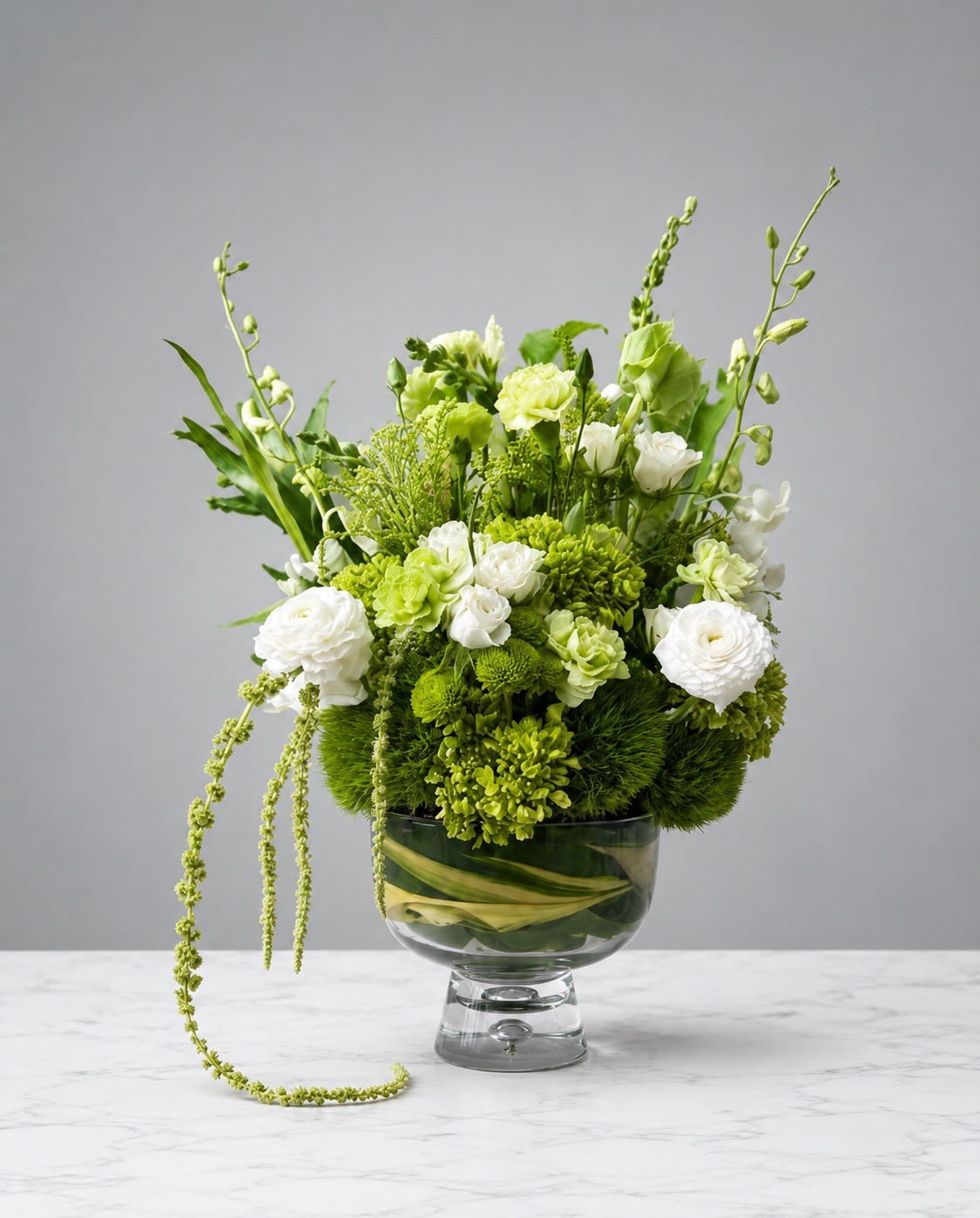
The Morning the Roses Were Not Ready
It was a rehearsal dinner — sixty guests, long tables dressed with pillar candles and low vessels of garden roses. The flowers had arrived Thursday. By Friday afternoon the stems were conditioned, the buckets full. The arrangement began Saturday at seven in the morning.
By noon, everything was on the tables. By six, when guests arrived, the Mondial roses — still at three-quarters open, outer petals stiff, centers compressed — looked like they were waiting for permission. The color read flat under candlelight. The silhouette had no give. The arrangement had not yet become itself.
The second cut had happened correctly. The composition had happened too soon.
What the Second Cut Actually Is — And What It Demands
The term moves through workrooms casually, sometimes imprecisely. In practice, the second cut refers to the rehydration cut: the fresh diagonal made to a stem before it enters conditioning water, removing the air-sealed callus that forms within minutes of the original harvest cut. Without it, the stem cannot drink. With it, uptake begins again.
But the second cut is also a moment of assessment. It is the point at which a florist holds a stem and makes a determination: ready, or not yet.
Most conditioning guides address mechanics — angle of the cut, water temperature, clean buckets, appropriate depth. Fewer address the harder question: when has the flower, having been cut and conditioned, actually arrived at the state in which it can carry its weight in a composition? These are two different disciplines. The first is procedure. The second is judgment.
The Four Stages of Cut Flower Maturity
A cut flower passes through recognizable stages between harvest and the end of its vase life. Understanding these stages — not as abstract categories but as physical, observable conditions — is foundational to knowing when to compose.
The discipline of the second cut is, in practice, the discipline of distinguishing stage two from stage three — and resisting the pressure to compose before that transition is complete.
Variety-Specific Maturity: What Repetition Teaches
General conditioning guides give broad parameters. The more useful knowledge is variety-specific, and it accrues through repetition — through running the same flower through the same workroom across enough installations to know what it does.
Mondial rose. One of the most-used garden-style roses in atelier work — large-headed, cream-edged, reliable in structure. Mondial is a slow opener. Arriving from a Dutch auction at tight stage one, it requires a minimum of forty-eight hours at 55–60°F before it reaches a reliable composing stage, and often closer to seventy-two hours in cooler workrooms. A florist composing Mondial at twenty-four hours is composing the bud, not the rose.
Quicksand rose. A faster mover. The warm sand-and-blush tones open with relatively little encouragement, and Quicksand can arrive in workrooms at late transitional — meaning it may need as few as twenty-four to thirty-six hours from delivery to composition. The risk with Quicksand runs the other direction: left in warm conditioning water past forty-eight hours, it moves toward blown quickly. It rewards attention.
Vendela rose. A white rose with exceptional vase life but a long conditioning requirement. Vendela benefits from a longer cold hold — thirty-six to forty-eight hours at 38–40°F before transitioning to room-temperature conditioning. Composed too early, it has a waxy stiffness that resists the drape quality that makes it valuable in large-scale work.
Peony. Peonies arrive almost exclusively in hard bud — small, dense, nothing like their final form. A Coral Charm or Sarah Bernhardt peony in bud gives almost no indication of what it becomes. The standard conditioning window is three to five days at room temperature, with consistent water changes and stem re-cuts every twenty-four hours. Composing a peony at day one or two is a gamble. The florist who composes at day three, when the outer guard petals have released and the center has begun to show, is composing with the actual flower.
Lisianthus. Deceptive in the other direction. Lisianthus conditions quickly and opens in sequence — lower blooms on each stem opening first while upper buds remain closed. A stem at forty-eight hours may carry three open blooms and four closed. This is its natural presentation and part of its value: it carries movement through a composition. But the florist must assess the overall stem, not the leading bloom — a stem that is already half-blown at the base is past its composing window regardless of how the top buds read.
Clematis. The fragile case. Clematis has an extraordinarily narrow composing window — sometimes fewer than twelve hours between transitional and blown. It is sensitive to heat, requires cutting with extreme freshness (ideally the morning of installation), and should be among the last materials added to any arrangement. Its value is precisely its impermanence. That is also its constraint, and the florist who treats it like a garden rose will find it collapsing before the guests arrive.
Dusty miller and eucalyptus. Foliage conditions more predictably than bloom, but the same principle applies. Eucalyptus held in water for more than four days begins to soften at the stem and will not hold a curve. Dusty miller cut before it has fully hydrated will wilt within hours of arrangement. The second cut on foliage is as important as on bloom — perhaps more so, because the failure is subtler and longer in arriving.
Temperature Is Forecasting, Not Management
A flower does not ripen in isolation. The conditioning environment — temperature, humidity, water chemistry, available light — determines how quickly and how completely a stem moves from stage one to stage three.
Cold slows everything. A workroom kept at 38–40°F will hold flowers at stage one or early two for days. This is useful when timing an installation far in advance. It is counterproductive when a florist needs flowers to open for a Saturday morning and receives them Thursday in bud, holds them cold overnight, then wonders why the Mondial is still tight at eight a.m. on Saturday.
The correct approach is intentional temperature management — moving flowers from cold storage to a room-temperature environment forty-eight to seventy-two hours before composition begins, not the morning of. This requires forecasting. A florist who receives peonies on Thursday and plans to compose Saturday morning must make a temperature decision on Thursday. That decision cannot be revisited on Saturday.
Water temperature matters at the moment of the second cut. Warm water at 100–110°F at the time of re-cutting encourages faster initial uptake and can accelerate opening in a flower that is running behind schedule. Cold water retards uptake. Floral preservative at the correct concentration — per-packet instruction, not doubled under the assumption that more is more — maintains water clarity and reduces bacterial buildup that would otherwise block stem uptake within twenty-four hours.
Uneven heat sources — grow lights, radiators, sun from a south-facing window — can push flowers through their stages unevenly, opening blooms on one side of a bucket while the other side remains transitional. Rotate buckets if the environment is irregular. Consistent exposure produces consistent maturity, and consistent maturity is what makes a cohesive composition possible.
How Maturity Changes the Composition Itself
This is the part that is hardest to teach and most consequential to understand: a flower at stage three composes differently than the same flower at stage two. Not just aesthetically. Structurally.
An open garden rose has weight. Its head moves with the stem. It can be positioned to face, to turn, to lean — to do something in the arrangement rather than simply occupy space. A tight bud holds position only because it has no other option. The open rose gives the florist something to work with: a surface to catch light, a form that interacts with adjacent material, a silhouette that registers at six feet.
The discipline of negative space — one of the central practices of composition — depends on this. Negative space is only legible when surrounding blooms have enough presence to define it. A composition built with tight buds has no negative space. It has gaps. The eye reads the gaps as absence rather than intention, because the flowers themselves have not yet claimed the space around them.
The relationship between bloom and foliage changes with maturity as well. Dusty miller placed against an open Quicksand rose reads as contrast — silver velvet against warm blush, two textures in conversation. The same combination with a tight Quicksand bud reads as decoration. The foliage has nothing to react to. The contrast cannot exist between a flower that hasn't opened and a leaf that has.
This is why the decision of when to compose is not merely logistical. It is compositional. The florist who waits for the flower to arrive at stage three is not being precious about process. They are waiting for their material.
Building the Discipline Into Studio Practice
Practically, this means reconsidering how delivery and composition are scheduled — and being willing to push delivery windows earlier than feels intuitive.
A common error in studio workflow is treating delivery day as the beginning of preparation time. In atelier practice, delivery day is the beginning of conditioning time. Preparation — stem assessment, design decisions, supplementary sourcing — happens after flowers have been in water for twelve to twenty-four hours and the florist can see what they actually have. Composition begins when the material is ready, not when the calendar says it should begin.
This requires a buffer. For a Saturday wedding with a first-look at eleven in the morning, flowers should arrive no later than Wednesday — Thursday at the outermost limit for reliable garden roses and peonies, and only if the workroom can guarantee the temperature management needed to bring them through on schedule. For clematis or other fast-moving materials, Friday morning arrival with same-day composition is the correct sequence, not a shortcut.
Regular stem assessment during conditioning is non-negotiable. Check buckets morning and evening. Re-cut stems every twenty-four hours — a fresh diagonal, two inches up from the previous cut, in clean water with fresh preservative. Note which materials are ahead of schedule, which are running behind. This is not extra work. It is how the florist stays in control of the composition before the composition begins.
When a particular farm or auction source consistently ships peonies at hard stage one with a forty-eight-hour delivery window, that is a logistics problem presenting as a quality problem. The flowers are not inferior. The timeline is incompatible. Knowing the difference — and adjusting the sourcing relationship rather than the composition schedule — is part of running the atelier with any rigor. According to post-harvest research from the UC Davis Postharvest Technology Center, the primary cause of premature flower quality loss in the supply chain is improper temperature management during transit and holding — meaning the flowers that arrive behind schedule were often behind before they reached the workroom. The Royal Horticultural Society's guidance on cut flower care similarly identifies consistent water uptake as the variable most within a florist's control once a stem arrives.
The Unready Bloom and the Composition That Waits
There is a principle in composition: the eleventh stem ruins the arrangement. The work is done at ten. Adding more — material, color, form — obscures what was already resolved.
The same logic applies to timing. The arrangement composed before the flowers are ready is the arrangement that does not quite work, and no additional stem will correct it. The tightness is in the material, not the design. The florist looks at the installation and feels that something is missing. What is missing is time.
The second cut is an act of assessment. It is the moment the florist decides whether to proceed or wait. Waiting is not delay. In atelier practice, waiting is part of the work — as deliberate as the cut itself, as consequential as any placement decision made in the finished arrangement.
The flowers that carry a room are not the ones that were composed earliest. They are the ones that were ready.
Considered
What is the second cut in floristry?
The second cut is a fresh diagonal cut made to a flower stem before it enters conditioning water, removing the air-sealed callus that forms within minutes of the original harvest cut. Without it, the stem cannot take up water. It is also the moment of assessment — when a florist evaluates whether a flower has reached the maturity stage at which it is ready to be composed with.
How long should I condition flowers before arranging?
It depends on variety. Garden roses such as Mondial need 48–72 hours at room temperature after initial cold conditioning. Peonies require three to five days from farm delivery. Quicksand rose can be ready in 24–36 hours. Clematis has a window of less than 12 hours and should be cut the morning of installation. There is no single number — maturity varies by flower, temperature, and source.
When is a peony ready to arrange?
A peony is ready to compose with when the outer guard petals have fully released and the center has begun to show — typically day three to four after delivery at room temperature. A peony composed at day one or two, when it is still a hard, tight bud, is a gamble. It may not open further under installation conditions, particularly in cool or dry spaces.
Why do my flowers look closed in the finished arrangement?
Most likely the flowers were composed at stage two — transitional — before they had arrived at their full open stage. Tight or transitional buds may not continue opening once placed, especially in cool, dry, or low-light environments. The arrangement looks withheld because the flowers haven't yet committed to their final form. The fix is earlier delivery and longer conditioning time, not a different variety.
What temperature should I condition cut flowers at?
Cold storage at 38–40°F slows maturity and holds flowers at an early stage — useful for managing timing on large installations. For flowers that need to open, room temperature conditioning at 60–65°F accelerates the process. Warm water (100–110°F) at the time of the second cut encourages faster initial uptake. The key is intentional temperature management, not a single setting.
How often should I re-cut flower stems during conditioning?
Every 24 hours, making a fresh diagonal cut two inches up from the previous cut in clean, fresh water with preservative. Regular re-cutting removes the bacterial buildup that blocks stem uptake and gives the florist a daily opportunity to assess maturity across all varieties in conditioning — catching anything that is moving faster or slower than expected.