Traditional Bouquet Forms: A Guide to Floral Etiquette
A bride stands in a fitting room in El Dorado Hills, holding a round bouquet of garden roses against a dress with a low back and a long train, and something does not sit right. The shape is correct by every modern standard — tight, domed, photographed everywhere — and still it argues with the dress instead of finishing it. This is the quiet problem traditional bouquet forms were built to solve long before anyone called it floral etiquette: which shape belongs to which moment, which silhouette answers which gown, which arrangement knows when to recede.
38 min read · Les Fleur Company
Traditional Bouquet Forms and the Weight of a Shape
A bride stands in a fitting room in El Dorado Hills, holding a round bouquet of garden roses against a dress with a low back and a long train, and something does not sit right. The shape is correct by every modern standard — tight, domed, photographed everywhere — and still it argues with the dress instead of finishing it. This is the quiet problem traditional bouquet forms were built to solve long before anyone called it floral etiquette: which shape belongs to which moment, which silhouette answers which gown, which arrangement knows when to recede.
Etiquette, in this sense, has little to do with manners. It is closer to grammar — the rules that let a form communicate without announcing itself. A cascade says something different from a posy. A hand-tied bouquet carried loose at the wrist reads differently than one gripped at the waist like a shield. Knowing the vocabulary is not decoration; it is the difference between an arrangement that serves the day and one that competes with it.
This guide moves through the primary traditional bouquet forms — round, cascade, posy, hand-tied, crescent — and the occasions each was built for, with enough history to explain why the rules exist at all. None of it is arbitrary. Each form answers a question about period, posture, and proportion that brides have been asking for over a century.
The Round Bouquet and the Discipline of the Circle
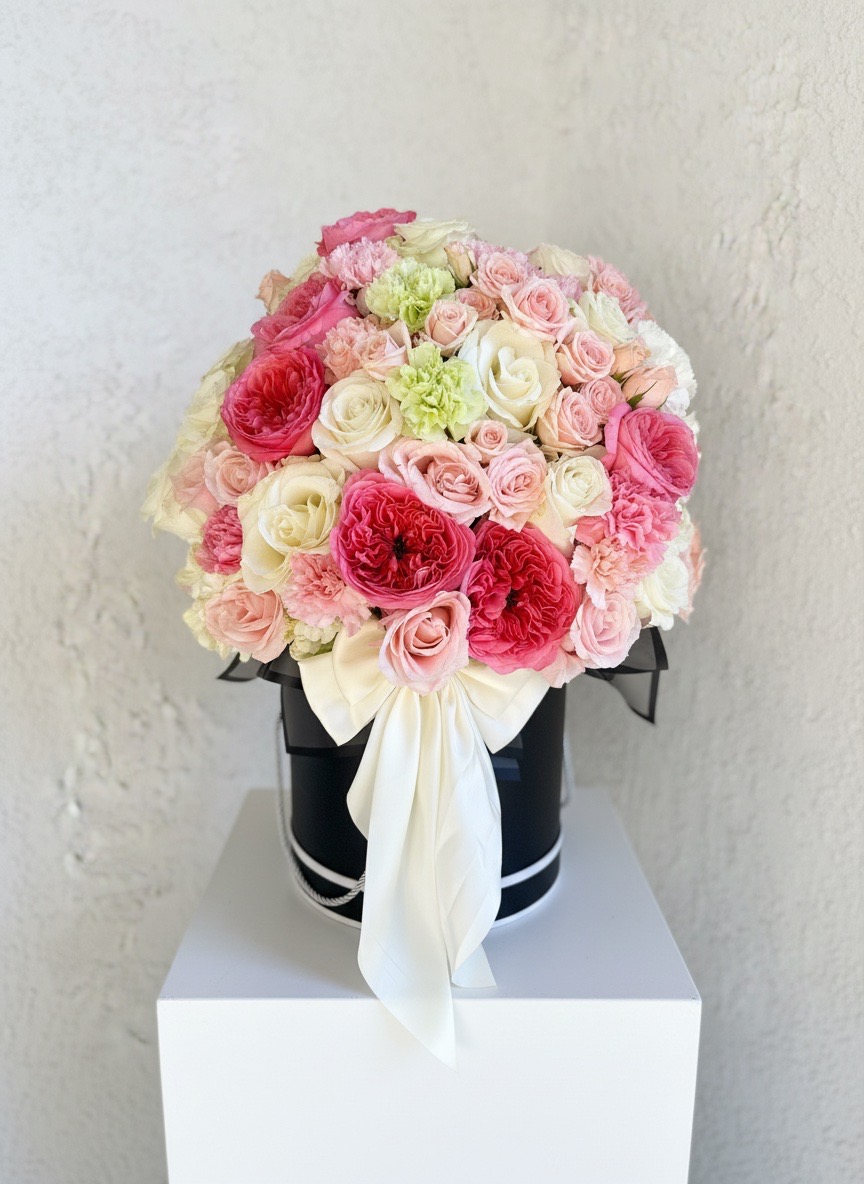
The round bouquet — sometimes called the posy bouquet when scaled down — is the form most people picture when they hear the words wedding flowers. Garden roses, peony, ranunculus set in a tight dome, stems cut to one length, the silhouette finished at a hard edge. It became the default sometime in the mid-twentieth century because it photographs cleanly and travels well, not because it is the easiest form to execute.
The discipline is in the edge. A round bouquet with an uneven perimeter looks unfinished no matter how fine the material inside it. We count stems the way a tailor counts stitches — a dome built from Vendela roses needs a different stem count than one built from lisianthus, because the two materials carry different weight and open at different rates over the four hours between pinning and the last dance.
The mistake we see most often, arriving as fixes from other studios, is overfilling. A round bouquet with too many stems loses its line; the eleventh stem does not make it fuller, it makes it formless. The better approach is a fixed stem count agreed on at the design consultation, with negative space built in rather than discovered by accident.
For clients working through palette before shape, our guide to timeless floral composition is a useful companion to this section — shape and color are decided together, not in sequence.
The Cascade and Its Garden Lineage
The cascade bouquet traces to the trailing garden arrangements carried at European court weddings in the nineteenth century, when the goal was abundance that moved with the body rather than sat still in the hand. Ivy, jasmine, and trailing amaranthus were chosen for their willingness to fall rather than hold a shape — the opposite instinct from the round bouquet's discipline.
A cascade is unforgiving of indecision. It requires a frame — often a hidden armature of wire and floral foam substitute — built to carry the visual weight downward without the lower stems snapping under their own weight by hour three. Clematis and sweet pea do this well; dense, heavy-headed garden roses generally do not, unless wired individually, which adds hours of bench time most clients never see.
We reserve cascades for gowns with a defined waist and a long line below it — a cathedral train, a mermaid silhouette — because the bouquet is meant to extend the garment, not compete with its volume. On a ball gown, the same cascade reads as clutter. This is the etiquette underneath the form: the bouquet answers the dress, not the trend board.
The cascade also carries the heaviest heritage weight of any form on this list, which is reason enough to ask, before choosing one, whether the silhouette will still read as intentional in photographs taken thirty years from now.
The Posy and the Nosegay — the Smallest Forms Carry the Most History
Before the round bouquet took its modern shape, there was the nosegay — a small, tightly packed cluster of herbs and flowers carried as much for scent as for appearance, a holdover from centuries when streets smelled of very little that was pleasant. Lavender, rosemary, and scented geranium were common inclusions, chosen for function before they were chosen for beauty.
The posy is the nosegay's quieter descendant: small, hand-held, usually no wider than the span of two palms. It remains the correct choice for a flower girl, for a bridesmaid standing beside a bride carrying something larger, or for a bride who wants a bouquet that does not become the main subject of her own photographs.
What the posy demands, more than any other form, is restraint in material choice. A posy built from five varieties looks busy at a scale where three or four would look composed. Dusty miller and a single garden rose variety — Mondial for its structure, Quicksand for its warmth — will outperform a posy crowded with half a dozen competing textures.
There is a case for the posy beyond its size: it is the form most likely to survive preservation, pressed or dried, because its density holds shape as it loses moisture. A larger bouquet collapses on drying in ways a tight posy does not, which is part of why it remains a quiet favorite among clients thinking about what outlasts the day.
The Hand-Tied Bouquet — What the Atelier Actually Does
The hand-tied bouquet is built the way the name suggests: stems spiraled by hand at a single binding point, then cut to a clean line, with no mechanical frame hidden inside. It is the form that most honestly shows the florist's hand, because there is no foam or wire to disguise an uneven spiral.
On the bench, a hand-tied bouquet starts with the focal material — peony, garden rose, ranunculus — placed first to establish the center, then built outward in a rotating spiral with each stem crossing the last at the same angle. Eucalyptus and other textural green go in last, not first, because green placed early crowds the spiral before the focal flowers have room to sit.
A well-built spiral allows the bouquet to stand upright in a vase of water the morning after the wedding, unaltered, which is the real test of whether the binding was done correctly. If a hand-tied bouquet collapses sideways overnight, the spiral was wrong, not the flowers.
This is the form we return to most often for clients who want evidence of craft rather than evidence of scale. Readers curious about the bench work itself may find our piece on curated floral arrangements useful background before a design consultation.
The Crescent and the Pageant Bouquet — Architecture Over Abundance
The crescent bouquet, built along a horizontal or arcing line rather than a dome, is the least forgiving form on this list and the one most often attempted without the structural knowledge it requires. It asks for asymmetry that still reads as balanced — a visual trick achieved by weighting one end with denser material and letting the other taper to a single stem of clematis or sweet pea.
The pageant bouquet, carried low in both arms rather than at the waist, is the formal cousin of the crescent — long-stemmed, architectural, closer to a presentation arrangement than a hand-held one. It belongs to a narrower set of occasions: a cathedral ceremony, a formal processional, a bride whose gown has enough structure in the bodice to anchor a bouquet carried low rather than close to the body.
Both forms fail for the same reason when they fail: insufficient stem support. A crescent built on soft stems droops into a formless question mark within an hour. We reinforce the understem with waterproof tape and, for anything longer than sixteen inches of visual span, a discreet interior wire structure that the eye never registers in photographs.
These are not forms we recommend for a first conversation about flowers. They are a second or third choice, arrived at once a client already has clarity on silhouette, gown structure, and how she actually intends to carry something for six consecutive hours.
Matching Form to Occasion
Etiquette earns its name here: certain forms carry social information whether or not a guest could name the rule. A round bouquet signals a contemporary, photograph-forward wedding. A cascade signals formality and scale — appropriate for a cathedral, overstated for a backyard ceremony of forty guests. A posy signals restraint, often chosen by brides having a second wedding or a more private ceremony.
The same logic extends past weddings into the corporate and gala work we do throughout the year. A gala centerpiece echoing a cascade's trailing line reads as formal from across a ballroom; the same gathering staged as a seated dinner for sixty benefits more from compact, round forms that do not block sightlines across the table. Context decides the form before taste does.
Clients planning events beyond the ceremony itself — anniversaries, landmark dinners, award galas — often find the clearest answers in our broader piece on floral design beyond weddings, where the same form logic applies to a different guest list.
The Materials That Hold a Form — and the Ones That Don't
Not every flower is suited to every form, regardless of how the color story is working. Garden roses in the Mondial and Vendela varieties hold their shape under the structural demands of a round bouquet because their petal count gives the dome density without excess weight. Peony, by contrast, is glorious for two days and then opens past the point a tight dome can hold — a fact every bride planning a late-June wedding should hear from her florist directly, not discover at the altar.
Lisianthus behaves closer to a rose than its price suggests, which makes it a dependable substitute when budget constraints meet a round-bouquet brief. Dusty miller and eucalyptus carry structure rather than bloom, doing the quiet work of giving a hand-tied bouquet body between focal flowers without adding visual noise.
Heritage, for us, is not nostalgia. It is the argument for choosing material that behaves predictably under the specific stress of the form it is built into — four hours of body heat and movement for a bouquet, six hours of room temperature for a centerpiece, a humid August afternoon that no air conditioning reaches. The rose that keeps its shape through all of that is the one worth specifying by variety name, not just by color.
Our longer reflection on preservation and material choice, the atelier's art of impermanence, goes further into why some flowers are chosen precisely because of how they fade, not despite it.
Choosing the Right Traditional Bouquet Form for Your Wedding
Start with the dress, not the flowers. A fitted silhouette with visible back detail wants a bouquet that stays compact enough not to obscure the line a tailor spent months perfecting — a round bouquet or posy, generally, rather than a cascade that competes with the gown's own drama. A fuller skirt can carry more visual weight without looking crowded.
Second, be honest about how the day will actually move. A bride walking a long outdoor aisle into wind needs a bouquet with a secure, weighted base more than she needs trailing stems that catch in gusts. A ceremony in a narrow chapel with tight pews benefits from a form that reads clearly at a distance of forty feet rather than one built for close-up detail.
Third, set the material conversation before the shape conversation locks in. A client who wants peony and insists on a cascade needs to hear, plainly, that the two are in tension — not as a sales objection but as a scheduling one, since peony's bloom window runs roughly ten days a year, and the form built around it has to be engineered for that specific flower's limits.
We walk every client planning a ceremony in Lake Tahoe through this same three-part sequence at the first consultation, because the order matters more than the preferences do. Decide dress, then day, then flower — and the form tends to choose itself.
A Bouquet That Does Its Work Quietly
A bride does not need to know the word nosegay, or the difference between a crescent and a pageant bouquet, to carry one correctly. She needs a florist who asked the right questions before cutting a single stem — about the dress, the aisle, the hour, the particular rose variety that will still look composed by the time the cake is cut. Form, chosen well, disappears into the day instead of narrating it. That is the entire point of floral etiquette: not a set of rules to recite, but a set of decisions made early enough that no one has to think about them again.
Every form in this guide earns its place by solving a specific problem — the round bouquet's edge, the cascade's gravity, the posy's restraint, the hand-tied spiral's honesty, the crescent's architecture. None of them is more correct than another in the abstract. Each is correct only in relation to a dress, a venue, an hour of the day, and a client willing to decide those things before the flowers are chosen rather than after.
If there is one practical step worth taking before any other, it is this: bring the dress, or clear photographs of it, to the first flower consultation, before any shape is chosen from a mood board. The gown dictates the bouquet far more reliably than season or trend does, and a florist who asks to see it first is telling you something about how the rest of the work will go.
The rest is bench work — spiral angle, stem count, the hour a peony is cut relative to the hour it is carried down an aisle. None of it needs to be visible to the guests. It only needs to hold.
Considered
What is the most traditional bouquet shape for a wedding?
The round bouquet is the most common traditional form, built as a tight dome of evenly cut stems — often garden roses, peony, or ranunculus. It became standard in the mid-twentieth century because it photographs cleanly and holds its shape through several hours of carrying, though cascade and hand-tied forms carry longer histories.
What is the difference between a posy and a nosegay?
A nosegay is the older term, originally referring to small clusters of herbs and scented flowers carried for fragrance rather than appearance. A posy is its modern descendant — small, hand-held, built mostly for visual restraint — commonly used for flower girls or bridesmaids standing beside a larger bridal bouquet.
When is a cascade bouquet appropriate?
Cascade bouquets suit formal, large-scale ceremonies — cathedral settings, long aisles, gowns with a defined waist and a train below it. The trailing form competes visually with fuller skirts or small, intimate ceremonies, where a round or posy bouquet reads as more appropriate.
How long does a hand-tied bouquet last without water?
A correctly spiraled hand-tied bouquet typically holds four to six hours out of water during a ceremony and reception before stems need re-cutting and water again. The spiral binding, not the flower variety alone, determines how well the structure holds through that window.
Can bouquet flowers be preserved after the wedding?
Dense, compact forms — posies and tightly built round bouquets — preserve more reliably through pressing or drying because their structure holds as moisture leaves. Looser, cascade-style bouquets tend to collapse during preservation, which is worth discussing with a florist before the wedding day.
What does floral etiquette actually mean?
Floral etiquette refers to the unwritten rules matching bouquet form to occasion, gown, and venue — not manners in the social sense. A cascade signals formality, a posy signals restraint, and choosing the wrong one for the setting reads as a mismatch even to guests who could not name the rule.