Atelier Floral Composition: A Step-by-Step Guide for High-Occasion Events
The call came in at 6:14 in the morning, the day of a 300-guest wedding. The coordinator's voice had the particular flatness of someone who has already decided the day is ruined: the garden roses hadn't opened. They sat in their buckets, tight and green at the collar, exactly as they'd been cut four days earlier outside Cayambe. The bride's mother wanted to know what we were going to do about it.
28 min read · Les Fleur Company
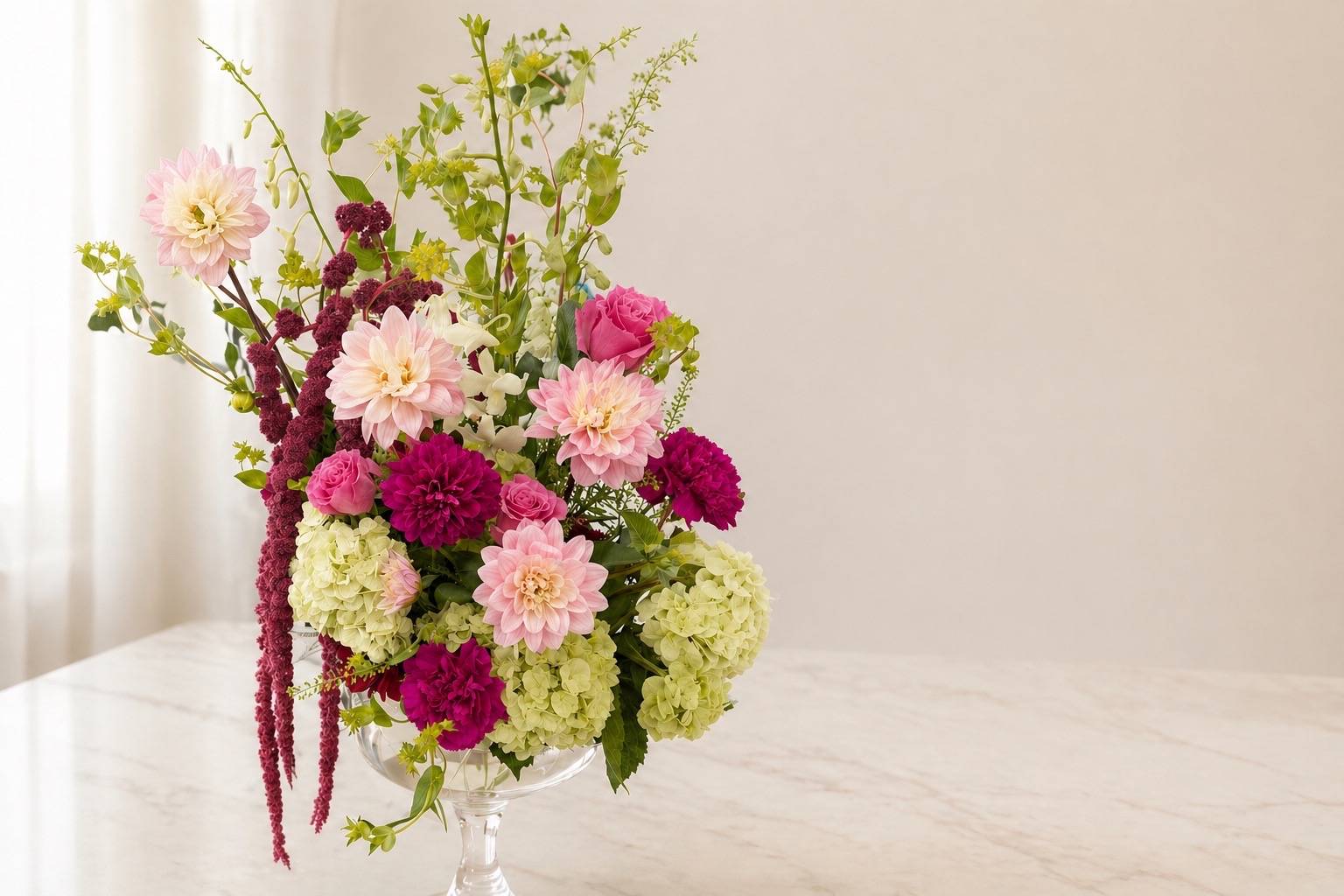
Composition Before the First Cut
Every arrangement gets designed twice: once on paper, once with the flowers. The paper draft is where the discipline lives. We sketch the silhouette — the outer line the arrangement will hold against the room — before a single stem enters the studio. This is where floral composition is decided, and it has almost nothing to do with which flowers are available that week.
The sketch answers three questions. What is the shape against the wall or the tablescape — round, cascading, asymmetric? Where does negative space sit, and how much of it? And what is the fixed stem count for the largest cluster in the piece? We hold to eleven stems as a hard ceiling for a focal cluster on a standard centerpiece. The eleventh stem is where an arrangement stops reading as composed and starts reading as full — a different, lesser thing.
Clients sometimes ask why we won't simply add more when a table looks sparse from across the room. The answer is that scale is solved with height and negative space, not stem count. A 24-inch arrangement with six stems and disciplined line reads larger across a ballroom than a 24-inch arrangement stuffed with eighteen. We've tested this against actual room photographs from past events enough times that it isn't a house opinion anymore — it's a working rule.
Inside the Atelier Process
A standard wedding order moves through five stages, each with its own calendar slot. Consultation happens eight to twelve weeks before the event for most clients; for weddings requiring 40 or more arrangements, we ask for four to six months to secure allocation from growers.
After consultation comes the mechanics build — the structural layer of chicken wire, floral frogs, and water tubes assembled the day before install, with no flowers involved. This is the stage most home florists and even some retail shops skip, and it is the single largest predictor of whether an arrangement holds its shape through a six-hour reception or collapses by hour three.
Flower day follows: stems arrive, get processed — stripped, cut at an angle, conditioned in solution for a minimum of four hours — and sorted by role in the composition, not by variety. Install day is the compression point, usually four to eight hours depending on venue count and access windows. We staff one designer per six to eight arrangements on install day; fewer than that, and quality drops in the final third of the order as fatigue sets in.
The process resists shortcuts. A studio that skips mechanics day to save labor cost will lose more in on-site repair time than it saved.
Sourcing on a Clock
Cut flowers operate on a hard biological clock, and an atelier's sourcing calendar is built entirely around it. Garden roses and peony are cut in the field at a specific bud stage — tight, with the outer guard petals just beginning to loosen — and from that cut, we work with a 72-hour window to get them into conditioning solution and opening on schedule for the event.
Miss that window and the flower either arrives too tight to open in time, as happened with the Cayambe roses, or opens too early and shatters before the ceremony. Neither failure is visible on the order sheet. It shows up on the morning of the event, which is why studios that source well build in a buffer day whenever the calendar allows it.
We source through three channels, in order of preference: direct farm relationships for garden roses (Mondial, Vendela, Quicksand are the three we return to most for their vase life and color consistency), wholesale auction for filler and foliage — lisianthus, dusty miller, eucalyptus — and local growers within a 200-mile radius for anything with a shorter shelf life, particularly clematis and lavender, both of which punish long transit.
Postharvest handling research from Cornell's floriculture program backs what the bench already knows: hydration solution and cool storage in the first hours after cutting matter more to final vase life than any variety selection. A rose handled well outperforms a better variety handled carelessly, every time.
Building the Silhouette
Once material arrives, it gets built in a fixed sequence: structure, focal, filler, movement. Skipping the order — reaching for the prettiest stem first, which is the most common mistake we see in florists trained outside a studio system — produces an arrangement that looks assembled rather than composed.
Structure goes in first: the woody, line-driven stems (eucalyptus, flowering branches, sometimes clematis vine) that define the outer silhouette and give later stems something to be placed against. Nothing about structure needs to be beautiful on its own. Its job is architecture.
Focal comes second, placed at the points the eye will land first — usually the lower third and one upper accent, never centered, never symmetrical. This is where the garden roses and peony do their work, and it is the only stage where we count stems against the eleven-stem ceiling.
Filler — lisianthus, dusty miller, smaller garden roses like Mondial — fills the gaps structure and focal leave open, but only the gaps that need filling. An arrangement with no visible negative space has usually had filler added past the point it was needed. Movement is the final pass: two or three stems placed off-axis, breaking the arrangement's symmetry just enough to keep it from reading as static. This stage takes ninety seconds, maybe less, and it is the difference clients feel without being able to name.
Working the Materials by Name
Every material earns its place by a specific property, not by trend. Garden roses carry the weight of most high-occasion work — Mondial for its density and deep burgundy edge, Vendela for its ivory consistency under any lighting condition, Quicksand for the warm taupe tone that reads well against both blush and deep florals. Each opens on a different timeline, which is why mixed-variety orders need staggered arrival dates, not a single delivery.
Lisianthus does the work roses can't: a ruffled, papery texture that softens a focal cluster without competing with it. Peony, when in season, is the single most schedule-sensitive stem we work with — a 48-hour window, tighter than roses, between right and wrong.
Structural and textural material carries as much design weight as the blooms. Eucalyptus (silver dollar and seeded, depending on the line we're building) provides the greenery that holds scent and shape longest. Dusty miller adds a soft gray that makes every warm tone next to it read warmer. Lavender, used sparingly and usually in late-summer work, does double duty as both filler and fragrance — but it dries fast out of water and needs placement near the arrangement's edge, not buried in its center. Clematis vine is the one material we treat as a luxury of timing: gorgeous when fresh, unusable after 36 hours out of solution, so it's the last thing cut and the first thing placed.
Heritage — Building an Arrangement That Holds
A wedding arrangement has two lives: the six hours it's photographed and the years after, when someone remembers it. Heritage-minded composition designs for both. We choose garden rose varieties partly on how they age through an event — Vendela, for instance, holds its ivory tone without browning at the petal edge longer than most commercially available whites, which matters for a reception that runs past midnight.
This is also where preservation enters the conversation. Clients increasingly ask about pressing or freeze-drying the bridal bouquet after the event, and the varieties that press and dry well are not always the ones that photograph best fresh. Garden roses with fuller petal counts (Mondial again) hold shape through drying better than looser, single-layer blooms. We flag this at consultation, not after the wedding, because the flowers destined for preservation sometimes need to be set aside — cut fresh, handled separately — before the reception even begins.
Heritage in atelier work is less about any single flower and more about the discipline of choosing material that will still make sense a decade later, in a photograph, in a shadow box on a wall, in a story told at an anniversary dinner. The rose that keeps is rarely the showiest one on the truck. It's the one bred and conditioned to hold its structure past the day it was cut for.
Occasion Logistics — Timelines for High-Occasion Events
A 300-guest wedding with 40 arrangements runs on a three-day calendar, and every studio that has tried to compress it into two has learned why that's a mistake. Day one is mechanics — chicken wire, frogs, tubes, containers staged by table number. Day two is flower processing and the bulk of the build, typically eight to ten working hours split across two or three designers. Day three is install: final touches, on-site adjustments for lighting and table spacing, and a walk-through with the coordinator roughly ninety minutes before doors open.
Smaller events — a 40-person dinner, a holiday gathering — compress this to a single build day, but the sequence stays the same; mechanics still happen first, even if it's an hour rather than a day.
The mistake we see most often from clients booking outside an atelier system is treating flowers like a same-day service, the way a caterer might handle appetizers. Flowers need lead time baked into three separate places: sourcing (the farm cut), conditioning (four-plus hours minimum), and build (never rushed on install day). A studio that says yes to a booking made 72 hours out is either working with severely limited material or setting the client up for a compromised composition. The Society of American Florists' guidance to member studios reflects the same standard the trade has held for decades — lead time is not a courtesy, it's a structural requirement of the material.
The Business Behind the Bench
Clients see the finished arrangement. What they don't see is the cost structure underneath it, and studios that don't understand their own numbers eventually price themselves into trouble. On a standard wedding centerpiece running $180–$240 retail, stems typically account for 30–35% of that price. Labor — mechanics, conditioning, build, install, and strike — runs closer to 40%. The remainder covers container, delivery, and studio overhead.
Underpricing almost always happens in the labor line, not the flower line. A new studio owner will quote competitively on rose cost per stem and forget to count the ninety minutes of mechanics work, the four hours of conditioning, or the strike-and-return trip after the reception ends. Multiply that miscalculation across 40 centerpieces and an installation, and a studio can lose money on a wedding that looked profitable on the invoice.
A short list of what we track on every high-occasion order:
None of this shows up in the photograph. It's the arithmetic that lets the studio still be composing arrangements ten years from now, for the next room that needs one.
Considered
What is floral composition in wedding design?
Floral composition is the structural discipline of arranging flowers — how stems are placed for silhouette, negative space, and balance, rather than simply gathered by color or volume. It borrows from painting and sculpture: line, mass, and the space left empty do as much work as the flowers themselves.
How far in advance should I book an atelier florist for my wedding?
Most ateliers book eight to twelve weeks out for standard events, though weekends in peak months (April through October) often fill six to nine months ahead. High-stem-count weddings — 40 or more arrangements — need the longer runway to secure garden roses and peony from farm allocation.
Why do florists limit the number of stems in an arrangement?
A fixed stem count keeps the silhouette legible. Once a cluster passes ten or eleven stems, the eye stops reading individual lines and sees only mass — the arrangement loses its shape and starts to look decorated rather than composed. Restraint is a design choice, not a cost-saving one.
How long do fresh flower arrangements last for events?
Properly conditioned garden roses, lisianthus, and eucalyptus hold for three to five days at room temperature once installed. For a wedding, arrangements built the morning of an evening ceremony typically hold their form through the following day if kept out of direct heat.
What is the difference between a florist and a floral atelier?
A floral atelier operates as a studio practice — one composition built at a time, with fixed process, sourcing relationships, and design discipline — rather than a retail shop filling standing orders. The distinction shows in the consultation, the sourcing window, and the refusal to overfill an arrangement.