Crafting Timeless Floral Arrangements: The Art of Composition for Luxury Weddings
A bride once brought in a photograph of her mother's wedding centerpiece from 1994 and asked if we could make something like it, only current. The arrangement in the photograph held maybe fourteen stems. Garden roses, a little dusty miller, nothing else fighting for the eye. Twenty-nine years on, it still looked composed. Beside it on her inspiration board sat six arrangements from the past two wedding seasons, dense with novelty blooms and unnecessary texture, and every one of them already looked dated. That is the argument for composition in a single comparison. Volume ages. Restraint does not.
33 min read · Les Fleur Company
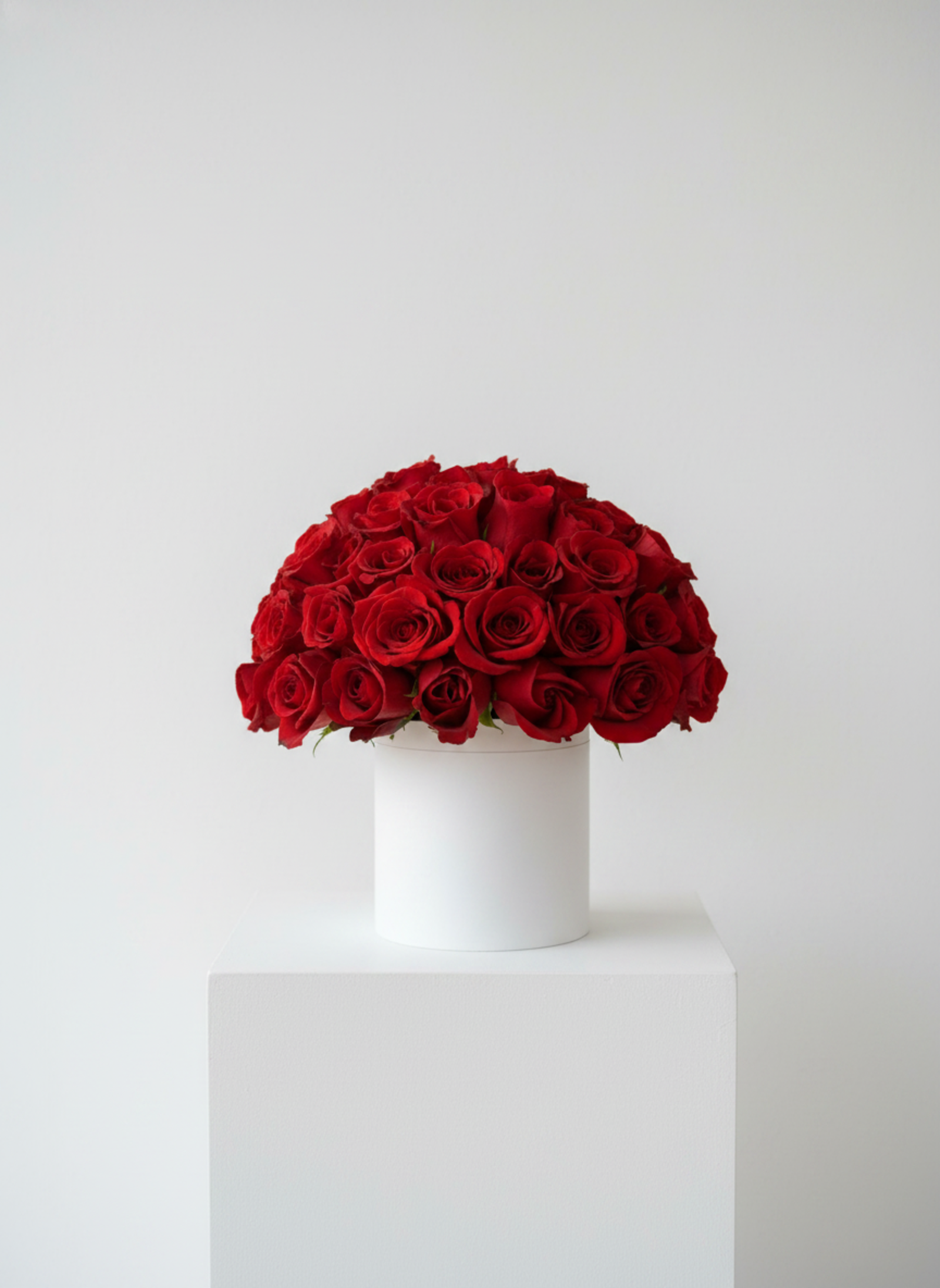
What Composition Actually Means in Floral Design
Composition is the set of decisions made before a single stem is cut: proportion, line, and the ratio between structure and bloom. It is closer to architecture than to arranging. A centerpiece is not a container filled with flowers in sequence. It is a silhouette decided in advance, then built toward.
At the bench, this means sketching the shape first — the outer line the arrangement will hold — and only then selecting which stems fill which part of that line. Foliage and structural stems like eucalyptus or clematis vine establish the frame. Focal blooms, most often garden roses, occupy specific points inside it rather than filling every gap.
A working ratio we hold to: roughly three parts structural material to two parts focal bloom, by stem count, not by volume. A 15-stem centerpiece might run nine stems of foliage, filler, and line work against six focal blooms. That ratio is what keeps an arrangement from reading as a mass of flowers rather than a composed shape.
Composition also governs viewing distance. A bridal bouquet is seen at arm's length and in close photography, so its composition tolerates more density. A reception centerpiece is seen from six feet across a table, so its silhouette needs to read clearly at that distance, with negative space doing real work. Treating both the same is one of the more common errors in luxury floral work — scaling a bouquet's density up to a centerpiece and wondering why it reads as cluttered.
The Discipline of Restraint: Why the Eleventh Stem Ruins the Composition
Every arrangement has a point past which additional stems stop adding and start subtracting. We call it the eleventh stem, though the number moves with scale. It is the stem added not because the composition needs it, but because someone in the room is nervous that ten looks unfinished.
The nervousness is understandable. A centerpiece with visible gaps between stems looks, to an untrained eye, like something has gone wrong. But those gaps are the negative space carrying the silhouette. Fill them and the silhouette disappears into a solid mass, and a solid mass has no line for the eye to follow.
In practice, restraint is enforced with a rule at the bench: once the silhouette is built and the focal points are set, no stem goes in without removing consideration of one already placed. This forces every addition to be a trade, not a bonus. Most arrangements that feel overworked got there because stems were added without that trade ever being asked.
We have pulled stems from finished bridal-party arrangements more times than we have added them. A bouquet built at 22 stems that reads as busy will often improve, not diminish, at 16. The difference is rarely visible to a couple until they see both side by side — at which point it is obvious which one holds the eye and which one scatters it.
Silhouette First: Building the Frame Before the Flowers
Every arrangement begins as a shape, not a flower list. Before any stems are cut, we decide whether the piece will be a low, horizontal line for a long reception table, an asymmetric cascade for a bridal bouquet, or a tight, rounded dome for a ceremony urn. That decision comes from the room and the occasion, not from what happens to be available that week.
The frame is built first, using structural stems — eucalyptus, olive branch, clematis vine, or a stripped foliage line — placed to establish the outer edge of the silhouette. Only once that frame holds its shape do focal blooms go in, each one placed to a specific point along or inside that line rather than distributed evenly.
This ordering matters because it is reversible in only one direction. A silhouette built first can absorb focal blooms placed with intention. Focal blooms placed first, with structure added around them afterward, tend to fight the eventual frame, and the arrangement is reworked more than it should be. Ordering the process wrong costs 20 to 30 minutes of correction on a single centerpiece — multiplied across sixteen tables, that is real labor lost to a process error, not a material one.
Negative Space as a Material
Negative space is treated at the bench the same way a stem is treated — as a material decision, chosen deliberately rather than left as whatever gap remains. The space between a garden rose and the clematis beside it is doing work: it separates the two so each reads individually, rather than blurring into a single mass of color.
Couples occasionally ask for arrangements to be filled in, worried that gaps will look sparse in photographs. The opposite is usually true. Photographed at close range, a fully filled arrangement compresses into a flat wall of color with no depth. An arrangement with intentional space between key stems photographs with dimension — light falls between the stems, and the eye can trace a path through the piece rather than stopping at its surface.
This is easiest to see in a low centerpiece built for a long table. A composed piece might occupy 60 percent of its visual footprint with material and leave 40 percent as space around and beneath the structure — low enough that guests can still see across the table, with the negative space reinforcing rather than undermining that sightline. A dense, filled version of the same brief blocks conversation across the table and reads as an obstacle rather than a composition.
Choosing Varieties That Hold: Garden Roses, Lisianthus, and the Rest
Material selection for a wedding is a durability decision as much as an aesthetic one. A ceremony arrangement seen for twenty minutes has different requirements than a reception centerpiece that needs to hold its form for six to eight hours under warm light and repeated handling.
Garden rose varieties are not interchangeable. Mondial holds a dense, full bloom and tends to open slowly, which makes it reliable for arrangements built two to three days ahead. Vendela runs a soft ivory-blush and holds its outer petals well under travel. Quicksand shifts in tone as it opens, from deeper apricot toward a paler blush, which we account for when timing the build relative to the ceremony hour. Lisianthus, by contrast, is chosen for arrangements needing a lighter, more layered petal structure without the weight of a full rose head.
Some varieties are simply not built for a twelve-hour wedding day. Peony is extraordinary in the first four hours and unreliable after that, particularly in a warm room — beautiful for photographs taken early, a liability for anything photographed at the end of the reception. Dahlia shares this limitation. Where a couple wants that fuller, softer look across an entire event, we substitute garden roses bred for density, such as Mondial, and reserve peony for arrangements with a defined, early viewing window.
A shortlist we return to for reliability across a full wedding day:
The Atelier Process: From Sketch to Stem
Composed work does not begin at the flower market. It begins at a table with paper, a proportion sketch, and a stem count decided before sourcing starts. For a full wedding order, that sketch phase typically runs four to six hours across the bridal party pieces, ceremony structures, and reception centerpieces, done two to three weeks ahead of the event.
Sourcing follows the sketch, not the reverse. Once proportions and stem counts are set, we order specific varieties in specific quantities, usually five to seven days ahead for garden roses arriving from growers who need lead time to cut at the right stage of bloom. Ordering without a finished sketch tends to produce arrangements built around whatever arrived, which is how compositions drift into being decided by inventory rather than intention.
Conditioning takes place over 24 to 48 hours before the build: stems recut at an angle, hydrated in cool water, stripped of foliage that would sit below the waterline. This step is invisible in the finished piece and is also the difference between a garden rose that holds through a reception and one that droops by the toast.
The build itself, for a full bridal-party order of eight to ten pieces plus a reception count of sixteen centerpieces, runs a two-person team roughly ten to twelve hours across two days. That labor is the actual cost being priced — the sketch, the sourcing discipline, the conditioning, and the bench time — not the wholesale cost of the stems themselves.
Color and Texture Without Noise
A restrained palette does more work than a wide one. Most compositions we build hold to two or three tonal families — a blush and ivory range built around garden roses, deepened with one darker foliage note such as dusty miller or olive, and lifted with a single unexpected texture like lavender or a trailing clematis vine.
The temptation in luxury wedding work is to add a fourth or fifth tonal family to signal range — a jewel tone here, a pastel accent there. Almost without exception, this reads as competing rather than layered. The eye cannot hold more than two or three color relationships at once inside a single arrangement seen at table distance, and a fourth family usually just muddies the first three.
Texture follows the same restraint. One structural texture (clematis vine, or a bare branch line), one soft textural note (lisianthus or garden rose petal), and one muted foil (dusty miller, eucalyptus) is enough to read as considered. Adding a fourth textural element — dried grasses, an unusual pod, a novelty bloom — tends to read as a flourish rather than a decision, and flourishes are the first thing that dates a wedding's florals when the photographs are looked at five years later.
Common Composition Mistakes at Weddings — and the Fix
The most common error is scaling density up with venue size, on the assumption that a larger room needs a denser arrangement. It needs a taller or wider silhouette, built with the same ratio of structure to bloom, not more stems packed into the same shape. A ballroom centerpiece should gain height and line, not mass.
A second common error is choosing focal blooms for the inspiration photograph rather than for the wedding's actual timeline. A couple who fell in love with a peony-heavy arrangement photographed at 10 a.m. often does not realize that same arrangement, built for a 6 p.m. reception, will have shattered by the first course. The fix is substitution early in planning — Mondial or Vendela garden roses in place of peony, keeping the color story intact while gaining eight to ten hours of durability.
A third error is symmetry treated as a default rather than a decision. Perfectly symmetrical arrangements can read as static, particularly in bridal bouquets, where an asymmetric line — heavier on one side, trailing on the other — reads as more considered and moves better in photographs than a mirrored dome shape.
A fourth, quieter error: matching every arrangement in the wedding to the same formula. A ceremony structure, bridal bouquet, and reception centerpiece serve different functions and different viewing distances, and treating them identically flattens the day's visual rhythm. Each should share a palette and material language without being a repeated shape.
What Timeless Actually Costs
Couples comparing quotes are often comparing stem count without realizing that is not what they are paying for. A restrained arrangement built from 15 to 18 well-sourced stems, with six to eight hours of design labor behind it, can cost more than a market-mix arrangement three times its density, because the labor and sourcing discipline sit in the composition, not the volume.
For context, a full-service floral order for a wedding of 120 guests — bridal party flowers, a ceremony structure, and sixteen reception centerpieces — typically runs a total of 60 to 90 hours of combined sketch, sourcing, conditioning, and build labor across a studio team. Priced hourly against material cost, the labor share of that invoice is frequently 45 to 55 percent, higher than most couples expect walking in.
Booking timeline affects both cost and composition. A studio taking three to four weddings per weekend during peak season needs 9 to 12 months of lead time to secure the specific garden rose varieties a composition calls for, rather than substituting whatever the market carries that week. Rush bookings inside six weeks often mean the sketch phase and sourcing phase compress into the same week, and composition is the first thing to suffer when that happens.
A Quiet Observation
The centerpiece from 1994 that started this piece was never trying to be noticed. It held its shape, did its work at the table, and let the room happen around it. That is still the measure. An arrangement that asks to be admired rarely survives the season it was built for. One that simply holds its composition tends to outlast the wedding, the decade, and the trend that was fashionable the year it was made.
Considered
What makes a floral arrangement look timeless instead of trendy?
Restraint. Arrangements that age well in photographs favor a disciplined silhouette, a limited palette, and negative space over saturation. Trend-driven work leans on volume and novelty varieties, which read as dated within a few seasons. A well-composed arrangement of ten stems will outlast one built from forty.
How many flowers should be in a bridal bouquet for a wedding?
Most considered bridal bouquets hold between 12 and 20 stems, depending on scale and variety. A bouquet built around larger focal blooms like garden roses needs fewer stems than one built around smaller lisianthus or ranunculus. Stem count is a design decision, not a value signal.
What flowers hold up best for an all-day wedding?
Garden rose varieties such as Mondial and Vendela, along with lisianthus and clematis, hold their structure for 10 to 14 hours out of water when properly conditioned. Softer blooms like peony and dahlia are best reserved for arrangements photographed early, before petal drop sets in.
How far in advance should a couple book a floral atelier for a wedding?
For a considered, made-to-order design, 9 to 12 months ahead is standard, particularly for peak months of May through October when a single studio can only take on 3 to 4 weddings per weekend. Rush bookings inside 6 weeks limit variety availability and often mean substitutions.
Why do some florists charge more for fewer flowers?
The cost sits in the hand labor and sourcing, not the stem count. A restrained arrangement of premium garden roses and clematis can take longer to design and condition than a full, market-mix arrangement three times its size, because the composition has fewer places to hide an imperfect stem.
What is negative space in floral design?
Negative space is the visible gap between stems and blooms that the eye reads as intentional rather than empty. It is used to define silhouette, direct the gaze toward a focal cluster, and keep an arrangement from reading as dense or overworked, especially in bridal work photographed at close range.