Bespoke Floral Compositions for Intimate Weddings
A bride once asked why her forty-guest wedding needed more design meetings than her sister's two-hundred-person reception three years earlier. The answer is close range. At a large wedding, a centerpiece is glanced at from across a table of ten, softened by candlelight and distance. At an intimate wedding, that same arrangement sits eighteen inches from a guest's elbow for three hours. Every stem is available for inspection. There is no crowd noise to hide a composition that is trying too hard.
32 min read · Les Fleur Company
Why Intimate Weddings Demand More Discipline, Not Less
The instinct with a smaller guest count is to assume the flower budget stretches further. It rarely works that way. Fewer arrangements mean each one carries more weight — there is no third centerpiece to distract from a lopsided second one. A single ceremony arch, one long table runner, a handful of bud vases: each piece is now doing the work that a dozen tables used to share.
We treat every intimate wedding as if it will be photographed in daylight, at close range, without retouching. That standard changes what gets approved at the design stage. A garden rose with a bruised outer petal that would disappear in a crowd gets pulled at an intimate table setting.
Clients planning under 75 guests should expect their florist to ask harder questions than a large-wedding client would hear — table height, chair spacing, how long guests will sit before the first course. These details determine mechanics choices invisible to anyone but the designer.
The Site Visit Comes Before the Sketch
No bespoke composition begins with a Pinterest board. It begins with a room. For venues across Lake Tahoe or San Francisco, light behaves differently by season and hour, and a composition designed without accounting for it will read flat or oversaturated on the day.
A proper site visit, six to eight weeks out, covers ceiling height, existing color in the room (wood tones, upholstery, stone), and the exact table count and shape. We measure. We photograph the light at the hour the ceremony will actually happen, not midday convenience.
Only after this visit does a mechanics sketch get drawn — a working diagram of stem angles, vessel heights, and negative space, not a mood board. This sketch becomes the reference the design team builds against during production week.
Skipping this step is the most common failure point in florals ordered from a catalog rather than an atelier: the arrangement may be beautiful in isolation and wrong for the room it lands in.
Composition: Silhouette, Negative Space, and the Eleventh Stem
Every arrangement has a point past which adding more ruins it. We call it the eleventh stem — the one added out of nervousness rather than necessity, the one that breaks a silhouette that was already resolved. Composition discipline means knowing where that line sits and stopping before it.
Negative space is not empty space. It is the visual rest that lets the eye register the shape of the arrangement rather than a mass of color. An intimate wedding centerpiece with too little negative space reads as crowded at close range in a way it never would from across a ballroom.
Our approach follows the same principles laid out in our guide to timeless floral composition: a defined silhouette, a focal cluster, supporting texture, negative space, and a finishing line — usually a trailing clematis vine or bare branch that keeps the eye moving rather than settling.
Material Selection: Garden Roses, Lisianthus, and the Case for Restraint
Not every beautiful flower survives a full wedding day. Intimate weddings, with their longer cocktail hours and unhurried dinners, put more hours of visible wear on every stem than a large reception where guests move through faster.
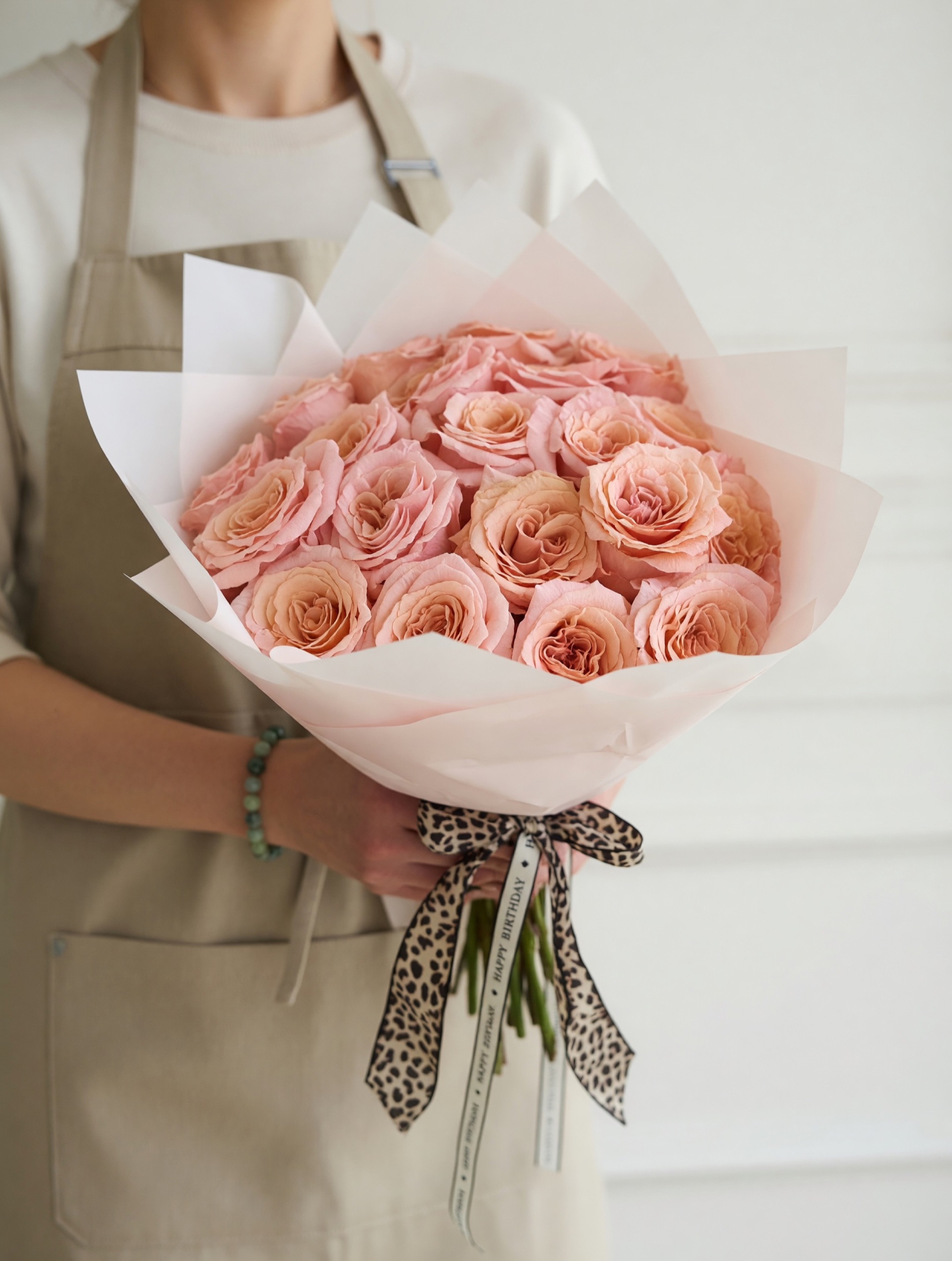
Garden rose varieties like Mondial and Vendela hold their form for eight to ten hours without excessive blowing open, which makes them dependable for arrangements guests will sit beside through an entire dinner. Quicksand, with its warm terracotta tone, has become a frequent request for autumn intimate weddings for the same reason — it ages toward deeper color rather than fading.
Lisianthus earns its place for a different reason: it reads as a rose to most guests but costs less and lasts considerably longer once cut, often five to seven days past the wedding date in the right conditions. Peony, by contrast, is a spring-only material with a narrower bloom window and should be positioned with backup stems on hand — we always order 15% over count for peony specifically.
Restraint in variety count matters as much as restraint in stem count. Three to four hero materials per arrangement, not eight, keeps a bespoke composition from reading as a flower market display.
The Atelier Process: From Sourcing to Staging
The work behind a finished arrangement is invisible by design, and that is the point of an atelier model. Sourcing for a bespoke intimate wedding typically begins five to six weeks out with grower calls — confirming specific rose varieties, checking bloom timing against the wedding date, and placing standing orders that account for weather delays.
Our full process, detailed in our behind-the-scenes guide to bespoke arrangements, moves through four stages: sourcing, conditioning, mechanics build, and staging. Conditioning alone — hydrating and trimming stems under controlled temperature — takes 24 to 48 hours before any arrangement is built.
Staging happens the day before or morning of the wedding, never earlier. Arrangements built too far in advance lose the crispness that close-range viewing demands. For a 40-guest wedding, our design team typically spends 30-35 labor hours across sourcing, conditioning, building, and installation — a number that surprises clients comparing quotes against wholesale-flower packages.
Color Palette and Seasonal Logic
A palette chosen without regard for season fights the room rather than complementing it. Lavender and dusty miller read as soft, cool notes suited to late spring; Quicksand and deep burgundy garden roses carry an autumn wedding without needing seasonal foliage to signal the time of year.
We build every palette around one dominant tone, one supporting tone, and one accent used sparingly — never in equal thirds, which flattens the composition. The principles behind this are covered at length in our piece on color theory in wedding floral composition.
Intimate weddings are more forgiving of monochrome palettes than large ones, since there is less visual field to fill and a tighter tonal range reads as intentional rather than sparse. A single-tone white and green palette — Vendela roses, eucalyptus, dusty miller — remains one of the most requested compositions for exactly this reason.
Scaling Without Losing Intimacy
Clients sometimes ask for a large-wedding statement piece — an oversized arch, a long floating installation — inside a fifty-guest room. Scale mismatches read immediately at close range; a piece built for a ballroom overwhelms a room meant to feel gathered rather than grand.
The better approach is repetition, not size. A bridal bouquet, boutonnieres, and a modest ceremony arrangement built from the same three to four materials create cohesion across the day without requiring any single piece to be oversized. Guests register the pattern even if they cannot name it.
Corporate and gala clients across our El Dorado Hills private events work face a similar calibration question — how to make a room feel considered without over-filling it — and the same restraint principle applies there as well.
Heritage: What Preserves and What Doesn't
Some clients ask which flowers can be preserved after the wedding — pressed, dried, or cast in resin as a keepsake. Garden roses and lisianthus dry well and hold color; peony and ranunculus, with their higher water content, tend to lose form and often brown at the edges.
Our approach to preservation is covered in our guide to crafting a timeless wedding bouquet legacy, which walks through which materials to specify at the design stage if preservation is a priority from the start — this decision has to be made before the bouquet is built, not after.
Heritage in floral work is not only about preservation after the fact. It is also about specifying materials sturdy enough to be photographed accurately years later, rather than blooms so delicate they read differently in every image taken across the day.
Budgeting for Bespoke Intimate Wedding Florals
Clients are often surprised that a 40-guest wedding's floral budget does not shrink proportionally from a 150-guest one. Labor, sourcing, and design time are largely fixed costs regardless of guest count — a bespoke ceremony arrangement takes nearly the same design hours whether 40 or 140 people will see it.
As a rough guide, expect 60-70% of an intimate wedding's floral budget to go toward the ceremony focal piece and reception centerpieces, with the remainder split across the bridal bouquet, boutonnieres, and incidental pieces like a welcome arrangement or bar display. Per the Knot's Real Weddings Study, florals and decor account for roughly 8-10% of total wedding spend nationally — a ratio that holds steady across guest counts.
A florist quoting well under this range for a bespoke intimate wedding is often substituting wholesale stems for the specific varieties requested, or compressing the labor hours that sourcing and conditioning actually require.
The Day-Of: Installation and the Work That Disappears
The best measure of a well-run intimate wedding florals is that no guest mentions the flowers directly. They mention that the room felt right — warm, unforced, gathered. That impression is the product of a great deal of invisible labor: a 5 a.m. delivery, a mechanics build tested the day before, a final walk-through checking sightlines from every seat.
Installation for an intimate wedding typically runs two to three hours, shorter than a large event, but the margin for adjustment is tighter — there is no back corner of the room to hide a piece that needs reworking. Every arrangement gets a final check at guest eye height, seated, not standing.
By the time guests arrive, the work is finished and should not need to be seen again. That is the standard an atelier model is built to meet — not a display that asks to be admired, but a room that simply feels complete.
Considered
What makes a floral composition 'bespoke' rather than just custom?
Custom usually means color and flower substitutions on a template. Bespoke means the arrangement is designed from a blank page for the specific room, table height, and guest count — mechanics, silhouette, and material list are built new, not adapted from a catalog piece.
How many guests count as an 'intimate' wedding for floral planning purposes?
Most florists treat 75 guests or fewer as intimate. Below that threshold, arrangements are viewed at close range for longer stretches, so composition flaws — an uneven silhouette, a stray stem — read more clearly than they would at a 250-guest reception.
How far in advance should I book a florist for an intimate wedding?
Eight to twelve weeks minimum, though peak season (May through October) often requires four to six months. Bespoke work involves sourcing specific garden rose or lisianthus varieties, which growers need lead time to guarantee.
Do intimate weddings actually cost less on flowers than large ones?
Not proportionally. A 40-guest wedding with three statement arrangements can cost more per guest than a 200-guest wedding with simple centerpieces, because labor and sourcing for a handful of exceptional pieces is concentrated rather than spread thin.
What flowers hold up best for close-viewing intimate wedding arrangements?
Garden roses such as Mondial and Quicksand, lisianthus, and clematis hold their form and color over a full event day. Avoid delicate, fast-blowing blooms for pieces guests will sit near for three or more hours.
Should I choose a smaller wedding florist or a large event floral company?
For intimate weddings, an atelier-model studio that limits the number of weddings it takes per weekend typically produces more considered work, since the lead designer is present for sourcing, mechanics, and installation rather than delegating to a rotating crew.