Atelier Couture Floral Arrangements
A mother of the bride once asked for fourteen arrangements down a sixty-foot table. Fourteen, she said, so no guest would sit without flowers near them. The florist she was speaking with proposed three — each nearly three feet tall, spaced to interrupt the table rather than crowd it. The mother resisted for a week. On the wedding day, the three arrangements were the only thing anyone photographed. This is the argument for atelier couture floral arrangements: not more, but composed — built through a process that treats each stem as a decision rather than an addition.
27 min read · Les Fleur Company
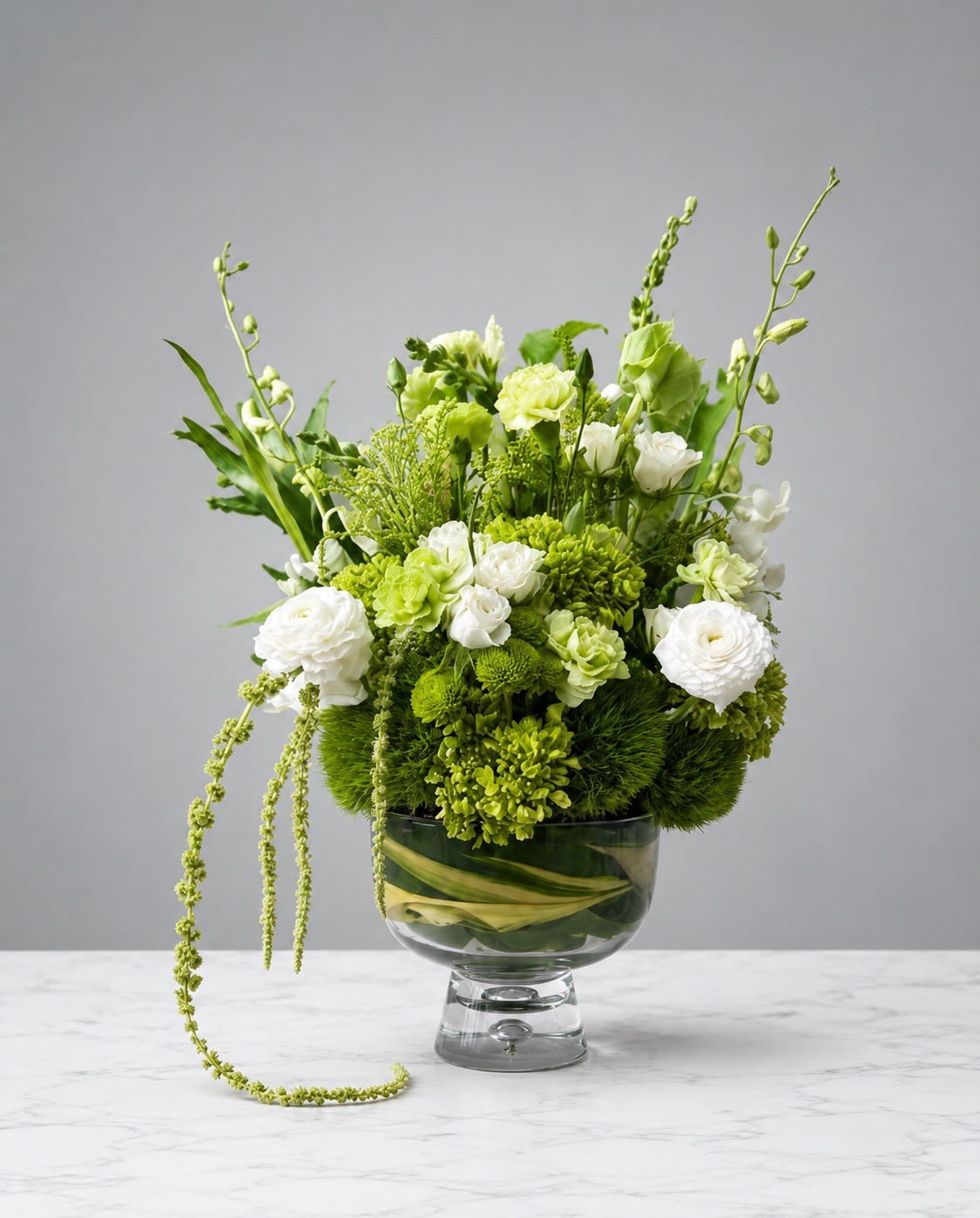
What Atelier Couture Means in Floral Design
The word atelier comes from French fashion houses, where it names the workroom behind the finished garment — the place where a coat is cut, fitted, and finished by hand before it ever reaches a client. Floral ateliers borrow the term deliberately. An atelier couture floral arrangement is not defined by its flower count or its price point. It is defined by process: a design plan made before a single stem is cut, material selected against that plan rather than pulled from stock, and a florist accountable for the piece from market to installation.
This distinguishes atelier work from volume floristry, where an order is filled to match a description using whatever inventory is on hand that morning. Volume floristry answers a request. Atelier floristry answers a room — its light, its architecture, the six hours a piece needs to hold its shape at a seated dinner.
The distinction matters most at scale. A gala with two hundred guests and a wedding with sixty both benefit from the same discipline: fewer, more deliberate pieces, chosen for what a space actually needs rather than what fills it.
The Sourcing Discipline: Where the Work Begins Before Dawn
Atelier work starts hours before a client sees anything, often before sunrise at a wholesale flower market. A florist working this way typically reviews two hundred to three hundred stems in a single sourcing trip and selects perhaps forty to sixty for a significant piece — a ratio that would read as waste in a retail shop and reads as method here.
The selection criteria are specific, not aesthetic guesswork. A garden rose gets checked for guard petal bruising and stem firmness. Lisianthus gets tested for how many blooms per stem are open versus still tight, since a florist wants a range across a single arrangement, not uniformity. Dusty miller and eucalyptus get assessed for how they will hold their gray-green cast under warm event lighting, which changes color rendering more than most clients expect.
A stem rejected at market is not a loss. It is the mechanism by which the arrangement stays composed rather than crowded. Florists who skip this step — who order by the box rather than by the stem — end up compensating for weak material with volume, which is how arrangements end up dense instead of deliberate.
Inside the Workroom: A Day at the Bench
The workroom itself is unglamorous by design. Buckets of conditioned stems, floral frogs and chicken wire in place of foam, a mechanics kit built around structure the client will never see. The physical layout of that space shapes the work more than most clients realize — a bench positioned for natural north light, a cooler close enough that stems never sit out of water for more than a few minutes. The atelier workspace itself is part of the discipline, not a backdrop to it.
A single significant arrangement — a large urn piece, a ceremony installation, a head table centerpiece built to anchor a sixty-foot table — commonly takes four to six hours of bench time. That figure does not include the market run, the conditioning, or the sample build most ateliers require before a client-facing consultation.
Smaller pieces move faster but rarely fast. A bridal bouquet built in this discipline still takes ninety minutes to two hours, because each stem is placed with the angle of the next one already decided. Volume work can produce the same bouquet in twenty minutes. The difference shows up in how the arrangement holds its shape eight hours later, not in how it looks the moment it leaves the workroom.
The Architecture of a Single Arrangement
Every atelier arrangement is built around a silhouette decided before cutting begins — a shape drawn in a consultation or sketched on a notecard, not improvised at the bench. That silhouette determines everything downstream: how tall the piece runs, how far it spreads, and where negative space is left deliberately empty rather than filled out of habit.
Negative space is the part of the discipline clients resist first and appreciate last. A florist working this way will often build to a point, step back, and stop — even when there is room, and material, for more. The reasoning is structural, not stylistic: an arrangement with ten well-placed stems reads as composed. The same arrangement with an eleventh stem added for fullness reads as busy. The eleventh stem does not improve the piece. It is the point where restraint becomes clutter, and it is the single most common mistake in floral work built for volume rather than composition.
This is covered at length in the five elements that hold a timeless composition together — proportion, focal hierarchy, and the discipline of knowing when a piece is finished.
Materials by Name: Reading a Stem List Like a Tailor Reads Fabric
Atelier florists work from named varieties, not generic categories, the same way a tailor specifies a fabric mill rather than saying "wool." A request for garden roses might resolve to Mondial for its dense, layered center, Vendela for a warmer ivory that photographs well against skin tones, or Quicksand for a dusty apricot that shifts color as it opens. Each choice changes how the finished arrangement reads under different lighting, and a florist who cannot name the variety usually cannot explain the choice either.
Clematis, peony, and lavender each carry their own handling requirements — peony in particular needs to be sourced at a specific bud stage to open on schedule for a wedding day rather than a day early or late. Eucalyptus and dusty miller do the structural work most clients never ask about: they hold the silhouette's edges and give the eye a place to rest between focal blooms.
Color decisions follow the same material-first logic rather than a mood board pulled from a search engine. A palette built around named varieties — how a specific rose ages, how a specific lisianthus fades — holds together in a way a color swatch cannot predict. This is the case made in the studio's approach to color theory in wedding composition.
The Client Consultation: Curating Before Cutting
The most consequential decisions in atelier work happen weeks before a stem is cut, in a consultation that functions less like ordering and more like a fitting. A florist working this way asks about the room's architecture, the light at the ceremony hour, the client's history with specific flowers — a grandmother's garden roses, a first-date lavender bouquet — before proposing a single material.
This is where curation actually happens. A client arrives with a Pinterest board of forty images; the florist's job is to identify the three or four elements those images share and build toward that throughline, rather than attempting to reproduce all forty. Clients who resist this narrowing at first are almost always the ones who thank the florist for it afterward, once the arrangement holds together instead of competing with itself.
Consistency across a full event — ceremony, cocktail hour, reception — depends on decisions made at this stage, not on matching every arrangement stem for stem. The goal is a shared vocabulary of material and form that reads as one event rather than three unrelated ones, a discipline covered in how atelier floristry carries consistency through a wedding.
Timeline and Logistics: What an Atelier Arrangement Actually Costs in Hours
Clients often ask why atelier pricing runs higher than a retail florist quote for what looks like a similar arrangement. The honest answer is hours, not flowers. A florist tracking her own time across a wedding season typically finds that market sourcing, conditioning, mechanics, build time, and installation add up to two to three times the hours a retail order requires for a comparable-looking piece.
A rough breakdown for a mid-size wedding: two hours at market selecting stems, one to two hours conditioning and stripping foliage, four to six hours building the largest pieces, one to two hours on secondary arrangements, and two to three hours of on-site installation and teardown logistics. That is twelve to fifteen hours of labor before counting design consultations, which run separately.
This is also why lead time matters more in atelier work than in retail floristry. Most studios ask for nine to twelve months' notice on a wedding date, since sourcing plans and sample builds happen well ahead of the event — not the two-to-three-week window a standard order can accommodate. Clients planning events in cities like San Francisco or Lake Tahoe should factor this timeline in before locking a date, particularly for peak spring and early fall weekends when studio calendars close first.
Preservation and the Case for Arrangements That Last
An arrangement's composition is only as good as its ability to hold that shape through the hours it needs to work. This is where sourcing discipline and design discipline meet: a firm, properly hydrated garden rose will hold its form through a six-hour reception in a way a stem pulled from weak stock will not, regardless of how well it was arranged at four o'clock.
Conditioning — the hours of hydration, stem-cutting angle, and temperature control before an arrangement is ever built — is unglamorous and almost entirely invisible to a client, but it is the difference between a piece that looks composed at five and a piece that looks composed at eleven. Florists who skip conditioning to save time are the ones fielding calls the next morning about wilted centerpieces.
Longevity also shapes material choice at the consultation stage. Lisianthus and garden roses selected slightly underripe will open across an event rather than peak too early. Eucalyptus, properly conditioned, can hold structural integrity for days past the event itself — which is part of why it appears so often in the mechanics of atelier work, doing quiet, unglamorous labor that keeps the visible flowers standing.
Where Atelier Curation Matters Most: Occasions Beyond the Wedding
Weddings are where atelier floristry is most visible, but the same discipline governs corporate dinners, galas, and private events where the arrangement needs to do its work without asking to be looked at. A gala centerpiece built for a seated dinner has different requirements than a ceremony installation — sightlines across a round table, height restrictions for conversation, scent restrictions near plated food — and an atelier florist accounts for all of it during the consultation, not the install.
This is covered directly in the studio's approach to floral design beyond weddings, which treats a landmark anniversary or a corporate gala with the same sourcing and build discipline as a wedding day. The occasion changes. The process that supports it does not.
What holds across every occasion is the same restraint that opened this piece — three considered arrangements outperforming fourteen crowded ones, a room served by what was left out as much as by what was placed. That is the argument atelier work keeps making, quietly, one composed piece at a time.
Considered
What does "atelier" mean in floral design?
In floral design, atelier refers to a workroom-based practice built around process rather than production — hand-selected material, a fixed design plan made before cutting begins, and a single florist or small team responsible for an arrangement from market to installation. It borrows the term directly from couture fashion houses, where the atelier is the workroom behind the finished garment.
How is atelier floristry different from a standard florist order?
A standard order is filled from available stock to match a description. Atelier work begins with a consultation, moves through selective sourcing at market, and is built stem by stem toward a specific silhouette agreed on in advance. The difference shows in stem waste, in hours per arrangement, and in how few pieces a room actually needs.
How many hours does a couture floral arrangement take to build?
A single significant arrangement — a large urn piece or an installation — commonly requires four to six hours of bench time, not counting market sourcing or conditioning. Smaller pieces built in the same discipline still take longer than volume work, because each stem is placed with the next one already in mind.
Why do atelier florists use fewer flowers than expected?
Restraint is the discipline itself. A composed arrangement relies on negative space and a defined silhouette to hold a room's attention without asking for it. Adding stems past that point does not add impact — it removes the shape the arrangement was built to carry.
Do atelier arrangements cost more than standard florals?
Generally, yes, because the cost reflects hours of hand-work and a higher rate of unused material rather than flower count alone. A client is paying for the selection process — the stems rejected at market are part of what makes the ones that remain work.
How far in advance should a couple book an atelier florist for a wedding?
Most ateliers ask for nine to twelve months of lead time for a wedding date, since sourcing, sample builds, and the consultation process happen well before installation week. Peak season dates in spring and early fall often close even further out.