Inside the Atelier: How Bespoke Wedding Floral Arrangements Are Made
A bride arrives with a photograph torn from a magazine, a brooch that belonged to her grandmother, and a single instruction: she does not want it to look done. That sentence — done — tells us more than any mood board. It means she has seen arrangements that announce themselves, and she wants the opposite. This is where the work of a bespoke floral arrangement actually starts, not at the flower market but in a conversation about what a room should feel like when she walks into it.
41 min read · Les Fleur Company
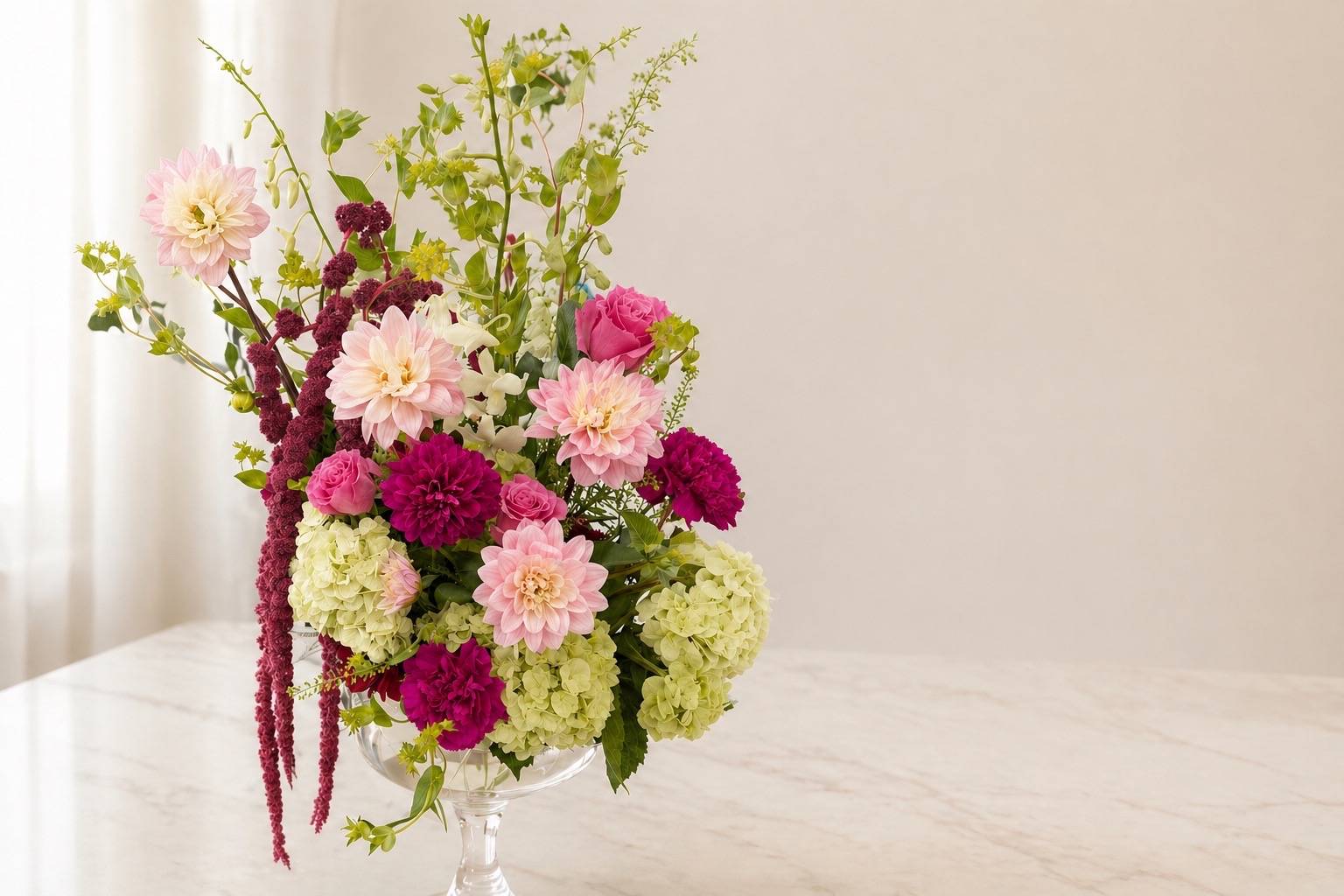
The First Conversation
Every bespoke order begins with questions that have nothing to do with flowers. What does the room look like at 5pm in October light. Is the ceremony outdoors, and if so, is there wind to account for. What has she inherited, worn, or carried that the arrangement needs to sit beside without competing.
A client's answers determine the palette before a single stem is chosen. A dress with heavy lace calls for texture that does not fight it — dusty miller, mostly, or the matte face of a garden rose rather than anything glossy. A venue with dark wood paneling needs the arrangement to carry light, not absorb it.
This consultation typically runs 60 to 90 minutes and produces a written brief: three reference images maximum, a defined palette of no more than five tones, and a list of what is explicitly excluded. Exclusions matter as much as inclusions. A client who says no ranunculus has just told us something true about her taste, and it shapes every decision after.
The brief is the contract between what she wants and what the season can deliver. It gets revisited twice before the wedding — once at the trial, once the week of — because a good brief is a living document, not a form filled out once and filed away.
Where the Flowers Actually Come From
Sourcing is where atelier work diverges most from retail floristry. We order from growers and wholesale markets 10 to 14 days before an event, working within a seasonal calendar rather than around it. Peony has a six-week window in late spring. Garden roses like Vendela, Mondial, and Quicksand come through in flushes, not on demand.
A domestic grower in Oregon or California can supply garden roses with three to five days' more vase life than an imported stem, at a cost premium of roughly 20–30%. For a bridal bouquet that needs to hold through a 10-hour day, that difference is not cosmetic — it is the reason the flowers photograph the same at 11pm as they did at 3.
Once stems arrive, they go into a cooler held at 34–38°F, processed within two hours: stripped of lower foliage, cut at an angle under water, and given 12 to 24 hours to fully hydrate before any design work begins. Skipping this step is the single most common cause of a bouquet that wilts by the reception.
Local sourcing is not always possible or even preferable — some varieties simply are not grown regionally in the volume a full wedding order requires. The discipline is in knowing which flowers are worth the wait and which substitutions preserve the composition without compromising it.
Reading the Room Before Choosing a Palette
Color decisions are made against the room, not against a trend board. A palette that reads correctly in a sunlit conservatory can go flat under the tungsten lighting of an evening reception. We ask for venue photographs at the hour the event will actually happen, not the hour that photographs best.
A restrained palette — three to five tones, one of which is nearly always a green — holds up better across a full day of shifting light than a palette built on six or seven competing colors. Lisianthus does useful work here: its ruffled bloom reads as soft without adding visual noise, and it takes color modification well when a precise tone is needed.
Texture matters as much as hue. Eucalyptus and dusty miller provide the silver-grey undertone that keeps a warm palette from tipping saccharine. Clematis, used sparingly as a trailing element, introduces movement without requiring additional color.
The rule we return to: a palette should be describable in one sentence. If it takes a paragraph to explain why five different flowers belong in the same arrangement, the palette has not been decided — it has been accumulated.
The Discipline of Composition
This is where most arrangements fail, and it has nothing to do with flower quality. It is a failure of restraint. The instinct, especially under pressure to justify a price point, is to add — one more stem, one more bloom, one more filler. The eleventh stem is almost always the one that ruins the composition.
A well-built arrangement has a silhouette — a defined outer edge the eye can trace — and negative space inside that edge. Space is not absence. It is what lets individual blooms register as individual blooms rather than dissolving into mass. Overpacking a centerpiece does not read as generous; it reads as anxious.
We build to a stem count decided in advance, not discovered along the way. A 30–36 inch centerpiece is typically budgeted at 25–40 stems across greenery, filler, and focal bloom. Going over that count mid-build is usually a sign the structure underneath was never sound to begin with.
Composition discipline extends to the bridal bouquet, where the temptation to overfill is strongest. A bouquet built around seven to nine focal blooms, supported by textural greenery, holds its shape and its story better than one built around twenty stems competing for attention.
Mechanics Before Beauty
No composition survives without sound mechanics, and mechanics are decided before color or shape. Floral foam, still common in retail work, is avoided in most bespoke construction — it restricts water uptake and does not hold heavier stems like garden rose or peony reliably through a long day.
Chicken wire, formed into a loose dome and secured inside the vessel, gives stems a grid to root into while keeping the water source open. For hand-tied bouquets, a spiral technique secured with waxed thread allows the bouquet to sit naturally in the hand without a hidden mechanical collar showing through.
Waterpicks — small sealed tubes of water — extend the life of individual stems used outside their natural water source, in boutonnieres or trailing installation pieces. A boutonniere built without one will visibly wilt within three to four hours; one built with a waterpick can hold through an entire reception.
None of this is visible in the finished piece, which is exactly the point. The mechanics are the part of the craft no one sees and the part that determines whether everything else holds.
The Trial Arrangement
For a full wedding order, we build a trial four to eight weeks out — typically one centerpiece and the bridal bouquet, built at full scale using the actual palette, as close to the actual venue light as we can arrange. Photographs alone do not reveal how a color reads at 6pm through a west-facing window.
The trial is not a final decision locked in stone; it is a working draft. Clients routinely ask for the palette to shift warmer, for a bouquet to be built slightly smaller once they see it against a dress, for one variety to be swapped for another once availability shifts closer to the date.
What the trial does not do is guarantee identical flowers on the wedding day. Garden roses are agricultural products, subject to weather and grower yield. What the trial guarantees is scale, palette logic, and mechanics — the elements within our control.
Skipping the trial is the most common source of wedding-day disappointment we see, almost always tied to a mismatch between what a client pictured and what a photograph or verbal description actually conveyed.
The Week Before: Production on a Schedule
A full wedding order is built on a strict hour-by-hour schedule, not assembled the morning of. Large arrangements and greenery structures are typically built two days out and held in cooler storage. Bouquets and boutonnieres, which are more delicate and shorter-lived once fully hydrated, are built the day before.
Cooler space becomes the limiting factor for any atelier during peak season — a single Saturday wedding of 150 guests can require 15 to 20 buckets of conditioned stem alongside 10 to 15 finished pieces, all needing climate-controlled storage simultaneously with other clients' orders.
A production schedule for a mid-size wedding typically looks like this:
This schedule exists because rushing any single stage compounds error into every stage after it. A stem processed poorly on day one shows its damage by day three.
Installation Day, Hour by Hour
Transport is its own discipline. Arrangements travel in custom-built crates or low, flat containers designed to prevent shifting — a centerpiece that looked correct in the studio can arrive at the venue with its silhouette collapsed if it was packed loosely for a 45-minute drive.
We typically arrive at a venue three to four hours before guest arrival, which allows time to reassess how each piece reads in the actual room light, make final adjustments, and address anything that shifted in transit. Ceremony pieces go first, since they are often the most photographed and the least revisable once guests are seated.
Reception tables are set two to three hours before doors open, timed to avoid extended exposure to direct sun through venue windows, which can visibly stress a garden rose or peony within 90 minutes. Bridal party flowers are delivered last, closest to the ceremony start time, to preserve their freshest hours for photographs.
A well-run installation is invisible to guests entirely. No one should see a florist working the room; they should simply arrive and find it already composed.
What Outlasts the Day
Heritage, inside this work, means designing for what survives past the reception. A growing number of clients request their bridal bouquet be preserved — pressed, freeze-dried, or set in resin — turning a single day's arrangement into something kept for decades.
Preservation is a separate craft from arrangement, typically handled by specialists who work directly with the couple after the wedding, and it requires flowers that were never treated with heavy preservative sprays during the event, since those chemicals interfere with drying. We flag this at the consultation stage if preservation is a stated goal, because it changes handling instructions for the entire day.
Some clients ask for something simpler: a single stem, pressed and framed, or a small jar of dried lavender from the ceremony arrangement kept on a windowsill. These smaller gestures matter as much as the full preserved bouquet — they are what remains once the flowers themselves are gone.
The rose that keeps is not a marketing idea. It is a genuine second life for work that would otherwise last a single day, and it is worth discussing before the wedding, not after.
What the Bespoke Process Actually Costs
Bespoke floral work is priced on labor as much as material. A single 30–36 inch tablescape can take two to three hours of build time once mechanics, greenery, and focal blooms are accounted for — before delivery, setup, or teardown are added.
For a wedding of 100–150 guests, floral budgets commonly fall between 8% and 12% of total wedding spend. Centerpieces typically range $150–$450 depending on scale and material; bridal bouquets $350–$900; ceremony installations, when included, often represent the single largest line item.
Where clients are frequently surprised is delivery, setup, and breakdown labor, which can add 15–20% to a floral invoice and is easy to overlook when comparing quotes. A lower initial estimate that excludes these costs is not a better price — it is an incomplete one.
The honest advice we give every client at the consultation: decide the three elements that matter most — bouquet, ceremony backdrop, and centerpieces are the usual choices — and allocate budget there first. Everything else can scale to fit what remains.
By the time the last guest leaves and the flowers are struck from the room, the work has already done its job quietly enough that no one thought to ask how it was made.
Considered
How far in advance should I book a florist for my wedding?
Book nine to twelve months out for a peak-season Saturday, especially if the design calls for garden roses, peony, or other varieties with narrow growing windows. Off-season or weekday weddings can sometimes be arranged with four to six months of notice, though color and stem availability will be more limited.
What is a trial arrangement and do I need one?
A trial is a built sample of one centerpiece or the bridal bouquet, made four to eight weeks before the wedding to confirm scale, palette, and mechanics. It is not required for every event, but for a full wedding order — ceremony, reception, and bridal party — it is the difference between an assumption and a confirmed result.
How many flowers do I need for a wedding centerpiece?
A 30–36 inch low-to-medium centerpiece typically uses 25–40 stems once greenery, filler, and focal blooms are combined. Taller or more architectural pieces can run higher. The number depends less on table size than on how much negative space the composition is built to hold.
What's the difference between a florist and a floral atelier?
A florist arranges from available stock to meet a request. An atelier designs from a brief — a conversation about the client, the room, and the occasion — then sources and builds toward that specific outcome, often producing a trial before the final work.
How much do bespoke wedding flowers cost?
Full-service bespoke wedding florals commonly run 8–12% of total wedding budget, with centerpieces ranging from $150 to $450 each depending on scale and material, and bridal bouquets from $350 to $900. Labor, mechanics, and delivery are typically a third or more of the total invoice.
How do I keep wedding flowers fresh through a long event day?
Cut flowers should be conditioned and hydrated the day before, held cool until two to three hours before the event, and kept out of direct sun and heat once installed. A garden rose or lisianthus arrangement built with proper mechanics and adequate water access will typically hold through a 10-hour day without visible wilt.