Atelier Techniques for Floral Composition
A mother of the bride once stood at the edge of our workroom, watching four hours of work go into a single head-table arrangement, and asked why it was taking so long for what she called "just flowers." The honest answer is that the flowers are the last four minutes of the process. Everything before that — the conditioning, the mechanics, the decision about where the composition stops — is the actual work. Atelier techniques for floral composition exist because an arrangement built without a system looks like one, no matter how expensive the stems were. This piece is a walk through the methods a trained studio actually uses, in the order they get used, and why skipping any of them shows.
28 min read · Les Fleur Company
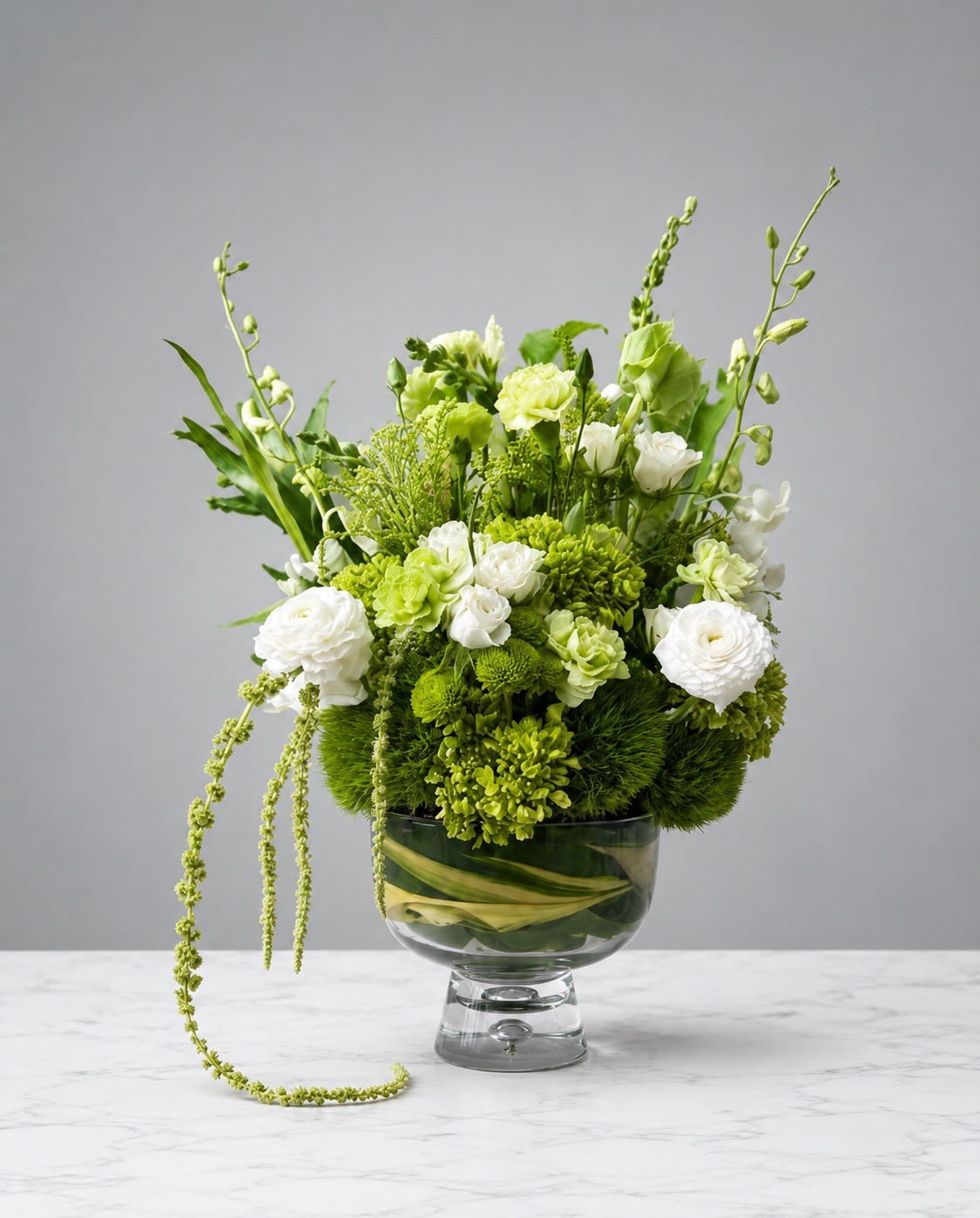
The Order Nobody Sees
Every composition that holds together was built in a sequence, and the sequence rarely resembles how the finished piece gets photographed. Material arrives, gets conditioned, gets sorted by function — line, mass, filler, accent — before a single stem is considered for placement. A studio that skips this step is designing blind.
We sort by what a stem is for, not what it is. A branch of clematis might serve as line in one composition and texture in another. The decision gets made at the sorting table, not the vase, because a design built on the fly tends to drift toward whatever looks good in the hand rather than what the silhouette needs.
This is the difference between arranging and composing. Arranging responds to the stem in front of you. Composing has already decided what role every stem will play before it is cut to length. The second approach is slower by design — and it is the only one that scales past a single bouquet to a fifteen-piece wedding order without falling apart by piece eleven.
Reading the Stem Before the Design Does
Material selection is where most compositions are won or lost, and it happens before anyone discusses color or shape. A garden rose like Mondial arrives tight and will open over 48 to 72 hours; Vendela arrives more open and holds a cooler, cleaner white longer under warm event lighting. Quicksand shifts color as it ages, from a dusty apricot toward a muted mauve, which means its placement date in a timeline matters as much as its placement in the vase.
A studio that does not track this will build a Thursday composition with Saturday-blown roses, or worse, Saturday-tight roses that never open in time for a Saturday event. The fix is a conditioning calendar, not a better supplier. We log delivery date, expected bloom day, and cooler temperature for every lot, and we build backward from the event date.
Stem quality also dictates mechanics. A lisianthus stem with a weak node will not hold a cantilevered position in a grid without support wire, while a dusty miller stem is sturdy enough to anchor an edge without any reinforcement at all. Reading this correctly before design starts is what separates a composition that survives an eight-hour reception from one that collapses by the toast. For more on how material choice shapes a wedding-specific composition, our piece on five essential elements of a timeless floral composition walks through the sourcing side in more depth.
Grid, Spiral, and Parallel: Choosing Mechanics on Purpose
Three mechanical systems cover most of what an atelier builds, and the choice between them is not stylistic — it is structural. A grid, built from tape or chicken wire across the mouth of a vessel, suits low, wide compositions where stems need to hold a fixed angle without drifting. A spiral, where stems cross at a single point below the binding line, suits hand-tied work and round forms that need even weight distribution. A parallel system, where stems run straight down without crossing, suits tall, architectural pieces where the eye is meant to read vertical lines.
Choosing wrong does not usually cause outright failure, but it caps how refined the result can look. A spiral bouquet built as a grid will look stiff at the binding point. A parallel installation built as a spiral will lean within an hour of standing upright.
We teach new designers to ask one question before mechanics are chosen: what is the silhouette doing. A silhouette that needs to cascade asks for a different structural answer than one that needs to sit flat and wide across a twenty-foot table. The mechanics are chosen to serve that answer, then the stems go in after, never the reverse.
The Discipline of Negative Space
The eleventh stem is the one that ruins the composition. Not because it is a bad stem, but because the design asked for ten and stopped communicating anything once an eleventh was forced into a gap that was doing structural work.
Negative space gets budgeted, not discovered. Before placement starts, we decide roughly what percentage of the silhouette's visual area will stay open — often a third to half of it in a restrained composition — and we build toward that boundary rather than filling until the vessel looks full. This is uncomfortable for newer designers, who read open space as unfinished work. It is the opposite. Unfilled space is what lets the eye land on the two or three stems doing the actual work of the piece.
A client once asked for "more" on a ceremony arch, three separate times, over the course of one install. We added material twice. The third time, we stopped and explained that the gaps were load-bearing to the design — removing them would make the arch read as dense rather than considered. She kept the gaps. The arch read better in photographs for it. Our piece on harmony in floral composition covers this tension between fullness and restraint at more length.
Color and Texture Layering Without Clutter
A composition with six colors and six textures is not more luxurious than one with two of each — it is usually just louder. Atelier technique treats color and texture as a budget with a hard ceiling, generally one dominant tone, one or two supporting tones, and a single textural contrast strong enough to register without competing.
Eucalyptus and dusty miller do similar work — both soften a palette and both read as neutral — so using both at full volume in the same composition usually cancels out the contribution of either. The more disciplined move is choosing one as the dominant textural note and letting the other appear only at the edges, if at all.
Peony against lavender is a pairing that works because the color relationship is close enough to feel composed rather than contrasted for effect. The same peony against a saturated jewel tone reads as a different kind of arrangement entirely — not wrong, but a different brief. Knowing which brief a client is actually asking for, even when they describe it in color words rather than mood words, is a skill learned over dozens of consultations, not a chart.
Sourcing on a Seasonal Clock
No atelier technique survives bad timing with the market. Garden roses have a narrower availability window than standard roses, and the varieties a studio builds a signature look around — Mondial, Vendela, Quicksand — are not guaranteed from the same grower lot to lot. We place orders 10 to 16 weeks ahead for peak wedding season and still build a secondary plan for substitution, because a grower's crop can shift by a week with no warning tied to weather at origin.
Working within season is not a limitation we apologize for; it is a structural decision. Peony has a real season, roughly April through June in most Northern Hemisphere growing regions, and forcing it outside that window means flying stems from the opposite hemisphere at a cost and a quality tradeoff that shows in the finished bloom. A composition built around what is actually in season tends to look more coherent than one assembled from whatever a catalog can source on demand, because the materials were grown for that light and that climate.
This is also where heritage and atelier technique meet directly — the discipline of working seasonally is itself a form of preservation, a refusal to treat flowers as an interchangeable commodity rather than a grown thing with a window.
Mechanics Built to Disappear
The best technical work in a composition is invisible in the finished photograph. Chicken wire cages, floral adhesive dots, paddle wire in 22, 24, and 26 gauge, waterpicks for woody stems that cannot reach a reservoir directly — none of it is meant to be seen, and if a guest can spot the mechanics, the build has a defect, not a style.
We test every installation piece under its actual event conditions before calling it finished — full water weight, the angle it will actually sit at, the temperature range of the room if it is known. A ceremony arch tested flat on a workroom table tells you almost nothing about how it will hang once lifted vertical. More compositions fail from skipped testing than from any material choice.
Water sources get the same rigor. A composition that looks finished at 9 a.m. and needs to hold through an 11 p.m. reception needs a water source sized for twelve-plus hours, not a floral foam block sized for a same-day delivery. Our workspace design piece covers how we set up conditioning and mechanics stations to keep this testing step from getting skipped under deadline pressure, which is when it most often gets skipped.
Common Mistakes and the Atelier Fix
The most frequent error we see in less disciplined work is not technical — it is additive. A designer under deadline pressure tends to keep placing stems because placing feels like progress, even once the composition has already answered its own question. The fix is procedural: decide the stem count range before starting, and treat exceeding it as a signal to stop, not a sign the design needs more.
A second common mistake is uneven conditioning across a single order. If half the garden roses in a fifteen-centerpiece order were conditioned a day later than the other half, the bloom stage will be visibly inconsistent by the event, even if every piece used the same recipe. We batch-condition by delivery lot specifically to avoid this, and we label coolers by bloom-readiness, not just by variety.
A third mistake is mechanics chosen for convenience rather than the silhouette's needs — grid work because it is fast, on a piece that actually needed a parallel structure to hold its line. Our atelier couture piece goes further into how a studio matches technique to brief rather than defaulting to whichever mechanic is quickest under deadline.
Restraint as a Learned Skill, Not an Instinct
New designers in our studio are, almost without exception, better at addition than subtraction in their first year. Restraint is not an aesthetic preference that shows up naturally with good taste; it is trained the same way stem conditioning is trained, through repetition and correction.
We run new hires through a drill where they build the same compote three times — once to their own instinct, once capped at two-thirds their original stem count, once capped at half. In almost every case, the half-count version photographs as the most composed of the three, and the designer is the one most surprised by the result. The instinct to add more is strong and mostly wrong.
This is the same instinct that governs how we think about permanence in the work generally — a composition that will be looked back on in a wedding album five years from now benefits more from restraint than from density, because density dates a photograph in a way that a clean silhouette does not. Our piece on the art of impermanence takes this idea further, into why the temporary nature of the material makes the discipline matter more, not less.
None of this is a secret technique. It is a sequence, repeated correctly, by people who have been corrected enough times to stop adding the eleventh stem.
Considered
What does "atelier technique" mean in floral design?
It refers to the procedural methods a trained studio uses to build an arrangement — stem conditioning, structural mechanics like grid or spiral placement, and sequencing of material — as distinct from decorative arranging done without an underlying system. The technique is what makes the result repeatable.
How many stems should go into a floral composition?
There is no fixed count; the right number is the one the silhouette requires, not a maximum. Most compositions fail by exceeding that number, not by falling short of it. A trained eye stops adding once the negative space starts to close.
What is negative space in floral design?
Negative space is the deliberate gap left between stems and masses so the composition reads as structured rather than dense. It is planned before placement begins and is treated as a material the design depends on, not an accident of leftover room.
How long does a wedding centerpiece take to build in an atelier?
A single compote or low centerpiece built with full mechanics — chicken wire, water source, conditioned stems — typically takes 45 to 90 minutes per piece once materials are prepped. Prep, including conditioning and stripping, often takes longer than the build itself.
Why do some floral arrangements look more expensive than others at the same stem count?
The difference is almost always mechanics and sourcing, not stem count. Even conditioning, consistent stem length, and disciplined spacing read as considered; uneven conditioning and crowded placement read as assembled, regardless of the flowers used.
What tools does a floral atelier use that a home arranger typically does not?
Chicken wire cages, floral adhesive, paddle wire in multiple gauges, a conditioning station with stem-specific water temperatures, and a sourcing relationship with a flower market or grower are the main differences. The tools support mechanics that hold a composition for the full length of an event.