Atelier Revival: Reinterpreting Vintage Florals
A bride arrived at the atelier on a Tuesday in March carrying a shoebox. Inside, wrapped in tissue gone the color of weak tea, were four roses pressed flat in 1962—her grandmother's wedding bouquet, kept in a book for sixty-four years. She did not ask us to copy it. She asked us to build something that remembered it.
41 min read · Les Fleur Company
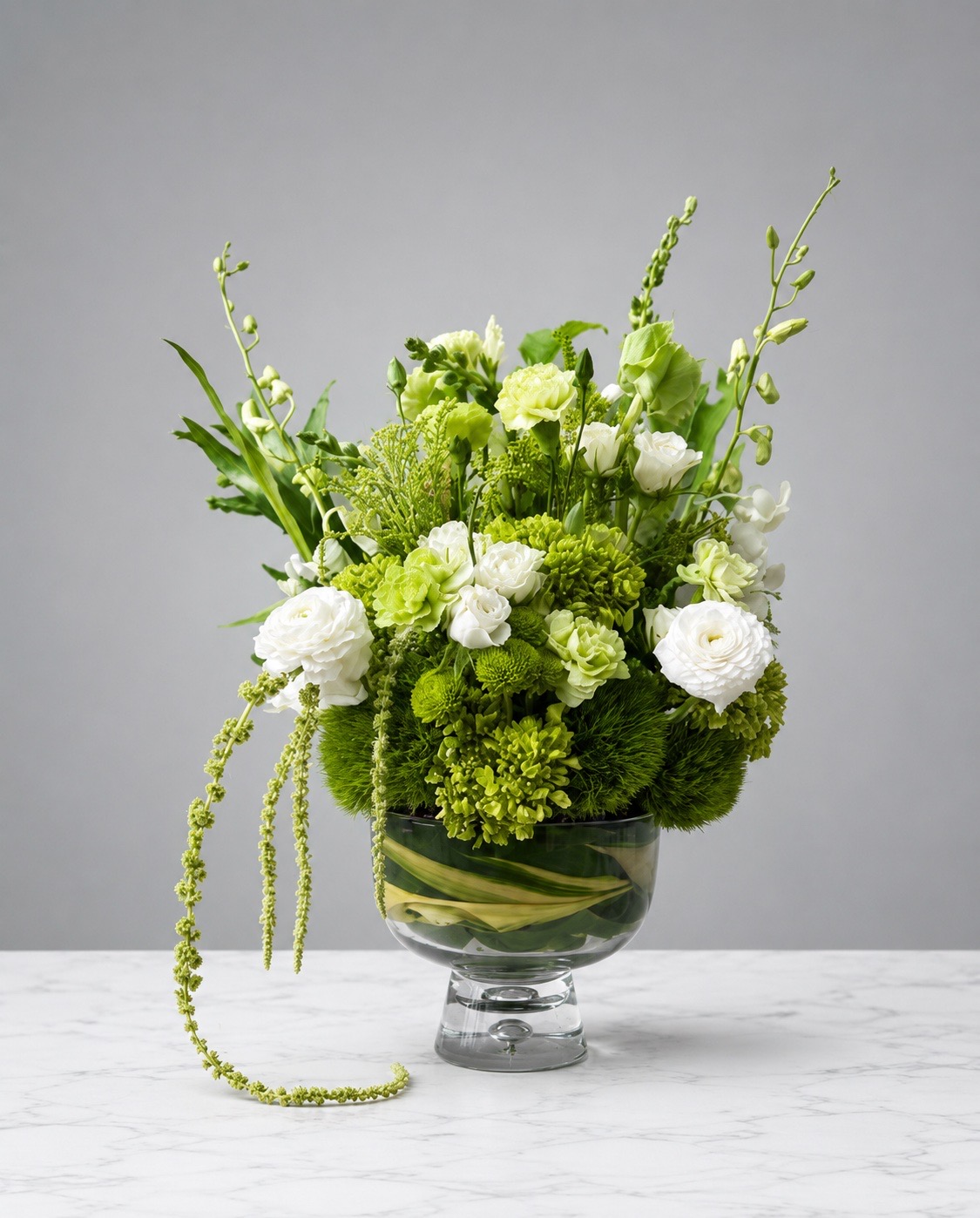
A Shoebox on the Worktable
A bride arrived at the atelier on a Tuesday in March carrying a shoebox. Inside, wrapped in tissue gone the color of weak tea, were four roses pressed flat in 1962—her grandmother's wedding bouquet, kept in a book for sixty-four years. She did not ask us to copy it. She asked us to build something that remembered it.
This is the request behind most vintage floral commissions, though clients rarely phrase it so plainly. They bring a photograph, a swatch of lace, a bouquet pressed between the pages of a hymnal, and they want the new arrangement to carry some trace of the old one without becoming a reenactment. That distinction—between carrying a trace and staging a costume—is the entire discipline of atelier revival.
Vintage floral arrangements are not made by sourcing antique varieties, because most of them no longer exist in commercial production. The roses grown in 1962 were bred for scent and garden performance, not for the cold-chain shipping and seven-day vase life a modern wedding requires. What survives is proportion, palette, and restraint—the qualities a photograph can still teach us, stem list or not.
Over eleven years of running this studio, we have built perhaps thirty commissions around inherited material. The work succeeds or fails on one decision made in the first consultation: whether the client wants a replica or a reinterpretation. We only take the second kind.
What Revival Means in the Atelier
Revival is not restoration. A restored painting returns a damaged original to its intended state. A revived arrangement has no original to return to—the flowers are long gone, the bouquet dismantled within a week of the wedding it served. What remains is documentation: a photograph, a guest's memory, a line in a florist's ledger. The atelier works from that documentation the way a conductor works from a score written for instruments no longer built.
Our process for a revival commission runs in three passes. The first is research—photographs, if the family has them, cross-referenced against period floral manuals to identify likely varieties and construction. The second is translation—matching period material to current stock, accounting for what has changed in breeding, availability, and the realities of a modern event timeline. The third is construction, which looks almost nothing like a standard arrangement, because period mechanics (posy holders, tussie-mussies, wired collars) require different hand skills than a contemporary hand-tied round.
We have found that clients respond best when we are honest about the limits of this work early. We cannot grow a rose that was discontinued forty years ago. We can build toward its character—its density, its blush, the particular way it held its head—using material bred for a different century but suited to the same purpose. Our approach to curated composition runs on the same principle regardless of era: restraint first, ornament second.
A revival commission takes longer than a standard order—typically three additional consultation hours spent on research alone, billed separately from design time. Clients who are not prepared for that investment are usually better served by a conventional arrangement with a vintage-adjacent palette.
Reading the Archive Before Touching a Stem
Before any cutting begins, we read. A revival commission starts with whatever documentation exists—a photograph is the strongest source, a written description the weakest, a surviving pressed bloom somewhere in between. Each tells us something different, and conflating them produces errors.
Photographs, even faded ones, show proportion with precision a verbal description cannot. We measure the ratio of bloom to foliage, the height of the arrangement against the bodice or the table it sat beside, the density of the binding point. A 1920s posy typically ran dense and compact, rarely exceeding ten inches across. A 1970s cascade, by contrast, often ran to thirty inches of trailing material—two eras, two entirely different engineering problems.
Written descriptions are weaker evidence. A grandmother's recollection of "white roses and something purple" could mean lisianthus, could mean stock, could mean sweet pea. We ask clients for any secondary source—a dress fitting photo, a seating chart with a centerpiece visible in the background, a newspaper wedding announcement—before committing a palette to the design.
Surviving pressed material is the richest source and the most fragile to work from. Color fades unevenly in pressing; a rose that reads dusty pink today may have been a saturated coral in 1962. We cross-reference pressed material against contemporaneous color photography whenever it exists, because pressed flowers alone will mislead a designer into muting a palette that was, in its own time, considerably bolder.
This research phase typically runs six to eight hours for a full wedding commission. It is unglamorous work, closer to archival research than floristry, and it is the part clients never see in the finished arrangement—though they would notice immediately if it were skipped.
Sourcing Material for a Period That No Longer Grows
The practical heart of revival work is substitution, and substitution lives or dies on the quality of the stand-ins. We rely on a narrow set of garden roses that carry the density and softened form period varieties are remembered for: Mondial, with its deep ruffled center; Vendela, cream and clean-lined; Quicksand, which ages from apricot to a dusty beige that reads as decades old within three days of opening.
None of these varieties existed in 1962. All three, in our experience, photograph and behave closer to the florals of that era than anything bred explicitly to look "vintage"—a marketing category we treat with suspicion, since most roses sold under that label are simply high-petal-count hybrids with no real historical claim.
Lisianthus does heavier lifting in revival work than almost any other stem, because its ruffled, paper-thin petal reads as aged the moment it opens. Dusty miller supplies the silvered foliage that period arrangements used generously and modern arrangements often skip. Clematis, used sparingly as a trailing element, recalls the garlanded mechanics of Edwardian corsage work. Lavender, when the palette calls for it, does the work that dried statice once did in actual 1960s arrangements—though we use it fresh, bound in small bundles, rather than dried and brittle.
Sourcing these varieties on the timeline a wedding demands means working directly with growers eight to ten months out. Garden roses at this quality are not held in general wholesale stock; they are grown to order, in quantities as small as thirty stems for a single ceremony installation. Clients who approach us inside of four months for a full revival commission are told plainly what is and is not achievable in that window.
Mechanics Borrowed from a Different Century
Period florals were not built the way modern arrangements are built, and reviving the look without reviving the mechanics produces a shape that photographs wrong. A Victorian posy was constructed around a holder, often silver or ivory, with a tight spiral bind and a paper or lace collar folded beneath the blooms to catch moisture and hide the stems. An Edwardian presentation bouquet ran long and loosely bound, cradled rather than gripped.
We teach our apprentices both mechanics because the binding point changes the silhouette entirely. A modern hand-tied round, built on a spiral stem bind with no collar, opens wider and sits looser than a period posy ever did. Building a "vintage" arrangement on contemporary mechanics is the single fastest way to lose the character a client is paying for.
This is where our framework for timeless composition earns its keep in revival work specifically—because restraint in stem count matters more, not less, when the silhouette is already doing historical work. A period posy rarely exceeded twenty-four stems total. Adding an eleventh rose past what the design calls for does not make it fuller; it makes it formless, and in revival work, formlessness reads as modern rather than historic, which defeats the entire commission.
Wired collar work, largely abandoned in contemporary floristry for speed, takes roughly ninety additional minutes per piece. We reserve it for processional bouquets and personal flowers, where the camera sees the arrangement up close, and skip it for larger installations where the labor cost cannot be justified against the visual return.
Palettes Reclaimed from Faded Photographs
Color is where most revival commissions go wrong before a single stem is cut. Clients arrive with a black-and-white photograph and describe the bouquet as "white," when period photography simply could not render color accurately. White-appearing roses in a 1920s photograph were very often blush, cream, or pale apricot—tones that read as white on film stock of the era but would look distinctly warm in person.
We correct for this by cross-referencing against period color plates where they exist—garden catalogs, fashion plates, hand-tinted photographs—rather than taking a black-and-white photograph at face value. A client who insists on pure white because that is what the photograph shows is, more often than not, asking us to recreate a color that never existed in the original bouquet.
Our work on palette construction for weddings generally applies here with one adjustment specific to revival commissions: period palettes ran narrower than contemporary taste prefers. A 1950s bridal palette was often a single hue family—blush through ivory, or lavender through plum—rather than the three- and four-tone palettes common in weddings booked through the atelier today.
We advise clients who want an authentic revival to resist the urge to widen the palette for "more color." The restraint of a narrow, tonal palette is, itself, one of the most historically accurate choices available, and it is usually the first thing a client wants to abandon once swatches are in front of them.
Where Revival Commissions Go Wrong
In eleven years we have made every mistake available in this category of work, usually in the first few commissions before a pattern became clear enough to correct for. The most common failure is scale—building a design sized for a mantelpiece photograph and then asked to carry a six-foot ceremony arch. Density that reads as charming at twelve inches reads as cluttered at six feet; the stem count has to drop, sometimes by half, to hold the same character at a larger scale.
The second failure is over-literal replication. A client hands over a photograph and asks for an exact match, stem for stem, color for color. We decline this request as stated, because exact replication is rarely possible and the attempt produces something stiff—a museum reproduction rather than a living arrangement carried by a living person. We propose interpretation instead, and in every case where a client has accepted that reframing, the result has satisfied them more than a literal copy would have.
The third failure is ignoring the preserved material itself. Families sometimes supply an actual dried bloom from the original bouquet, expecting it rebuilt into the new arrangement's structure. Dried, decades-old material cannot bear structural weight—it crumbles under handling—but it can be set as a single accent, pinned near the binding point where it will be seen without being load-bearing. We have done this perhaps a dozen times, and it is, consistently, the detail a bride mentions first in her thank-you note afterward.
A fourth, smaller failure: assuming revival work is cheaper because it uses "old" ideas. In practice it runs 15 to 25 percent above a standard commission once research hours and specialty sourcing are counted.
A Wedding Built Entirely on Revival
The shoebox bride's wedding took place that October, at a private residence above Lake Tahoe, where the light in late afternoon runs gold rather than white—a detail we factored into the palette, warming it slightly past what the 1962 photographs alone would have suggested.
We rebuilt her grandmother's bouquet in character rather than in fact: Vendela roses standing in for the original's unnamed white variety, lisianthus doing the work her photograph suggested had been stock or sweet pea, dusty miller replacing foliage too degraded in the photograph to identify precisely. One pressed rose from the original bouquet was set at the binding point of the new one, visible but not load-bearing, exactly as described above.
The ceremony arrangement scaled the posy's proportions up by roughly three times rather than attempting a direct enlargement—twenty-four stems in the original photograph became roughly seventy across a wider but shallower structure, preserving the density ratio rather than the raw stem count. Guests who had seen the 1962 wedding photograph, several of them in their eighties and present at the original ceremony, recognized the bouquet immediately. None of them could have told you a single flower had changed.
This is, in the end, the measure of successful revival work: not a perfect match, which is impossible, but a true one. The client's mother, who had carried a version of this same bouquet forty years before her daughter did at her own wedding, said only that it felt like the same flowers. It was not. It only had to feel that way.
Preservation and the Life After the Event
Revival work runs in both directions. We are often asked to rebuild a vintage arrangement from an old photograph, and just as often asked to preserve a current bouquet so a future bride—a daughter, a niece—might ask us to revive it decades from now. The two services are, in practice, one continuous relationship with a single family across generations.
Pressing remains the most reliable method for individual blooms, particularly flat-faced varieties like garden roses and ranunculus, which hold their color and form better under weight than trumpet-shaped flowers do. We press within six hours of an event's end, before petals begin to soften, using blotting paper changed every three days for roughly three weeks.
Silica gel drying preserves three-dimensional form rather than a flattened impression, and we recommend it for brides who want the bouquet displayed rather than framed. The process takes seven to ten days and suits dense, structured blooms—garden roses again, and peony, which silica handles better than almost any other variety we work with.
Our thinking on impermanence runs directly counter to the instinct most clients bring to preservation, and we say this plainly in consultation: an arrangement's value was never going to be its permanence. The bouquet a grandmother carried in 1962 was not preserved for sixty-four years by accident of good fortune. It was pressed, deliberately, within days of the wedding, by someone who understood it would not last otherwise—and who wanted something of it to.
Building Revival into the Atelier's Daily Practice
Revival work has changed how the studio operates even outside the commissions that explicitly call for it. We now photograph every wedding arrangement from four fixed angles before it leaves the workroom—a habit adopted specifically so that, should a client's granddaughter arrive at this door in 2060 asking us to revive what we built this year, the documentation will exist to do the work properly.
We have also begun keeping a reference file of period floral photography, organized by decade, built over the past four years from estate sales, archive requests, and donated family photographs clients have allowed us to copy. It now runs past two hundred images and functions as a working library for every new revival consultation, cutting research time on common eras—the 1950s and 1960s, by far our most requested—by roughly half.
None of this changes the central discipline, which has nothing to do with the decade a client names. Composition still depends on restraint. The stem that should not have been added still ruins the arrangement, whether the design points backward sixty years or forward to the ceremony this coming spring. A bride's grandmother understood this without naming it; she simply built a bouquet, had it photographed, pressed four roses, and closed the book.
The shoebox still sits in our archive room, four pressed roses inside, tissue gone the color of weak tea. We did not need to open it again after that first consultation. We had already read what it had to say.
Considered
What does "vintage floral design" actually mean for a wedding?
It means building toward the proportion, density, and palette of an earlier period—Victorian, Edwardian, mid-century—using material available now. Few varieties from a 1920s garden survive in commercial rotation, so the work is translation: matching the feeling of the original with roses, lisianthus, and foliage bred for today's growers.
Can a florist use flowers from an old family bouquet in a new arrangement?
Rarely as fresh stems—most inherited florals arrive pressed, dried, or preserved in resin. An atelier can incorporate a dried bloom or a pressed petal into a new composition as a single accent, but it is not built to carry the structure of the piece.
Why do vintage-style arrangements often look wrong at full scale?
Period photographs are usually close-ups of small posies or table arrangements, not the six-foot installations modern weddings commission. Scaling a Victorian posy up without adjusting density and negative space produces something heavy and shapeless rather than historic.
What flowers read as "vintage" without using actual antique varieties?
Garden roses with high petal counts (Mondial, Vendela, Quicksand), lisianthus, dusty miller, clematis, and lavender carry a softened, undone quality close to period material. The effect comes from loose structure and muted tone, not from any single variety.
How long does it take to plan a revival-style arrangement for a wedding?
At Les Fleur, a revival commission typically begins eight to ten months before the event—time enough to source heirloom-adjacent garden roses from growers who plant to order, since these varieties are rarely held in general wholesale stock.
Does reviving a vintage style cost more than a standard arrangement?
Usually, yes—by roughly 15 to 25 percent, driven by the cost of specialty garden roses and the additional hours spent on research and hand-tying mechanics rather than wire-and-foam construction.