The Composition of a Single Peony: When One Stem Is the Arrangement
The client says it almost every time, and always with the same slight apology in her voice: I was thinking just one stem. Is that enough? She has already decided. She is asking for permission.
34 min read · Les Fleur Company
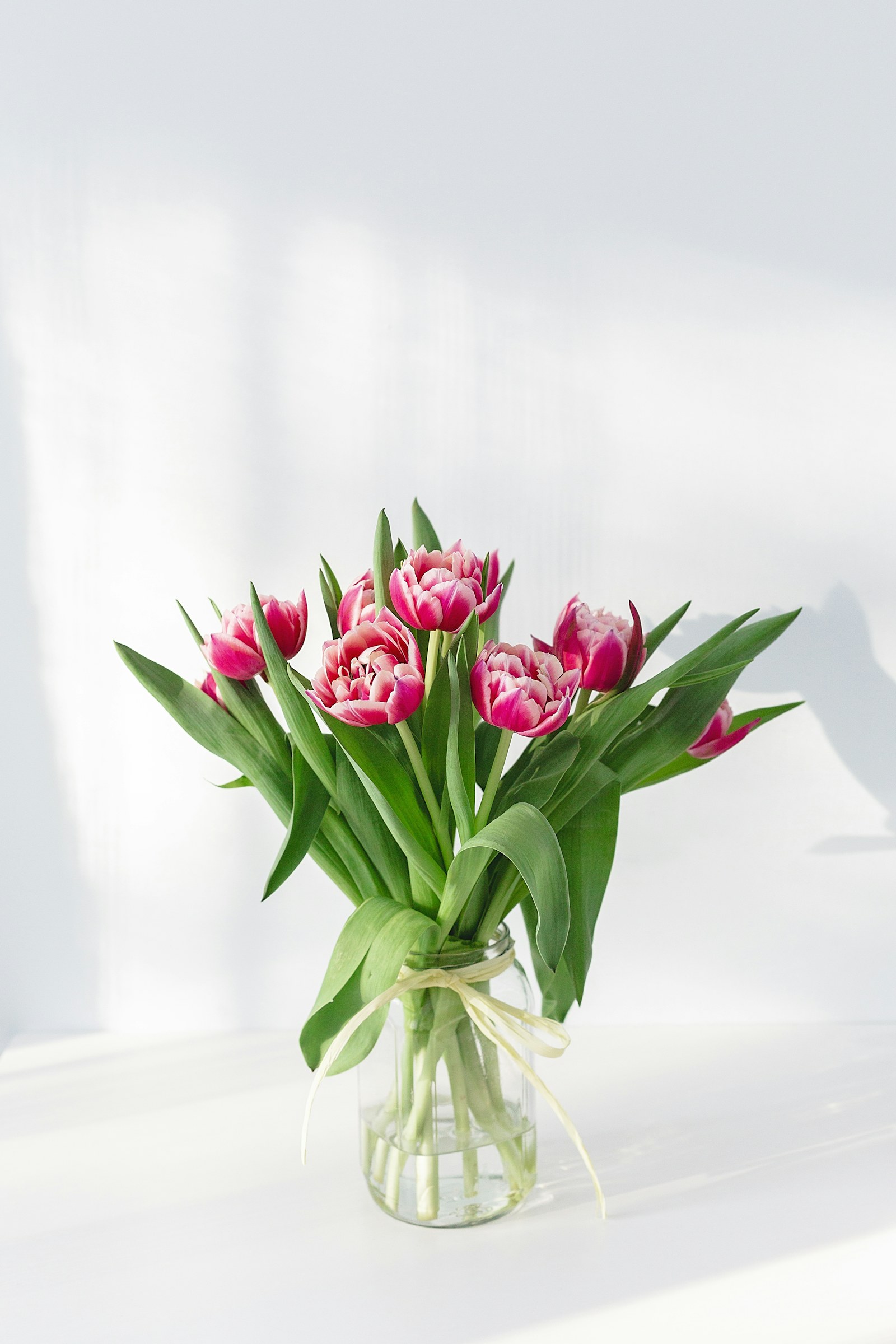
Why the Peony Holds Alone
Most cut flowers require company. A single stem of lisianthus reads as incomplete — the spray habit of the plant implies branching and multiplicity, and a lone stem resists that implication. A single dahlia, placed without support, can look unmoored. The peony is constitutionally different.
A fully open peony carries between 5 and 6 inches of diameter at peak bloom. That is not a measurement of excess; it is a measure of visual mass. The bloom occupies space in a way that most flowers achieve only in groups. More importantly, the architecture of the peony head creates its own internal composition: petals unfold in concentric rings, producing a geometry that the eye can follow without external guidance. The viewer has somewhere to travel. No secondary stem is needed to complete the circuit.
There is also the matter of fragrance. A single fully open peony in a room of moderate size will scent the air without announcing itself. Twelve peonies together become a statement the room cannot ignore. One peony simply is.
This is what distinguishes the peony from most other candidates for single-stem work: it is already complete. The eleventh stem ruins the composition not because it is one too many in principle, but because the peony had already said what needed to be said at one.
Variety Determines Whether One Stem Can Stand
The decision to work with a single peony stem is not made at the vase. It is made at the point of variety selection. Not all peonies hold alone, and the American Peony Society's variety registry is a useful reference for understanding the structural differences between cultivars — particularly for distinguishing herbaceous varieties suited to cut flower work from tree peonies and intersectionals with different stem characteristics.
Coral Charm is perhaps the most versatile single-stem variety available. It opens in stages — from a tightly closed coral bud to a fully blown peachy-cream at maturity — which makes the single-stem composition an evolving piece rather than a static one. Placed on Monday, it becomes a different arrangement by Thursday. This lifecycle quality suits atelier work particularly well; the client who takes one home is receiving something that changes.
Sarah Bernhardt is the most reliable choice for formal interior work. Its blush-pink, densely layered petals carry enough weight to hold the head upright without lateral support from adjacent stems — a structural consideration that matters more than it sounds. When the stem is the only thing in the vessel, it bears the full load. Sarah Bernhardt can bear it.
Festiva Maxima — white, with a characteristic fleck of crimson at the petal edges — rewards proximity in a way that arrangements of twelve obscure. At close range, the crimson speckling reads as detail. As a single stem on a small dinner table, it offers that detail to anyone seated nearby. It is a variety that earns attention without seeking it.
Bowl of Cream, which opens wide and pale cream, works best in a low, wide-mouth vessel where it sits at table level. The bloom is almost architectural in its fullness at peak open; it does not need height to register.
Varieties that tend not to work alone include heavily double-flowered types with weak stems. Duchesse de Nemours, despite its beauty in mixed arrangements, will often require support — the head grows heavy relative to stem strength, and without neighboring stems for lateral bracing, it droops. Tree peony varieties present similar challenges: shorter stems and wide blooms create proportion problems in most standard vessels.
The Vessel Is Half the Composition
Every single-stem arrangement is two objects in conversation: the flower and the vessel. This is always true, but in a full arrangement the vessel recedes — it is context, not subject. In a single-stem composition, it steps forward. Choose it poorly and neither object works.
For a peony stem typically cut to 18–24 inches after conditioning, the vessel must justify its proportions. A tall glass cylinder at 14 inches forces the stem into a vertical line that reads as deliberate — this works in contemporary interiors with clean horizontal surfaces. A wide-mouth ceramic at 8–10 inches creates a composition where the bloom floats at low height, almost resting on the surface. This works on a low table, a window ledge, a bedside surface where closeness is the point.
What does not work is the vessel that splits the difference without intention: a mid-height vase that is neither grounding the stem nor extending it. In a single-stem composition, ambivalence in the vessel becomes the composition's primary quality. That is not what the peony is for.
Material matters as much as dimension. Matte ceramics — stoneware, bisqueware, unglazed terracotta — absorb the visual noise that glass reflects. Clear glass vessels work in specific contexts: on a surface where light passes through (a shelf against a window, a north-facing sill) the transparency can serve the composition. In most other contexts, the reflectiveness of glass competes with the bloom for the viewer's attention. The peony needs the vessel quiet.
On color: neutral. A vessel with a strong glaze color or pattern divides attention. Warm whites, dove grays, dark-clay charcoals, unglazed earth tones. The vessel's job is to present the stem — not to share equal billing with it.
Conditioning the Single Stem: There Is No Margin
In a full arrangement, one stem that droops or browns early is largely invisible. Twelve stems carry the composition; the failing one disappears into the mass. In a single-stem composition, the failing stem is the arrangement. There is no margin, which means conditioning cannot be approximate.
The basics apply: cut the stem on a 45-degree angle under water to prevent air from entering the cut surface. Strip every leaf below the waterline immediately — submerged foliage accelerates bacterial growth, and bacterial growth shortens vase life. Change the water every two days, recutting the stem each time.
The peony-specific consideration is timing relative to bloom stage. Peonies are often harvested in tight bud for shipping — at what the trade calls marshmallow stage, when the bud is soft but petals have not yet begun to separate. A bud at this stage needs encouragement: a warm-water soak at 70–75°F for six to eight hours will prompt the bloom to begin opening. If the peony arrives more open than expected, move it to cool water in a room kept below 65°F to hold it. The Royal Horticultural Society's guidance on peony cultivation is a useful reference for understanding how temperature affects both bloom development and longevity — principles that apply equally in the vase.
Expect 5–7 days of vase life for a properly conditioned stem. Warm rooms shorten this; cool rooms with indirect light extend it. Direct afternoon sun accelerates opening beyond what the arrangement's lifespan can support — the bloom opens fast and fades at the petal edges before the interior layers have fully revealed themselves.
One note on water level: keep it at approximately one-third of the vessel's height rather than full. More stem surface in contact with water accelerates softening at the cut end. Lower water, changed regularly, produces a cleaner stem for the duration of the arrangement's life.
Placement and the Argument for Negative Space
The single peony does not succeed everywhere. It succeeds where it is given room.
On a table with six other objects — candles, a water carafe, stacked books, a plate — a single bloom disappears into its surroundings. The single-stem composition is not a background element; it is the only element. To function as such, it requires negative space: cleared surface, absence of competing objects, a background that does not interrupt.
The practical standard: approximately 18 inches of cleared surface on either side of the vessel for a bloom of average head size — 4 to 6 inches in diameter. Less than that and the arrangement is simply a flower someone placed on a table. More than that and it becomes a composition — something the eye registers as chosen rather than incidental.
Height placement is often underestimated. Eye-level siting, at approximately 48 to 54 inches from the floor, works for most residential settings. Below that threshold, the bloom is seen from above and loses its silhouette — the layered petal geometry that makes the peony worth studying flattens into a circle of color. Above 54 inches, the stem elongates and the bloom reads as perched rather than presented.
Natural light is the preferred companion. North-facing light — consistent, cool, non-directional — is ideal for both cut flowers and the photographs that often document this kind of work. East-facing morning light works well but is brief. Direct afternoon western light is hard on the bloom and on the composition both.
The Single Peony in Event Work
The single-stem composition has practical logic in event settings that goes beyond aesthetics.
For intimate dinners — a table for four, or six — a single peony stem at each place setting performs differently than a centerpiece arrangement. It personalizes the table. It reads as considered rather than appointed. It does not obstruct the sightline across the table, which matters in small gatherings where the whole point is conversation without architecture in the way.
For rehearsal dinners, where the register tends toward warmth over ceremony, a Quicksand rose — dusty rose-taupe, with a muted vintage quality that reads as peony-adjacent — in a small bud vase beside each setting creates an atmosphere that a statement centerpiece cannot replicate. The scale is human. The arrangement belongs to the person seated next to it.
For ceremonies where the florals are secondary to the architecture of the space — a nave, a courtyard with existing stonework, a garden loggia — single stems placed in sequence along a ledge or railing create rhythm without interruption. The eye moves along the line of blooms rather than pausing at any one point. This is a different logic from the arrangement as focal point; it is the arrangement as cadence.
There is also the budget argument, which clients do not always permit themselves to make plainly: a reception for 40 guests with a single peony stem per table requires 40 blooms. The same reception with full centerpiece arrangements requires ten times that. The single-stem decision is not a concession to budget; it is a position about what the table should do. That the budget follows the restraint is a secondary benefit, not the reason for the choice.
What One Stem Teaches About Composition
Working with a single stem — any stem, but the peony in particular — is an exercise in understanding what a composition actually requires. Most floral work involves addition: the next stem, the foliage fill, the accent element that ties the palette together. The single-stem arrangement asks a different question. It asks whether each addition is necessary, or whether it is compensation for not trusting what is already there.
The peony does not need compensation. What it requires is the appropriate vessel, the cleared space to breathe, and the patience to let it open on its own schedule. The arrangement that results is not minimal — it is complete. Minimal implies something withheld. Complete implies that nothing is missing.
The eleventh stem ruins the composition not because eleven is the wrong number in every case, but because ten was already one too many for what the peony was trying to say. The single stem teaches you to stop at the right moment. In a discipline that is largely about restraint, that is the lesson worth carrying into every other arrangement.
A fully open Coral Charm on a cleared table, in a matte vessel, in north-facing light — it does not ask to be looked at. It is simply there. That is the thing about compositions that hold: they do not require an audience to function. They function regardless.
Considered
How many peonies do you need for a simple table arrangement?
One peony stem — properly conditioned, placed in the right vessel, and given adequate negative space — functions as a complete arrangement. Varieties with strong stems and dense heads, such as Sarah Bernhardt or Coral Charm, hold best alone. The cleared surface around the vessel matters as much as the bloom itself.
What is the best peony variety for a single-stem arrangement?
Coral Charm, Sarah Bernhardt, Festiva Maxima, and Bowl of Cream perform well as single stems. Avoid heavily double varieties with weak stems — Duchesse de Nemours tends to droop without lateral support from adjacent stems. Stem strength and head weight together determine whether a variety can carry a composition alone.
How long does a single peony stem last in a vase?
A properly conditioned peony stem lasts 5–7 days in a vase. Cut at a 45-degree angle, strip all foliage below the waterline, and keep the room below 65°F to extend vase life. Warm rooms shorten it. In a single-stem composition, there are no other stems to carry the arrangement if one fails — conditioning is the work.
What size vase works best for a single peony?
For a peony cut to 18–24 inches, a tall cylinder at 14 inches creates a deliberate vertical line. A wide-mouth ceramic at 8–10 inches allows the bloom to float at low height. Avoid mid-height vessels that neither ground nor extend the stem — the vessel that splits the difference without intention is the most common single-stem error.
Can a single flower work as a wedding centerpiece?
For intimate tables of four to six, a single peony in a bud vase at each place setting personalizes the table without obstructing sightlines. For larger reception tables, a single stem works best as a complement to other design elements. Quicksand rose, with its dusty rose-taupe quality, is particularly well-suited to rehearsal dinner settings.
What does negative space mean in floral arrangement?
Negative space is the cleared area surrounding an arrangement — the table surface, shelf, or background that allows the bloom to read as intentional. For a single-stem peony, approximately 18 inches of cleared surface on either side is recommended. Without it, the arrangement is absorbed into its surroundings and the composition fails to register.