The Arrangement That Gets Remade — Composing for a Long Entrance
The arrangement was right on the worktable. Two hours of work — a full pedestal composition with Vendela garden roses, dusty miller, trailing clematis, the silhouette exactly as designed. It photographed correctly from eight feet. At the venue, positioned at the far end of a seventy-foot nave, it disappeared. Not small, exactly. Not wrong in the way that wrong usually announces itself. It simply failed to register. The scale, the material selection, the proportion of bloom to foliage — all of it had been calibrated for a worktable reading in a studio with an eight-foot ceiling, not for the reading a seventy-foot stone entrance demanded.
25 min read · Les Fleur Company
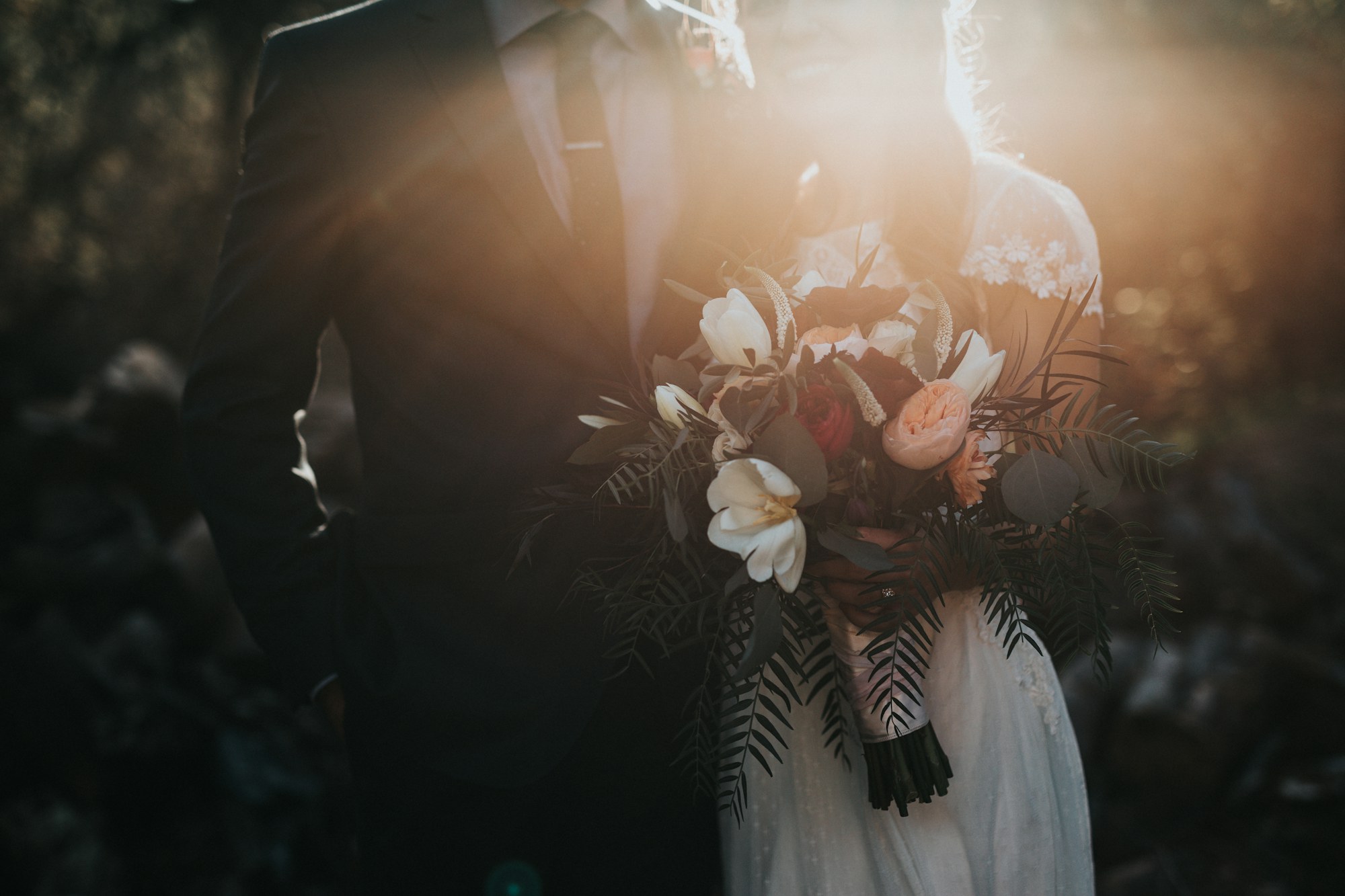
The Compositional Problem Unique to a Long Entrance
Most arrangements are designed for a single primary viewing distance. A dining table arrangement is experienced from across the table — 3 to 5 feet. A mantelpiece arrangement is read from across the room — 10 to 15 feet. A ceremony bouquet is seen from the pews — 15 to 30 feet — then up close in photographs. In each case, a primary distance governs the compositional decisions: the stem heights, the bloom spacing, the silhouette, the degree of negative space between flower heads.
A long entrance has no single primary viewing distance. The guest experiences it at 60 feet from the courtyard, at 30 feet approaching the door, at arm's length walking through. A composition designed for only one of those readings fails at the other two — sometimes quietly, sometimes obviously. The arrangement that holds is the one that was composed with all three distances as active requirements, not as afterthoughts to the worktable version.
This is what it means for an arrangement to be remade: not rebuilt physically, but resolved differently at each approach, offering something distinct at each distance without contradicting what it offered at the last.
The Three Distances — How Wedding Entrance Flowers Are Actually Read
At 40 to 70 feet, the individual flower is not legible. Bloom species, color variation, the specific tone of a Quicksand rose against dusty miller — none of this registers at distance. What registers is shape, mass, and the contrast of the arrangement against its background. The silhouette carries everything. An arrangement that reads as a tall, gently irregular column of warm material against a stone pillar is doing its compositional work from sixty feet. An arrangement that reads as an indistinct horizontal cluster has already failed before a single guest has walked through the door.
At 15 to 25 feet, the material becomes legible. The viewer understands: roses. Foliage. Something trailing along the lower third. The color is now readable, and the proportional relationship between elements begins to emerge. This is where the secondary structure of the arrangement must be visible — where the dusty miller reads as a distinct silver-grey material doing specific work in relation to the ivory bloom beside it, rather than as a grey blur behind the primary flower. If the arrangement has no legible secondary structure at this distance, the mid-distance reading collapses into the same undifferentiated mass the long view offered, just closer.
At arm's length, the individual stems are legible. The construction becomes visible. The specific relationship between a peony bud and the open garden rose beside it — the clematis vine finding its own line through the lower third — is what the passing guest reads. This is also where the mechanics become visible if they are exposed: foam, wire, a vessel the composition has outgrown. The arrangement that only survives at distance has a problem. The guest who walks through the entrance is reading it up close, at the distance where everything shows.
Scale, Height, and the Sight Line of the Entrance
The most immediate compositional failure in entrance arrangements is scale miscalculation — building for worktable readings rather than for the spatial reality of the venue. At 60 feet, a bloom head under 4 inches in diameter does not register as an individual focal element. It registers as texture, as color area, as part of an undifferentiated surface. For wedding entrance flowers to carry their primary structure at 40 to 60 feet, the dominant bloom needs to be large enough to read as a distinct form from that distance. This means full-headed garden roses with bloom heads of 7 to 8 centimeters or more — not spray roses, not lisianthus in bud, not smaller-headed varieties used as focal material in a context they cannot serve.
For floor-standing arrangements flanking a ceremony entrance, the working standard is a visual mass centered between 28 and 36 inches above floor level — the height at which most of the primary bloom material is concentrated. This keeps the arrangement in the natural sight line of a standing adult from any viewing distance. An arrangement with its primary material concentrated below 20 inches reads as ground-level from across the venue, regardless of how carefully it was constructed. The guest at 60 feet sees the profile of the arrangement against the background, and what sits below knee height does not read as part of that profile.
Stem length operates as an internal scale decision. A tall pedestal arrangement built with 60-to-70-centimeter stems composites differently at distance than one built with 40-centimeter stems at the same total height. The longer stem creates vertical space between bloom heads that reads as compositional intention from 20 feet — the negative space principle in large-scale floral design operates identically to its application in a dinner table arrangement, just at a different spatial scale. Dense, short-stemmed compositions read as mass. Arrangements with internal vertical space read as compositions. The distinction is legible from forty feet.
Repetition as Compositional Rhythm — and When It Becomes Wallpaper
Long entrances almost always involve repeated arrangements: pedestal pieces at regular intervals down an aisle, compote arrangements flanking each pew section, column pieces through a hall. Repetition is a compositional tool at this scale — used correctly, it creates a visual rhythm that guides the guest through the space and builds toward the ceremony. Used without intention, it produces wallpaper: a surface pattern that the guest registers as quantity rather than as a sequence of composed objects.
The distinction is made in two places: in the individual arrangement and in the spacing between repetitions. Each individual piece in a repeated sequence needs to be fully composed — not a simplified version of itself produced because the stem count was distributed across twelve repetitions rather than six. The guest who passes a pew-end arrangement at arm's length is reading that specific arrangement, not the series. If the individual piece reads as sparse or under-resolved because the budget was spread thin, the guest at passing distance will read that compromise. The series does not compensate for the individual.
Spacing determines whether the repetition reads as procession or as wallpaper. Every 8 feet is tight — the guest moves through the sequence too quickly to experience any single piece in isolation, and the overall effect reads as continuous surface decoration rather than a series of distinct compositions. Every 12 to 14 feet gives each arrangement visual breathing room: the eye arrives at the piece, rests for a moment, and moves on. That interval — the space between arrangements where there is nothing — is doing compositional work. It is the silence between notes that makes the rhythm legible.
The Arrangement That Gets Literally Remade — Composing for Transport
Some entrance arrangements are physically remade during the event: the ceremony entrance pedestal pieces moved to the reception hall during cocktail hour, the aisle compotes repurposed as dinner table flanking arrangements. This is a specific brief, and it changes nearly every compositional decision made in the original piece. An arrangement composed for one spatial context — a particular pillar, a specific wall color, a ceiling at thirty feet — will often read incorrectly in the second context without adjustment. Composing for transport means composing for both venues simultaneously.
The mechanical requirements of transport impose their own constraints. A composition that holds correctly at the ceremony entrance must also hold through being carried, loaded, repositioned, and placed in a different spatial relationship. This means the construction method — foam mechanics, water source, stem security at the vessel — needs to account for movement. An arrangement built beautifully for one position is not necessarily an arrangement that will survive being moved with its composition intact.
Materials matter here as much as mechanics. For arrangements intended to travel and then hold across a second event:
A composition designed for transport also needs to read correctly against a different background, different ceiling height, and different light conditions than the ones it was originally made for. The ivory tones of Vendela and Mondial hold well across a range of background colors; warmer-toned roses can shift significantly in tone between the cool light of a stone nave and the warmer interior light of a reception room. Color is a transport decision as much as a compositional one.
The Silhouette from the End of the Aisle
The silhouette of a wedding entrance arrangement is the composition the guest reads first — from sixty feet, before anything else is legible — and also the composition that appears in the ceremony photograph taken from the back of the venue, with the couple framed against the entrance and the arrangements visible in the background of every image from that angle. That photograph will exist for the rest of their lives. The silhouette it contains was decided or arrived at by accident.
For a tall floor-standing piece, a clear asymmetric silhouette — wider at the base, narrowing toward the top in an irregular rather than geometric line — reads clearly at distance without the formal rigidity of a perfect oval. In a historic venue where the architecture is already providing strong geometric forms, a precisely symmetric arrangement can read as theatrical, competing with the building's lines rather than working within them. A naturalistic asymmetry suggests height and organic presence, holds across multiple viewing angles, and reads consistently in photography whether the camera is at floor level or eye height.
What fails from the end of the aisle: an arrangement with no defined internal structure, where the silhouette reads as an unresolved mass regardless of what the individual stems are doing; an arrangement too narrow for its height, which reads as a vertical line rather than a presence; and an arrangement where the primary bloom material is positioned at the wrong height for the sight line. An arrangement with most of its mass below 18 inches reads as a ground arrangement from 60 feet, whether it is one or not. The silhouette is decided from the far end. Everything else is detail.
Building the Composition from Far to Near
The sequence for composing a long entrance arrangement inverts the sequence for most other floral work. Most arrangements are built from the vessel outward — the primary flower placed, the secondary material added around it, the silhouette arriving as a consequence of those decisions. A long entrance arrangement is built from the far view inward. The silhouette at 60 feet is the first decision, not a consequence.
Establish the long-distance read first. What is the silhouette profile against the specific background at this venue? What is the height at which the primary bloom material needs to sit to remain in the sight line? Are the focal flowers large enough — at 7 to 8 centimeters — to register as individual forms at 40 feet, or are they disappearing into texture? Answer those questions before a stem is placed.
Then build the mid-distance reading. What secondary material makes the composition legible at 20 feet — creates a visible relationship between the focal rose and its surroundings rather than an undifferentiated bloom-and-foliage mass? Dusty miller in a large-scale entrance arrangement does exactly the work it does on a dinner table: it creates visible contrast that allows the rose to read clearly against it. The scale is different. The principle is not.
Finally, build the passing-distance reading. The trailing clematis that finds its line through the lower third. The individual stem of lisianthus that extends slightly beyond the silhouette edge. The open peony bud beside the tighter garden rose. These are the details that reward the guest who moves through the space at arm's length, and they are invisible at 40 feet — which is exactly where they belong in the construction sequence. Last, not first.
The guest at the end of the aisle sees the arrangement one way. Halfway down, another. Passing through, another still. That is not inconsistency. That is a composition with enough depth to hold the space it was made for — each distance resolved, each reading earned, the arrangement complete at every point in the approach.
Begin at sixty feet. Compose inward from there. Everything else follows.
Considered
How tall should wedding entrance flower arrangements be?
For floor-standing arrangements flanking a ceremony entrance or processional aisle, the visual mass of the arrangement — where most of the bloom material is concentrated — should sit between 28 and 36 inches above floor level. This keeps the arrangement in the natural sight line of a standing adult at any viewing distance. Arrangements where primary material is concentrated below 20 inches read as ground-level from across the venue, regardless of total height.
What flowers work best for a long ceremony aisle?
Large-headed garden roses — Vendela, Mondial, Caramel Antike — carry the long-distance read at 40 to 60 feet because their 7-to-8-centimeter bloom heads register as individual focal elements. Dusty miller provides secondary texture and contrast at every distance. Trailing clematis or jasmine reads best at passing distance, adding compositional depth up close without competing with the silhouette at distance. Spray roses and small-headed varieties belong in secondary layers, not as focal elements.
How far apart should aisle flowers be spaced?
Every 12 to 14 feet gives each arrangement visual breathing room and allows the eye to arrive, rest, and move on — the spacing that reads as a procession. Every 8 feet is too tight; the guest moves through the series without experiencing a single piece as an independent composition. The spacing decision is a rhythm decision: it determines whether the repeated arrangements read as intention or as quantity.
Can ceremony flowers be reused at the reception?
Yes, but the arrangement must be composed for it. Pieces designed for transport need a tighter silhouette that holds during movement, stems pre-conditioned to last across the three-to-four-hour gap between ceremony and reception, and a construction method — foam mechanics, secure water source — that allows repositioning without stem loss. Vendela and Mondial hold most reliably through transport. The arrangement also needs to read correctly against a different backdrop, light condition, and ceiling height.
How do you design flowers for a large venue entrance?
Begin at the long view — 60 feet — and establish whether the silhouette and scale read at that distance before designing anything else. A bloom head under 4 inches does not register at 40 to 60 feet. Visual mass should be concentrated at standing eye level, roughly 28 to 36 inches above the floor. Then build toward the viewer: add the mid-distance material that becomes legible at 20 feet, and the trailing or fine-detail material that rewards the passing guest. Compose from far to near, in that order.
What does an asymmetric silhouette do for a ceremony entrance arrangement?
An asymmetric silhouette — wider at the base, narrowing irregularly toward the top — reads clearly at distance without the formal rigidity of a perfect oval or column. In a historic venue where the architecture already provides strong geometry, a symmetric silhouette can feel theatrical and competing. A naturalistic asymmetry suggests height and presence without hard edges, holds across different viewing angles, and reads consistently in photographs taken from the back of the venue during the ceremony.