On the Discipline of a Quiet Tablescape for an Autumn Dinner
There is a dinner table that has already failed before anyone sits down. The arrangement is full — dahlias, amaranthus, three kinds of foliage, and a ring of votives that circles the perimeter like a moat. The guests arrive. They move the candles to see each other. They shift their wine glass to the left because there is nowhere else for it. By the second course, someone has pushed the centerpiece to one side and the evening continues around it, politely ignoring the effort. This is the table that worked too hard.
36 min read · Les Fleur Company
What the Dinner Table Actually Asks of an Arrangement
A dinner table is a stage for conversation, not for flowers. The arrangement's job is to mark the occasion without demanding attention — to signal that someone considered the room, then stepped back. When the flowers succeed, no one talks about them. When they fail, they are the only thing anyone talks about, usually while repositioning them.
This is a different brief than a ceremony arch or an entrance installation. Those arrangements are meant to be looked at directly. The dinner table asks the opposite: arrive, and then recede.
For an autumn dinner tablescape specifically, this discipline matters more than at any other time of year. The season's colors are inherently strong. A full arrangement of deep burgundy dahlias and copper beech branches is compositionally assertive — it reads before anything else in the room registers. The work is to use those same materials with enough restraint that they read as atmosphere rather than as decoration. That is a narrower target than it sounds.
The Autumn Dinner Tablescape and the Problem of Abundance
Autumn is the one season that requires the most rigorous editing. A peony-heavy spring table is easily kept light. But in October, the florist's cooler is loaded: Caramel Antike garden roses, dusty miller, dried pampas, smokebush, lisianthus in pale mauve, amaranthus that hangs in long cordovan drops, Quicksand roses in their particular tone of warm blush-nude. The temptation to include each of them is real.
Each of those materials is beautiful on its own terms. Together, unchecked, they produce a table that feels stuffed — visually heavy before the first course arrives.
The discipline begins at selection, not arrangement. For a seated dinner of eight to twelve covers, the composition typically wants no more than three to five distinct elements: a primary flower, a secondary texture, a foliage, and a structural accent at most. The fifth element is a considered decision. The sixth is almost always a mistake.
Consider what each material contributes before committing to it:
When a material cannot answer the question — what specifically is this doing that the other stems are not — it is the stem that comes out. Not the question.
Sightline, Height, and the Architecture of the Dinner Table
The single most common failure in dinner table florals is not the choice of flower. It is the height. Specifically, the failure to understand that height on a dinner table is not a neutral decision — it is a spatial one, and it determines whether the table can function as a table.
There is a zone — from approximately 10 to 22 inches above the table surface — that interrupts conversation at a seated dinner. A guest looks through the arrangement, not past it or cleanly under it. Faces disappear. The table fractures into two parallel conversations, each side speaking around the flowers rather than across them. By the end of the main course, someone has moved the arrangement.
The solution is not complicated: go low or go tall. A bowl or shallow vessel sitting at 8 to 10 inches clears the sightline entirely. A tall narrow arrangement — long stems in a column vessel reaching 26 to 30 inches above the surface — lifts the flowers above eye level and opens the view cleanly beneath them. Both approaches function. The middle does not.
For an autumn dinner tablescape, the low arrangement is usually the right call. The season's materials — short-stemmed garden roses, the natural arc of a dusty miller stem, the compact weight of a branching foliage — read better close to the table. Their warmth and texture are experienced at nearness, not from across the room. A guest leans forward slightly. They notice the exact tone at the center of a Quicksand rose, the specific grey of the dusty miller against the linen. This is the arrangement doing its work without announcing itself.
A tall arrangement belongs at a long banquet table, where it serves as a vertical anchor at measured intervals. At a table of eight, one low composition flanked by two or three votive clusters is sufficient. The table does not need more than that.
The Flowers That Belong in October
Not every flower that is available in autumn belongs on an autumn dinner table. The question is not what the season produces but what behaves well in a restrained, low composition under candlelight across a three-hour dinner.
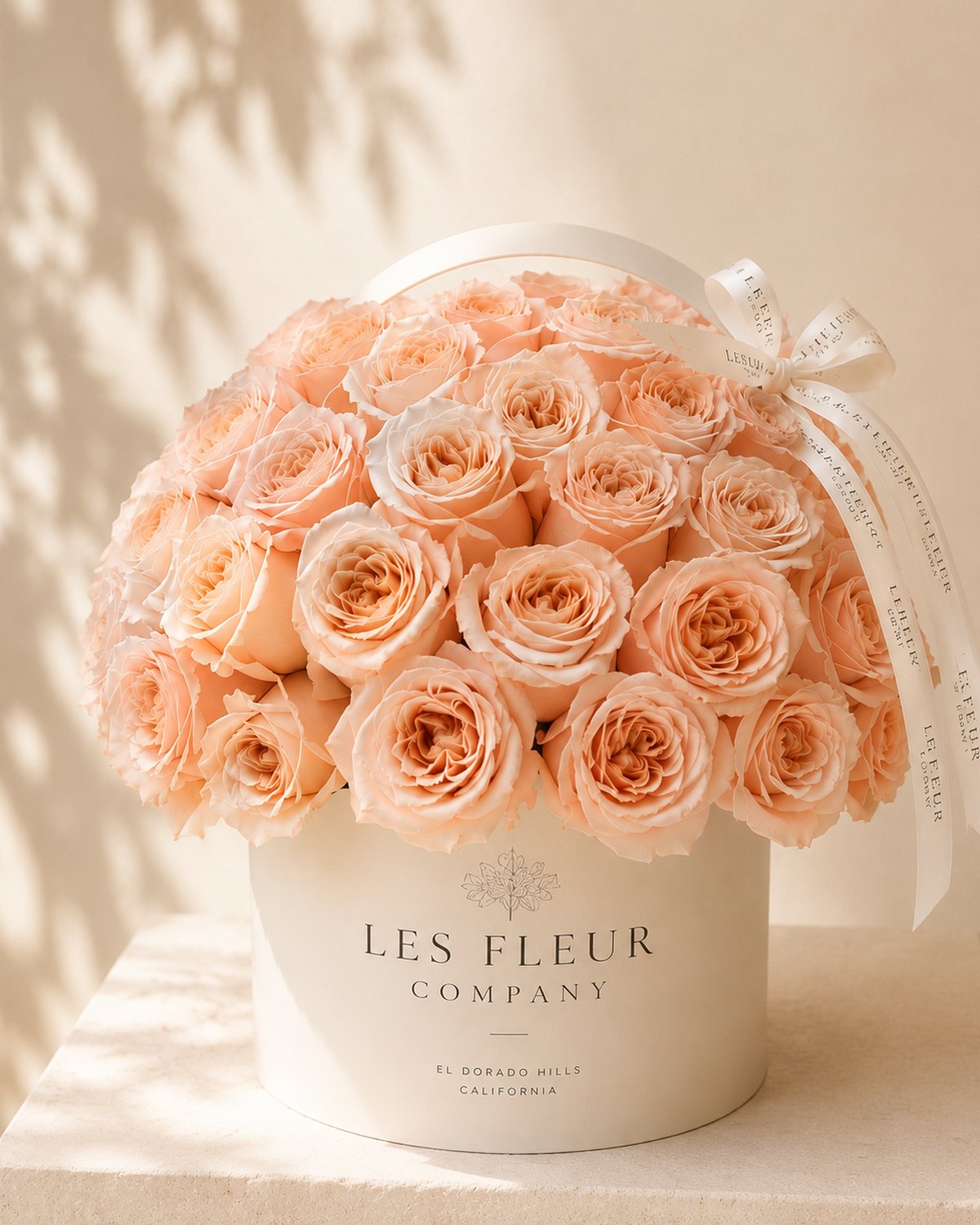
Quicksand roses are close to ideal for this purpose. Their color — a warm, dusty blush-nude that reads differently depending on the light source — does not overstate itself at any hour. They open slowly and hold their form past midnight. The Caramel Antike, a heritage-adjacent garden rose with cupped petals and a slightly bronzed inner tone, is a deeper option for a palette that runs warmer. Both varieties carry the season without requiring it to be announced.
Lisianthus in ivory or pale rose provides volume without heaviness — a quality that is genuinely rare in autumn materials. It is a flower that is easily underestimated: the stems are long, the bloom is full, and it holds well out of water during a full evening of service. In a low autumn arrangement, lisianthus occupies the middle distance between the rose and the foliage, keeping the composition from reading sparse without adding visual density.
Dusty miller is not a filler material. It is structural. The silver-grey of its leaf surface cools any warm palette and allows adjacent tones to read more clearly against it. A single dusty miller branch trailing slightly over the lip of the vessel does more compositional work than three stems of generic greenery packed behind the primary flowers.
Clematis vine — particularly in late autumn before full frost — provides the trailing quality that the low composition sometimes wants without the bulk of additional foliage. It moves. It finds its own line. Three or four vine lengths tucked under the roses change the character of the arrangement without changing its weight or height profile.
What does not belong at an autumn dinner table: sunflowers (compositionally declarative, they insist on being seen), orange asiatic lilies (the color and fragrance compete directly with the food and the conversation), heavy tropical foliage used as structural fill, and anything that has been dyed, bleached, or spray-painted to read as seasonal. The autumn palette is already warm. It does not need amplification.
Color Without Declaration
Autumn's palette is simultaneously its greatest gift and its primary risk. Burgundy, terracotta, deep rust, pale amber, dusty mauve — these are beautiful colors, and they carry considerable visual weight. A table that commits fully to that palette can feel dense before the first course is served.
The restraint is in choosing which colors to use and which to imply.
Quicksand roses imply warmth without committing to orange or red. Pale lisianthus implies ivory without going stark. The burgundy arrives through a single long stem of hanging amaranthus — not five — or through a length of vine that has begun to turn. The dark tone enters as an accent and reads as depth, not statement. The table carries the season without announcing it to the room.
Candlelight changes everything. A color that reads as warm terracotta in the afternoon light reads almost as pale blush when the tapers are lit and the overhead lights are low. This is worth testing before the evening: arrange the table in the room, light the candles, sit down at the correct seated height and look at it. What the arrangement looks like at noon is not what it will look like at eight o'clock. The two are different compositions.
Vessels carry color even when they appear neutral. A low ceramic bowl in matte sand, mushroom, or stone grey cooperates with almost any autumn palette without adding its own voice to the arrangement. A polished brass compote is more assertive — it introduces warm reflection that participates actively in the composition. Clear glass disappears entirely, which is its own kind of statement. The choice of vessel is a color decision as much as any flower selection, and it is made first.
What to Leave Off the Table
Composition is as much about removal as addition. For the autumn dinner table, this means making deliberate decisions about elements that have nothing to do with flowers.
Scatter petals: never. They read as effort — as someone wanting the table to be noticed as designed. By the end of the first course, they are displaced and beside the point.
Ribbon and wired decorative bows belong on a gift. Not on a table arrangement. Not under any framing of the word seasonal.
Excess greenery used as structural fill: eucalyptus has its place and its particular grey-green is useful, but a table arrangement that is thirty percent eucalyptus reads as a decision deferred rather than made. If the flowers are not providing enough, the answer is fewer materials arranged with more intention — not more greenery loaded behind them.
The napkin matters. A napkin folded into a standing form competes with the flowers for vertical interest at a low table. A napkin laid flat or simply draped allows the arrangement to own its territory. The linen, the ceramic, the unlit taper before the match is struck — these are all part of the tablescape whether they contain flowers or not. They are either working with the arrangement or against it. The discipline of the whole table is the same discipline as the arrangement itself: each element is either there for a reason or it is not there.
The table that works is the one where every element — vessel, flower, foliage, candle, linen — has been considered and either included for a specific reason or set aside. It does not feel empty. It feels resolved. Those are different conditions, and the difference is visible from across the room.
The Arrangement That Does Its Work
An autumn dinner table arranged with discipline does something specific: it disappears into the evening.
The guests arrive and register the table as whole — warm, considered, particular to the season and the hour. They do not pause at the flowers. They find their seats. Over the next two or three hours, the candlelight changes, the roses open a half-inch, the room settles into dinner and conversation and the kind of time that tables are actually built for. At no point does anyone move the arrangement. At no point does the table interrupt what is happening at it.
This is what occasion florals are for. Not to be admired, exactly — or not only. To do their work quietly, without asking to be acknowledged for it.
For the host or florist composing an autumn dinner tablescape, the organizing questions are simple and concrete: Is there room for a wine glass on either side of the arrangement without touching it? Can two people seated directly across from each other see each other's faces without moving anything? Is there a stem in the composition that is not earning its position? Is there anything on the table that could be removed and not missed?
When the answers are yes, yes, no, and yes — the table is ready. The work is done. Set the candles and step back.
The eleventh stem is always easy to add. It is harder, and more important, to put it back.
Considered
What flowers work best for an autumn dinner table arrangement?
Quicksand and Caramel Antike garden roses, lisianthus in ivory or pale rose, dusty miller, and clematis vine behave best in a low, restrained autumn dinner arrangement. They open slowly, hold their form across an evening, and carry the season's palette without overstating it. Avoid sunflowers and orange asiatic lilies, which compete with the conversation.
How tall should a dinner table centerpiece be?
Stay below 10 inches or go above 22 to 24 inches. The zone between those heights falls directly in the conversation sightline — guests look through the arrangement rather than past it, and the table fractures into two halves. For most seated dinners of eight to twelve, a low bowl at 8 to 10 inches is the right call.
How many stems do I need for a dinner table centerpiece?
For a table of eight to twelve, a low arrangement with 12 to 18 stems across three to five varieties is typically sufficient. The number matters less than the discipline of the selection: each stem should have a distinct role — primary color, secondary texture, foliage, structural accent. A stem that cannot answer what it is doing specifically should come out.
What colors work best for a fall tablescape?
The strongest autumn tablescapes use a narrow range of the season's palette rather than its full spectrum. Warm blush-nude (Quicksand rose), dusty silver-grey (dusty miller), pale ivory (lisianthus), and a single deep accent — hanging amaranthus in cordovan, or a smilax length that has begun to turn — carry the season without making the table feel dense.
When should I arrange flowers before a dinner party?
Arrange the table flowers three to four hours before guests arrive. This gives roses time to open slightly and the composition to settle into the vessel. Avoid arranging more than six hours in advance; garden roses and lisianthus perform better with a fresh stem cut and clean water within the day of the event. Always light the candles and evaluate at table height before the evening.
What is the best vessel for an autumn dinner table arrangement?
A low ceramic bowl or compote in matte sand, mushroom, or stone grey cooperates with the autumn palette without adding its own color. Clear glass disappears into the table. Polished brass participates — it introduces warm reflection that becomes part of the composition. The vessel is a color and composition decision before it is a practical one.