Floral Composition Balance for High-Occasion Events
A bride stood at the back of a ballroom in Lake Tahoe last October, looking at the arch her florist had built for the ceremony that would start in forty minutes. Something was wrong and she couldn't name it. The stems were the right variety. The palette was the one she'd approved in April. But one side of the arch felt heavier than the other, and no amount of adjusting the bow was going to fix it. What she was seeing, without the vocabulary for it, was a failure of balance — the single most difficult thing to get right in floral composition, and the thing most often overlooked in favor of counting stems and matching swatches.
32 min read · Les Fleur Company
What Balance Actually Means in Floral Composition
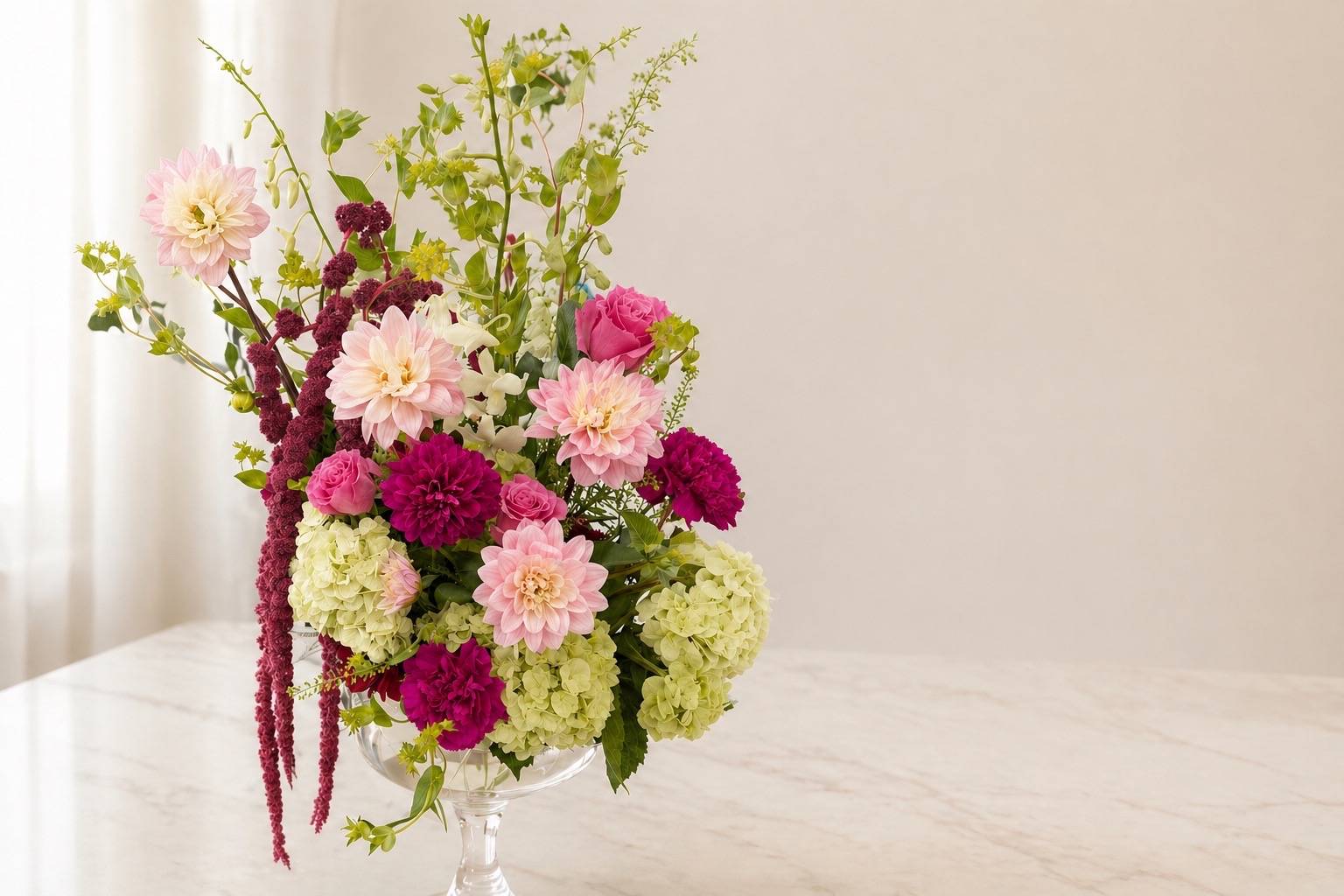
Balance is the distribution of visual weight around a center. It has nothing to do with counting stems evenly on each side of an arrangement — a common misunderstanding among clients pricing out their first wedding. Ten garden roses on the left and ten on the right can still look lopsided if the left cluster is a deep burgundy Mondial and the right is pale blush Vendela. Color carries mass. Density carries mass. Height carries mass. A single dark clematis bloom against pale dusty miller can outweigh five stems of something lighter.
This is why an experienced designer builds an arrangement by eye and by rotation, turning the piece every few minutes rather than working it flat from one angle. A composition assembled from a single fixed position almost always leans, because the builder's own hand and eye favor one side without noticing.
The essential elements of a timeless floral composition all trace back to this one principle — silhouette, focal point, and rhythm only work if the weight underneath them is distributed correctly. Get balance wrong and the other four elements are cosmetic.
Symmetrical Balance: When the Room Calls for It
Symmetrical balance mirrors weight exactly across a central axis — the classic urn arrangement, the matched pair of pedestal pieces flanking an altar. It reads as formal, composed, and deliberate. It is also the least forgiving structure in floral design, because any deviation is immediately visible. A single stem out of place in a symmetrical piece reads as a mistake in a way it would not in an asymmetrical one.
Symmetry tends to work in rooms that are already symmetrical — a cathedral with a center aisle, a ballroom with matched columns, a formal garden with a straight allée. In these settings, asymmetrical arrangements can look accidental, as though the florist ran out of material on one side.
A working rule from twenty years of ceremony builds: if the architecture has a centerline, respect it. If it doesn't, don't force one. Most historic venues in San Francisco were built with a strong axis in mind, which is part of why San Francisco weddings so often lean toward matched, symmetrical florals at the ceremony point even when the reception loosens into something wilder.
The cost of symmetry is time. A matched pair of six-foot pedestal arrangements takes roughly twice as long to build as a single asymmetrical urn of comparable stem count, because every addition on one side has to be checked and mirrored on the other before the next stem goes in.
Asymmetrical Balance: Weight Without a Mirror
Asymmetrical balance distributes weight unevenly in position but evenly in effect — a large, dense cluster of peony set low and to one side, counterweighted by a single trailing stem of clematis reaching in the opposite direction. It is the harder skill to teach, because it cannot be measured with a ruler. It has to be felt, then checked.
This is the structure that suits long farm tables, garden ceremonies, and anything installed against an irregular backdrop — a stone wall, a sloped lawn, a room with windows on only one side. Asymmetry lets the composition respond to the space instead of imposing a shape on it.
A useful working method: build the dominant mass first, then place the counterweight before adding any secondary material. Designers who build the small, airy elements first tend to lose track of where the true visual anchor should sit, and the arrangement drifts. Eucalyptus and lavender are frequently used as counterweight material precisely because they carry so little visual mass on their own — a long trailing stem of eucalyptus can balance a dense rose cluster without competing with it for attention.
Get this wrong and the arrangement looks unfinished rather than intentionally loose — the most common note a lead designer gives a junior florist during a final walk-through.
The Weight of Color and Density
Color has to be treated as a physical variable, not a decorative one. A deep burgundy or near-black dahlia reads as heavier than its actual stem count would suggest, the same way a small dark object draws the eye in a photograph before a larger pale one does. Studios that ignore this end up with arrangements that are numerically even and visually lopsided.
Density behaves the same way. A tightly packed cluster of eight lisianthus reads heavier than twelve stems spaced with breathing room between them, because the eye reads negative space as a signal of where weight is not. This is covered in more depth in color theory in wedding floral composition, but the short version for balance purposes is this: before adjusting stem count to fix a lopsided piece, check color and density first. Most corrections are solved by moving three or four stems rather than adding new ones.
A practical test used in the workroom: photograph the arrangement in black and white on a phone. Color often disguises an imbalance that becomes obvious the moment it's removed — a dark cluster that looked fine in full color suddenly reveals itself as the heaviest point in the frame.
Negative Space as a Load-Bearing Element
The eleventh stem ruins the composition. This is not a figure of speech in a working studio — it is close to literal. Most arrangements reach their correct visual weight at a specific stem count, and every stem past that point begins subtracting from the piece rather than adding to it, because it eats into the negative space holding the composition together.
Negative space is not empty space. It is the gap that lets the eye travel from the dominant bloom to the counterweight and back, the pause that keeps a dense arrangement from reading as a solid block of color. Removing negative space by overfilling an arrangement is the single most common mistake made under time pressure — when a florist has ten minutes left before a ceremony start and reaches for more material instead of stepping back.
A rough guideline used in high-volume production weeks: for a standard 14-inch compote centerpiece, the working range is 35 to 45 stems depending on variety size. Past 50, most arrangements in that vessel size begin to lose the gaps that hold the balance together, regardless of how carefully the color and height were planned. The discipline of subtraction — cutting a finished-looking arrangement back down — is harder to teach than the discipline of addition, and it is the mark of a designer who understands composition for high-elegance centerpieces rather than simply filling a container.
The Ten-Foot Test: A Working Method
Every arrangement leaving the workroom for a high-occasion event goes through the same check before it's loaded: step back ten feet — roughly the distance a seated guest views a centerpiece from — and look for ten seconds without touching anything. If the eye settles across the piece and moves comfortably between the focal bloom and the counterweight, it's balanced. If it snags on one corner or keeps returning to a single dense cluster, it isn't finished.
This test matters because most balance corrections happen at close range, where a designer's face is eighteen inches from the flowers and every stem looks individually justified. Distance is what reveals weight. A designer working alone on a large installation should physically walk away from it every fifteen minutes, not just at the end.
For a wedding with forty centerpieces built by a team of six, the ten-foot test also has to be run at the venue, not only in the workroom, because lighting changes visual weight. A candlelit reception at dusk makes dark, saturated blooms read heavier than they did under workroom fluorescents — a burgundy dahlia that looked balanced against ivory garden roses at 2pm can dominate the same arrangement by 7pm. Teams that skip the on-site recheck are the ones who find out at cocktail hour that six tables need adjusting.
Common Balance Mistakes at High-Occasion Events
The most frequent error is treating balance as a one-time decision made during design, rather than a condition checked at each stage of production. A composition can be perfectly balanced on the workroom table on Tuesday and arrive lopsided on Saturday because three stems wilted unevenly in transport.
A short list of what actually goes wrong, drawn from post-event debriefs across several seasons:
Every one of these is a process failure, not a design failure, which is why the studios that handle high-occasion volume reliably build the ten-foot check into their timeline rather than treating it as optional polish.
Balance Across a Multi-Arrangement Event
A single centerpiece can be perfectly balanced and still feel wrong if it doesn't relate to the ceremony arch, the bar florals, and the escort card display sitting fifty feet away. High-occasion events are judged as a room, not as a series of independent objects, and balance has to be considered at that scale too.
This does not mean every arrangement matches. It means a shared vocabulary carries across all of them — the same hero bloom appearing at different scales, a consistent ratio of dense to airy material, a palette that doesn't reset from one zone of the venue to the next. A gala with matched low centerpieces on every table but a wildly different, oversized bar arrangement will feel like two events sharing a room rather than one considered whole. This principle shows up consistently in work built for galas in El Dorado Hills, where the room itself is large enough that guests see multiple arrangements in the same sightline and any inconsistency in weight is immediately visible.
A working ratio for multi-arrangement events: the ceremony or entrance piece should read as roughly 1.5 to 2 times the visual density of the tablescape centerpieces, enough to register as the anchor without making everything after it feel like an afterthought.
Materials That Hold Balance Over the Length of an Event
Balance measured at 4pm is not the same as balance at 10pm. A composition built with material that wilts unevenly will list to one side by the time the toasts start, simply because one variety lost turgor faster than its counterweight. This is where composition and heritage — the case for the flower that keeps — intersect directly.
Garden roses in the Quicksand variety hold shape and color for the length of a typical eight-hour event better than many high-water-content blooms, which is part of why they appear so often in ceremony pieces meant to be photographed at both 4pm and 9pm. Lisianthus, by contrast, is visually light early and can wilt into an even lighter presence by evening — useful if that shift is intended, a liability if the arrangement was balanced around its early fullness.
A studio that understands this builds in a small margin: slightly denser than the ten-foot test technically requires at 4pm, anticipating the loss of a few percentage points of visual weight from the more delicate material by the end of the night. This is a craft judgment learned from watching hundreds of arrangements age across an evening, not something written into any single design brief — the kind of process knowledge covered in more detail in notes on atelier workspace design, where material handling and timing are treated as seriously as the arranging itself.
Working With Your Florist to Hold Balance
Clients rarely arrive at a consultation with the word balance in their vocabulary, and they don't need to. What they can bring is specificity about the room: where guests will actually stand, what time the light changes, whether the space has a natural centerline. That information is what lets a florist decide between symmetrical and asymmetrical structure before a single stem is cut.
A reasonable question to ask any florist during a proposal walk-through: how will the arrangement be checked before it leaves the workroom, and will it be rechecked on-site under the venue's actual lighting. A studio with a real process will have a specific answer rather than a general assurance.
The bride in Tahoe got her arch corrected in the end — four stems moved, one removed entirely, eleven minutes before the processional. Nobody in the room that day could have said what changed. That's the actual measure of balance done right: not that anyone praises it, but that no one notices anything was ever off.
Considered
What does balance mean in floral design?
Balance means the visual weight of a composition is distributed so no single area pulls the eye and holds it. It accounts for color density, stem mass, height, and negative space — not simply an equal stem count on either side of a central axis.
How do you measure balance in a floral arrangement?
Step back ten feet, the distance a guest would actually view it from, and give it ten seconds. If the eye settles across the whole piece rather than snagging on one dense corner or one dark cluster, the composition is balanced.
Is symmetrical or asymmetrical balance better for weddings?
Neither is inherently better — the room decides. Formal, architectural spaces with center aisles tend to hold symmetry well. Long farm tables, garden settings, and asymmetric room lines usually read better with weighted asymmetrical composition.
Why does negative space matter in floral composition?
Negative space gives the eye somewhere to rest. Without it, a dense arrangement reads as a mass rather than a composition. It is a deliberate structural choice, not an absence of flowers.
How many arrangements need to match at a wedding for the room to feel balanced?
Not all of them need to match — they need to relate. A shared palette, a repeated hero bloom, and consistent density across the ceremony, tablescape, and bar florals let the room read as one composition even when the pieces differ in scale.
Can a floral arrangement be too full to be balanced?
Yes. Past a certain stem count, additional flowers stop adding to the composition and start competing with it. Studios that work by discipline often remove stems at the end of construction rather than add them.