Petal Composition in Wedding Floral Arrangements
A bride once asked why her bouquet, built from the same flower order as her sister's three years earlier, looked heavier in every photograph. The order was nearly identical — garden roses, lisianthus, a few stems of clematis threaded through. The difference was not the flowers. It was the petals. One arrangement had been composed with space between its forms; the other had been packed until every petal touched another. Petal composition is the part of floral design that rarely gets named and almost always gets felt.
27 min read · Les Fleur Company
What Petal Composition Actually Governs
Composition in wedding floral arrangements is usually discussed in terms of stem count, bloom choice, and color. Petal composition sits one level below that — it is the density, overlap, and spacing of the petals themselves, and it is what determines whether an arrangement reads as considered or simply full.
Two bouquets with the same eleven stems can look entirely different depending on how open each bloom is allowed to be. A garden rose at quarter-bloom holds its petals close and reads as a single, quiet form. The same rose left to open fully becomes a cluster of individual petal planes, each catching light differently. Neither state is wrong. But mixing too many fully open blooms in one composition multiplies the visual information the eye has to process, and the arrangement starts to compete with itself.
This is why two florists working from an identical flower list can produce work that feels worlds apart. The discipline is not in the sourcing. It is in knowing, bloom by bloom, how much petal the composition can hold before it stops being legible. The essential elements of a timeless floral composition rest on this kind of restraint far more than on the rarity of the stems themselves.
Petal Density and the Weight of a Room
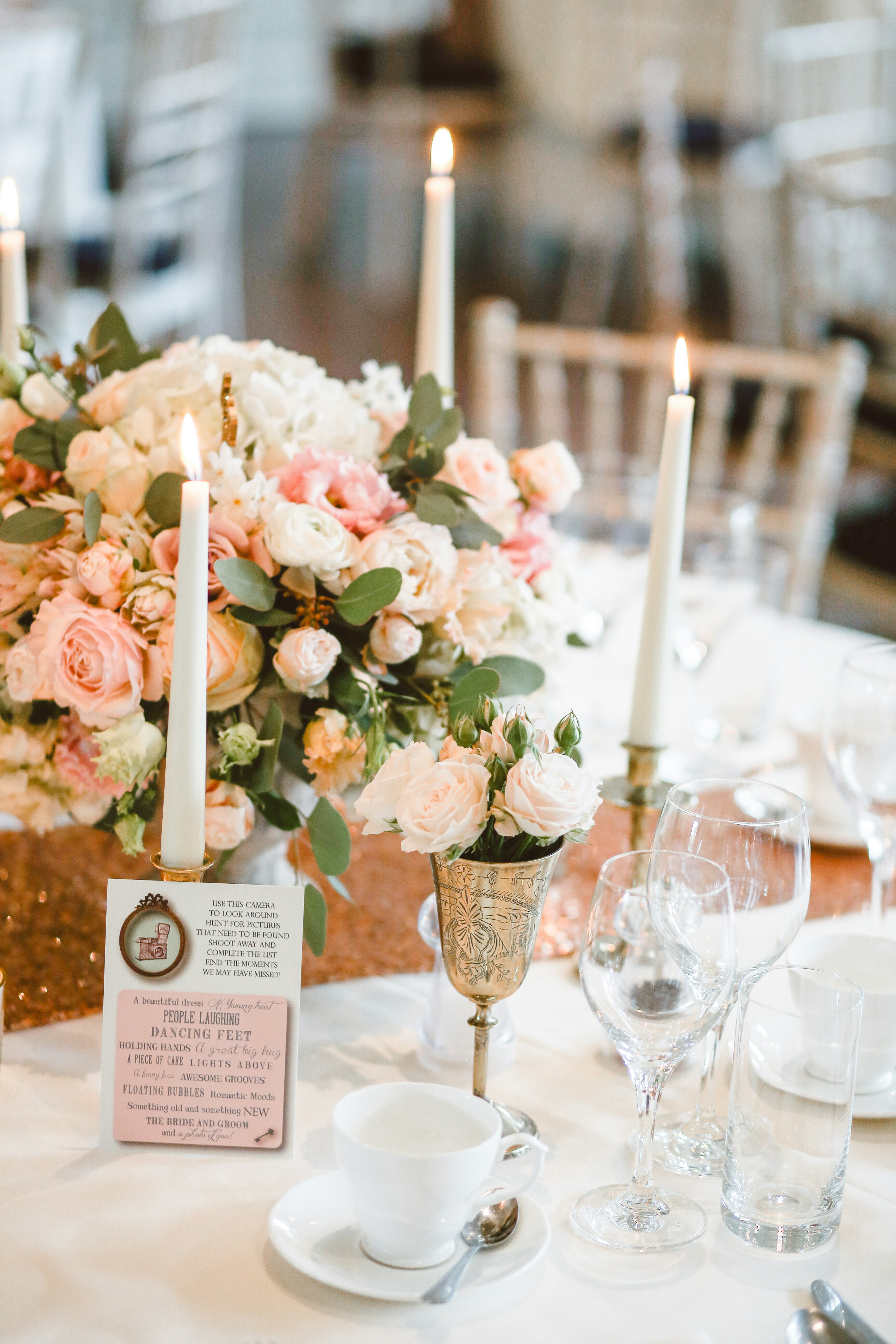
Every wedding florist has stood in a reception space an hour before guests arrive and felt an arrangement sit wrong against the room, even though nothing about the flower selection has changed since the proposal was approved. Petal density is often the reason. A centerpiece built with densely layered peonies and garden roses carries considerably more visual weight than one built with the same stem count in ranunculus and lisianthus, because the petal surface area per stem is so much greater.
In a long reception table setting — say sixty feet of tablescape — that weight compounds. Ten centerpieces of dense, fully-petaled blooms can visually shrink a room that was meant to feel open. The same ten centerpieces, composed with looser petal density and more negative space between forms, let the architecture of the room continue to breathe.
This is a calculation experienced studios make at the proposal stage, not the week of the event. A ballroom with eighteen-foot ceilings and heavy drapery can absorb petal-dense, architectural compositions. A garden tent with natural light and open sides generally cannot — the density competes with what is already there. Matching petal weight to room is as much a part of composition as matching color to linen.
Garden Roses and the Grammar of Overlap
Garden rose varieties behave differently enough from one another that treating them as interchangeable is a common and costly mistake. Mondial opens into a dense, cupped form that holds its petal structure for days. Vendela carries a looser, more romantic overlap and opens faster once conditioned. Quicksand sits between the two, with a warm petal edge that reads differently under candlelight than under daylight.
Composing with these varieties means understanding how their petals overlap as they age, not only how they look on delivery morning. A Mondial-heavy bouquet built tight at 8 a.m. will have opened considerably by the first dance. A florist who has not accounted for that will see an arrangement that photographs well at the ceremony and looks overfull by the reception.
The grammar of overlap extends to how roses are paired with finer-petaled material. Lisianthus, with its ruffled, papery petal, reads as a textural counterpoint to the dense rose — but only if it is given room. Packed against a fully open garden rose, lisianthus loses its own character and becomes noise. The craft is in letting each material's petal structure remain legible beside the next, which is the same discipline discussed in the balancing act of harmony in floral composition.
Negative Space Between Petals, Not Only Stems
Florists are trained early to leave negative space between stems — the gaps that let an arrangement breathe and keep it from reading as a solid mass. Fewer are trained to think about negative space between petals within a single bloom cluster, which is a subtler and arguably more important discipline.
Consider a cluster of three garden roses set close together. If each rose is allowed to open fully with no consideration for how their petal edges meet, the three blooms merge into one visual unit and the individual form of each rose disappears. Stagger their bloom stage instead — one at half-open, one at three-quarters, one fully open — and the cluster reads as three distinct, considered forms, even though the stems sit inches apart.
This is the same principle at the scale of a single petal cluster that negative space provides at the scale of an entire arrangement. It is also why studios condition roses to different bloom stages in the days before an event rather than simply ordering more stems to fill volume. Volume without staggered petal stage produces density. Staggered petal stage produces composition.
A bride planning a wedding in Lake Tahoe or along the coast should ask her florist directly how bloom staging will be handled across the timeline of the day — the question reveals more about a studio's discipline than any mood board.
The Eleventh Petal
The idea that the eleventh stem ruins a composition is familiar to most florists who have trained under a disciplined eye. Less discussed is that the same rule applies within a single bloom. A garden rose with its outer guard petals left intact reads as dense and formal. Remove two or three of those outer petals — a technique sometimes called petal reduction — and the same rose opens its form, exposes more of its inner structure, and sits lighter within the composition.
This is not a trick reserved for photography-ready blooms. It is a working tool used throughout an arrangement to control exactly how much visual weight each stem contributes. A bouquet of twelve roses, each reduced by two or three outer petals, can read as more refined and more intentional than a bouquet of eight roses left fully intact.
The test is the same one applied to stem count: build the arrangement, then ask whether removing the last petal cluster improves it. If the answer is yes, the composition was carrying weight it did not need. This discipline is detailed at the arrangement level in crafting a composition that bridges tradition and modernity, where restraint rather than addition is treated as the primary design tool.
Common mistakes at this stage include over-correcting — reducing so many petals that the bloom loses its identity — or applying the technique unevenly across an arrangement so some blooms read as sculpted and others as simply full. The fix is consistency: decide the petal density target for the piece before conditioning begins, then apply it to every stem the same way.
Seasonal Material and Petal Behavior Across a Wedding Day
A wedding day is long. Hair and makeup can begin at 7 a.m.; the last dance can run past 10 p.m. Flowers conditioned for that span behave differently from flowers built for a single photograph, and petal composition has to account for the full arc, not the first hour.
Peonies are the clearest example. A peony delivered tight and nearly closed will open across the day at a rate that depends heavily on ambient temperature — faster in an 85-degree outdoor ceremony, slower in an air-conditioned ballroom. A bouquet built with peonies at the wrong starting stage for its environment can arrive at the reception either still closed and underwhelming or fully blown and shedding petals on the dance floor.
Clematis and lisianthus behave more predictably but still shift — clematis petals can bruise in high heat, and lisianthus will drop its outer petals if handled roughly during transport. A studio that has run enough weddings builds in a margin: extra conditioning time, cooler storage until the last possible moment, and a petal-stage target calculated backward from the ceremony time rather than forward from the delivery truck.
Clients planning outdoor ceremonies in warmer settings — El Dorado Hills among them — should ask specifically how their florist plans for heat and petal drop across the day, since this is where petal composition and logistics intersect most directly.
Texture as a Compositional Tool, Not a Finishing Touch
Color gets the credit in most wedding floral conversations, but texture — which is really petal surface and petal density expressed visually — does as much compositional work. The matte, felted leaf of dusty miller set against the glossy curve of a eucalyptus leaf creates contrast before a single color decision has been made. The same is true at the petal level: the dense, velvet layering of a peony against the papery ruffle of lisianthus reads as considered even in a monochrome palette.
Experienced designers build palettes by texture first, color second. A blush-and-ivory palette composed entirely of smooth, uniform petal surfaces — one type of garden rose, nothing else — will read as flat regardless of how carefully the hues were matched. Introduce a textured counterpoint, and the same palette gains depth without adding a single new color to the order.
This is the reasoning behind pairing dense bloom types with finer, airier material rather than doubling down on a single texture for volume. The principle is explored further in color theory in wedding floral composition, where palette sophistication is shown to depend on textural range as much as on hue selection.
Common Mistakes in Petal-Heavy Compositions
A handful of errors show up repeatedly in petal-dense wedding work, and nearly all of them are correctable before the event rather than after.
Studios that build endurance into their work — arrangements meant to be photographed for decades, not just for a single evening — treat these corrections as standard practice rather than exceptions, a point addressed directly in composing for endurance in timeless floral arrangements.
A Quiet Observation
Petal composition is rarely what a client asks for by name. They ask for something that feels right in the photographs, something that does not compete with the room, something that still looks composed by the time the cake is cut. All of that is petal composition, working without being noticed — which is, in the end, the point.
Considered
What does petal composition mean in floral design?
Petal composition refers to how the density, layering, and spacing of individual petals within and across blooms shape an arrangement's overall silhouette. It governs how light moves through the piece and where the eye lands, independent of which flowers are used.
Why do some wedding arrangements look crowded even with fewer flowers?
Crowding usually comes from petal density, not stem count. A handful of fully opened garden roses can carry more visual weight than a dozen tighter blooms, so an arrangement with fewer stems can still read as overfull if those stems are petal-heavy and packed without negative space between them.
How many flowers should be in a bridal bouquet for proper composition?
There is no fixed number — the right count depends on bloom size, petal density, and the silhouette being built. A disciplined composition is tested by removing one stem at a time; if the arrangement improves, that stem was the eleventh one and did not belong.
Do garden roses hold their shape through a full wedding day?
Garden rose varieties such as Mondial and Vendela open progressively over 8 to 12 hours once cut and conditioned, so a bouquet built tight at 9 a.m. will show considerably more open petal by evening. Composition has to account for that unfolding, not just the bloom's state at delivery.
What is negative space in a floral arrangement?
Negative space is the visible gap between stems, blooms, or petal clusters that lets the eye rest and the individual forms stay legible. Without it, even well-chosen materials collapse into a single undifferentiated mass.
How do florists balance color and texture in wedding florals?
Experienced florists treat texture — the matte of dusty miller against the sheen of a peony petal, the fine cut of lisianthus against the density of a garden rose — as a structural tool, not a decorative afterthought, often weighting it equally with color when building a palette.