Creating a Timeless Floral Composition: A Step-by-Step Guide for High-Society Weddings
A bride sat across the worktable in March with a screenshot folder of forty images — peony walls, delphinium arches, a cascading bouquet with what looked like ninety stems. She wanted all of it, for one wedding, in October. The honest answer, given without apology, was that most of it would fight against itself in the room. The work of a wedding florist at this level is not adding what a client points to. It is deciding what stays out.
39 min read · Les Fleur Company
The Problem With More
Every consultation eventually arrives at the same request: more flowers, more color, more texture. It comes from a good place — the day matters, and abundance feels like a proxy for care. But abundance without hierarchy produces noise, not composition.
Consider two arrangements built for the same ceremony arch. One uses eleven stem varieties at full saturation. The other uses four — garden rose, clematis, dusty miller, eucalyptus — arranged with a clear structure and about a third of the visual field left open. In every photograph taken from the aisle, the second arrangement reads clearly at thirty feet. The first reads as texture, indistinct, competing with the dress.
The eleventh stem is rarely the one that completes a composition. It is the one that ruins it. This is not a stylistic preference; it is closer to an engineering constraint. The human eye can hold a focal hierarchy of three to four levels before it starts scanning rather than settling. Past that point, more material does not add impact — it removes it.
The discipline, then, is not about doing less for its own sake. It is about deciding, before the first stem is cut, exactly what job each material is doing in the room — and refusing to add anything that does not have one.
Start With the Silhouette, Not the Flowers
The atelier process for a wedding floral composition does not start with a flower list. It starts with a shape, sketched against the specific dimensions of the room: a compact round for a table of eight, a horizontal drift for a sixty-foot farm table, an asymmetric cascade for a stone archway with uneven sightlines.
The silhouette is decided first because it determines everything downstream — stem count, container proportion, mechanics, even which varieties will hold their form under the silhouette's demands. A trailing amaranthus reads correctly in a cascade silhouette and looks like an accident in a compact round.
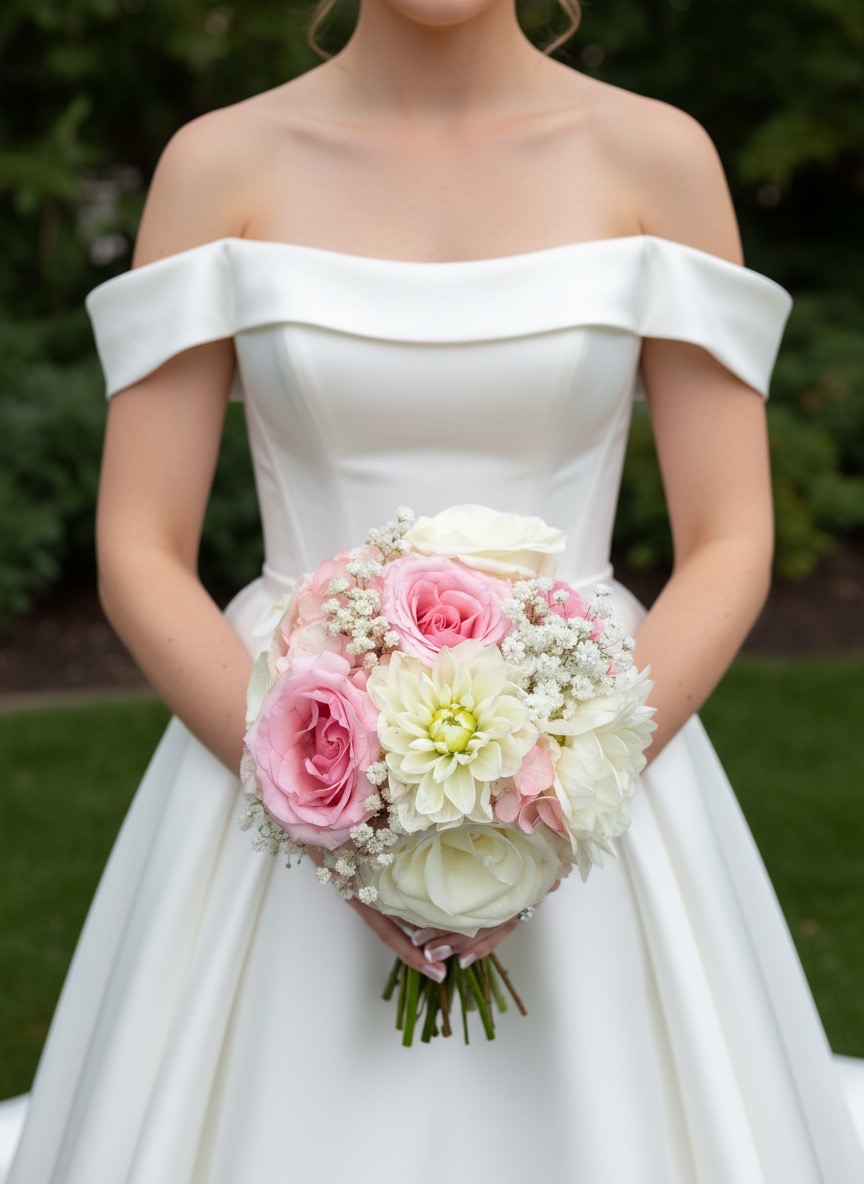
For a bridal bouquet, the working silhouette categories are limited on purpose: round, cascade, hand-tied loose form, and structured posy. Each has a known proportion — a round bouquet, for instance, generally holds at eight to ten inches in diameter for a bride of average height, scaled up or down against her frame and the dress silhouette, not against the photographs in the screenshot folder.
Skipping this step is the single most common reason a composition fails. Flowers get chosen first, out of enthusiasm, and the silhouette is forced to accommodate whatever was bought — usually resulting in a shape that is neither round nor loose, just full. Silhouette first. Materials second. The order is not negotiable.
The Stem Count Discipline
Every composition at the atelier is built against a stem count set in advance, not discovered by filling the container until it looks done. A bridal bouquet typically runs between eighteen and thirty stems, depending on silhouette and bloom size — a compact round of Vendela roses might hold twenty-two stems; a loose hand-tied piece with garden roses and clematis might use fewer, at fourteen to eighteen, because each stem occupies more visual weight.
Centerpieces follow the same logic, scaled to table size. A low compote for a round table of ten generally holds between twenty and thirty-five stems across all varieties, built in layers: structural greenery first, focal blooms second, filler and line material last.
Counting stems in advance does three things. It controls cost with precision rather than guesswork. It forces a decision about hierarchy before the build starts. And it creates a checkpoint — if the arrangement looks incomplete at the target count, the fix is rarely more stems. It is usually better negative space or a stronger focal choice.
The habit worth building, for any florist working at this level, is to write the count on the work order before the first flower is cut, and to treat going over it as a signal to stop and look at the piece, not a green light to keep going.
Choosing a Material Palette
Three to five varieties per composition is the working range, and each one earns its place by role, not by how well it photographs alone. A typical palette: garden rose (Mondial, deep and structured) as focal, lisianthus as secondary bloom, dusty miller for silver contrast and texture, eucalyptus for line and movement, and a single accent — clematis, sweet pea, or a garden rose in Quicksand for warmth — used sparingly.
Real materials, named specifically, matter here. A client asking for peony in December is asking for a compromise — imported, tighter-budded, a different flower in practice than the June peony she saw in a reference photo. Better to say so directly and offer garden roses like Mondial or Vendela, which hold their form and color consistently across seasons, than to promise a peony that will disappoint on delivery.
The palette should also be chosen against the venue's existing materiality — stone, brass, linen weight — rather than in isolation. A palette built around blush and cream reads correctly in a room with warm stone and candlelight; the same palette in a glass-walled modern venue with cool light needs more contrast to avoid washing out entirely.
Once the palette is set, resist mid-process additions. A sixth variety introduced halfway through the build, however beautiful on its own, usually means one of the original five gets crowded out of its job.
Negative Space as a Design Tool
Negative space is not the absence of design decisions — it is one of the most deliberate. In a well-built composition, roughly a third of the visual field is left open: gaps between stems, air beneath a cascade, the space where the container meets the first bloom.
This space does specific work. It gives the eye a place to land between focal points, which is what allows a composition to be read quickly and clearly from across a room or through a camera lens. Without it, even a technically well-built arrangement reads as dense, and density photographs as clutter.
The instinct to fill every gap is strong, especially under a client's eye during a final walkthrough. The correction is procedural: after the composition reaches its target stem count, step back three paces and look at it from the distance guests will actually see it — across a ceremony aisle, from the head table. Gaps that look uncomfortable up close often disappear, correctly, at real viewing distance.
Negative space is also what separates a composition from an arrangement built purely by volume. Two pieces with identical stem counts can read entirely differently depending on how the space between them is handled — one composed, one merely full.
Building the Composition: Structure, Focal, Filler, Line
The build itself follows a fixed order, and skipping steps is the fastest route to an arrangement that looks improvised rather than composed. Structural greenery goes in first — eucalyptus, dusty miller, or a similar material that establishes the outer silhouette and gives every later stem a frame to work within.
Focal blooms come next, placed at the points of visual weight the silhouette sketch already identified — never scattered evenly, which produces a spotted, unresolved look. Three to five focal points is typical for a centerpiece; a single, slightly off-center focal cluster often reads more intentional than several evenly spaced ones.
Secondary material and filler follow, used to soften transitions between focal points rather than to fill remaining gaps indiscriminately. Line material — a trailing clematis, a stem of sweet pea — goes in last, because it is the most visually active element and the easiest to overuse before the rest of the composition is settled.
The final step, and the one most often skipped under time pressure, is the edit: stepping back and removing three to five stems that were needed structurally but are no longer needed visually now that the piece is complete. This is where a composition separates itself from an arrangement. The edit is not optional; it is the last and most important stage of the build.
Working With the Venue and the Light
A composition designed without accounting for its room is a composition designed for the wrong room. Candlelight, common in evening receptions, saturates warm tones and mutes cool ones — a palette that reads correctly under studio light can go muddy under low candlelight unless the whites and creams are pushed slightly brighter to compensate.
Outdoor ceremonies bring their own variable: direct sun by early afternoon flattens color and can wilt delicate petals — lisianthus and sweet pea especially — within an hour if the arrangement isn't conditioned and, where possible, shaded until the ceremony begins. A site visit four to six weeks ahead of the wedding, at the actual hour of the event, is standard practice at the atelier for exactly this reason; a walkthrough at 10 a.m. tells a florist nothing useful about how a 5 p.m. ceremony will look.
Scale matters as much as light. A composition proportioned correctly for a twelve-foot ceiling can look undersized in a room with twenty-four-foot ceilings and oversized in an intimate parlor with eight-foot ceilings. The rule of thumb used in the studio: centerpiece height should relate to table width, and installation scale should relate to the room's vertical volume, not to a fixed measurement pulled from a past wedding.
None of this is guesswork if the site visit happens early enough to adjust the plan before materials are ordered.
Common Mistakes Couples Make — And What to Do Instead
The most common mistake is choosing flowers from inspiration photographs without checking whether those varieties are in season for the wedding date. A December wedding built around garden peony will either disappoint on delivery or cost significantly more for imported stock that behaves differently than the photograph promised. The fix: bring the inspiration images to the consultation, and let the florist translate the feeling — color, form, softness — into materials that are actually available and reliable for that date.
The second is over-ordering out of anxiety that the day will look sparse. This usually produces the opposite of the intended effect — a room that reads as busy rather than considered. The fix: trust the stem count set at the design consultation, which is calculated against the room, not against a fear of empty space.
The third is treating every table and every moment of the day — ceremony, cocktail hour, reception — as requiring the same intensity of floral design. A more resolved event uses hierarchy: significant investment at the ceremony and head table, simpler and more repeatable work at guest tables and secondary spaces. This isn't a budget concession; it is the same compositional logic — hierarchy, restraint, a clear focal point — applied to the event as a whole rather than to a single arrangement.
A fourth, quieter mistake: choosing flowers no one in the household will want to keep seeing after the wedding. Arrangements built around varieties the couple actually likes — not just what trended that season — tend to be the ones they remember warmly in the photographs for decades, which is, after all, the point.
The Timeline: From Consultation to Installation
A full-service composition, done properly, runs on a fixed calendar. At nine to twelve months out, the design consultation sets silhouette, palette, and budget — this is also when garden rose varieties like Mondial or Vendela, grown to order by specialty farms, need to be reserved, since they cannot be sourced last-minute the way standard stock can.
At four to six months, a mock-up centerpiece is built and reviewed in person wherever possible, since photographs of florals are notoriously unreliable for color accuracy. At six to eight weeks, the final stem count and material order are locked, and the site visit happens if it hasn't already. At two weeks, the final headcount-driven adjustments are made — table counts change, and the order needs to flex without redesigning the composition from scratch.
On the wedding day itself, install timing works backward from the ceremony: personal flowers and bouquets are typically the last items built, three to four hours before the ceremony, so they stay fresh through the receiving line and photographs. Structural installations — arches, large-scale pieces — go up earlier, often the morning of or the evening before, when the venue allows.
A florist who cannot walk a couple through this calendar at the first consultation is not yet ready to build the composition. The timeline is not administrative detail. It is the mechanism that makes restraint possible under real-world constraints.
What Timeless Actually Means
Timeless is not a synonym for traditional, and it is not the absence of a point of view. It describes a composition that relies on structural principles — silhouette, hierarchy, negative space, material honesty — rather than on a specific trend cycle. Trend-driven work dates the moment the trend passes; a well-built composition does not, because its logic was never borrowed from a season.
The garden rose has held its place in bridal work for over a century for exactly this reason — its form, layered and slightly imperfect, photographs consistently regardless of decade. The same is true of the compositional principles taught and preserved by organizations like the American Institute of Floral Designers: structure, focal hierarchy, and restraint are not stylistic fashions. They are the mechanics that make a composition legible.
What a couple is actually buying, when they commission this kind of work, is not a collection of flowers. It is a considered decision about what belongs in the room and what does not. The arrangement that does its work without asking to be looked at — that is the one still worth looking at, years later, in the photograph on the wall.
Considered
What makes a wedding floral arrangement look timeless instead of trendy?
Restraint and material choice. Trend-driven arrangements lean on color saturation, novelty stems, or maximalist stem counts that date quickly in photographs. A timeless composition relies on classic varieties — garden roses, peony, lisianthus — a controlled palette, and a silhouette with negative space, which photographs consistently well regardless of the decade.
How many flower varieties should be in a wedding centerpiece?
Three to five is the working range. Fewer than three can read as sparse unless the mechanics are precise; more than five starts to compete internally, and the arrangement loses a clear focal hierarchy. Each variety should have a stated job — structure, focal, filler, or line.
What is negative space in floral design?
Negative space is the visible gap between stems and blooms that the composition deliberately preserves. It gives the eye a place to rest and keeps the arrangement from reading as dense or overworked. In a well-built piece, roughly a third of the visual field is space, not material.
How far in advance should a couple book a florist for a wedding?
For a full-service atelier build, nine to twelve months ahead, particularly for weddings during peak season (April through October) or for arrangements built around specific garden rose varieties, which are grown to order and require a longer lead time than standard florist stock.
What is the difference between a floral arrangement and a floral composition?
An arrangement is a collection of flowers placed together. A composition applies the same discipline as any visual art form — silhouette, hierarchy, negative space, and a stem count held to what the piece needs, not what it can hold. The distinction shows up most in the editing: a composition has things removed from it.