Crafting Unforgettable Floral Compositions for Timeless Elegance
A bride once brought in a photograph of a reception table from a magazine — a centerpiece so dense with peonies and garden roses that not a single stem was visible on its own. She wanted it larger. The room she had booked sat 180 guests at round tables eight feet across, and scaling that density up would have meant close to sixty stems per table, a wall of bloom guests would have to lean around to see each other. What she actually needed was the opposite of more: an arrangement built on fewer stems, arranged with enough restraint that each one could be seen.
34 min read · Les Fleur Company
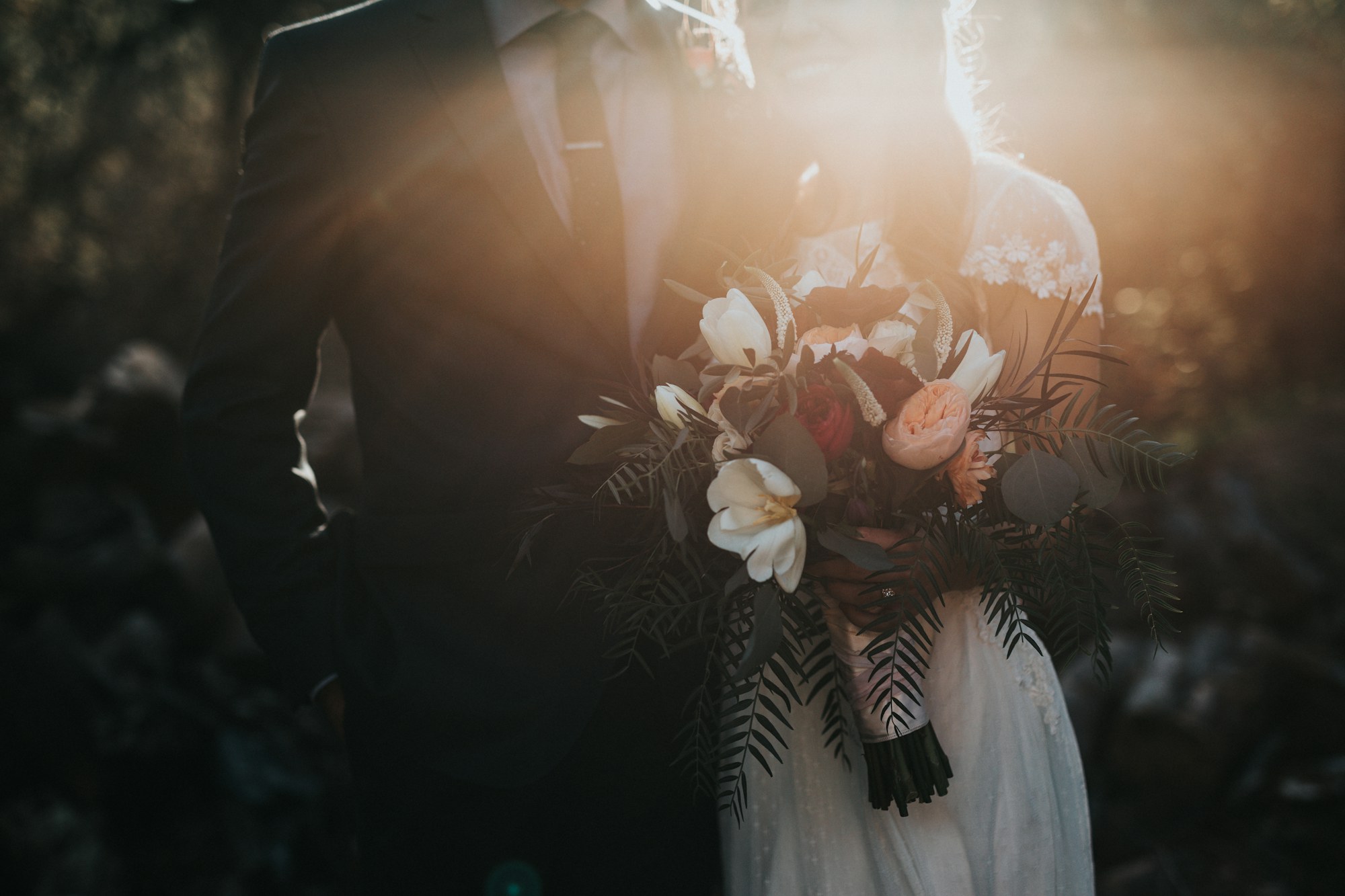
What Floral Composition Actually Means
Composition, in floral terms, borrows directly from painting and architecture: a structure built from a small number of fixed relationships rather than an accumulation of individually pleasing parts. A composed arrangement has a defined line — the outer edge the eye follows first — a mass that gives it visual weight, one or two focal blooms that anchor attention, and negative space that separates all of it into something legible.
Most florists are trained instead toward density. Fill the vessel, round the dome, repeat the pattern until the mechanics are hidden. That approach produces something technically correct and visually flat. It photographs fine from a distance and reveals nothing on closer inspection, because there is no hierarchy to discover.
A composed arrangement rewards a second look. The eye lands on the focal garden rose, moves along a trailing line of clematis, rests in a gap of negative space, then finds a secondary cluster of lisianthus. That sequence is designed, not accidental, and it is the actual mechanism behind an arrangement that people remember rather than simply photograph.
Recognizing this distinction is the first and most important shift for anyone commissioning floral work for a wedding or high-occasion event.
The Eleventh Stem: Why Restraint Reads as Elegance
There is a working rule in the studio: the eleventh stem ruins the composition. Not literally always the eleventh — the number shifts with vessel size — but the principle holds. Every arrangement reaches a point of balance, and every stem added past that point does not improve it. It dilutes it.
This is counterintuitive to most clients, who reasonably assume more flowers signal more value. The opposite is usually true in composed work. A ten-stem posy bouquet with visible air between each garden rose reads as more considered — and often costs more per stem in labor — than a thirty-stem bouquet packed edge to edge.
The test used in the studio is simple: could a single stem be removed without changing the arrangement's balance. If yes, that stem was filler, not composition. If removing it leaves a visible, meaningful gap, it was load-bearing. A well-composed piece has very few filler stems — most of what is included is doing structural work.
Practically, this means:
Clients who understand this principle going in tend to trust the lower stem count when they see the final result, rather than reading it as a shortfall.
Anatomy of a Composed Arrangement
Every composed arrangement, regardless of scale, is built from four fixed elements. Line establishes the outer boundary — often a trailing clematis vine or an arching eucalyptus stem that defines how far the piece extends beyond its vessel. Mass gives the arrangement physical weight, typically built from garden roses or lisianthus grouped in small, uneven clusters rather than spread evenly.
Focal point is the one or two blooms the entire arrangement is organized around — frequently a single large garden rose, such as a Mondial at full maturity, positioned slightly off-center rather than dead middle. Off-center placement, borrowed from classical asymmetry, keeps the eye moving instead of settling too quickly.
Negative space is the fourth element, and the one most often skipped by inexperienced designers under time pressure. It is not empty space left by accident — it is planned space, usually 20 to 30 percent of the arrangement's visual footprint, that separates the focal bloom from the supporting mass so both can be read clearly.
These four elements are decided before a single stem enters water. A studio sketch marks where the line falls, where the mass sits, where the focal bloom will turn, and where the gaps will be preserved. Skipping this planning stage and building reactively, stem by stem with no plan, is the most common reason arrangements drift toward density instead of composition.
Choosing Materials That Hold a Silhouette
Not every flower composes well. Some varieties are structurally suited to defined silhouette work; others perform better as filler mass and should be used accordingly. Garden roses, particularly Mondial, Vendela, and Quicksand, hold their form for several days once conditioned properly, making them reliable focal choices for both ceremony pieces and centerpieces that need to last a full event.
Clematis is one of the few vining materials with enough structural integrity to define a clean line without wire support, making it a natural choice for the outer boundary of a composition. Lisianthus, with its multiple blooms per stem, works well as mass material — a single stem can fill the role that would otherwise require two or three separate flowers.
Dusty miller and eucalyptus serve as framing foliage. Both hold their silvered or muted tone without wilting for the length of a full wedding day, and both are dense enough in texture to visually separate the focal bloom from the negative space around it, reinforcing the hierarchy rather than competing with it.
Peonies require timing more than substitution. Their bloom window is narrow, and a composition planned around peony focal blooms outside that window needs a fallback — typically a fuller garden rose — decided at the sourcing stage, not discovered the week of the event.
Building the Composition: The Studio Process
Construction begins with the line material, not the focal bloom. Placing clematis or eucalyptus first establishes the outer silhouette before any decision is made about where the mass will sit. Working focal-bloom-first is a common shortcut that tends to produce a centered, symmetrical result — competent, but rarely composed.
Mass comes next, added in small uneven clusters of two or three stems rather than a single evenly distributed layer. This unevenness is deliberate; perfect symmetry reads as manufactured rather than considered. The focal bloom is placed after the mass is roughly established, positioned off-center and angled slightly outward so it catches light rather than sitting flat.
Negative space is checked continuously through the build, not assessed only at the end. After every few stems, the designer steps back — often a full arm's length from the worktable — to confirm the gaps are still doing their job. This step alone, done consistently, is what separates a fifteen-minute rushed build from the ninety minutes to two hours a genuinely composed arrangement typically requires.
The final stage is angle correction: turning the vessel or bouquet slowly to check the silhouette from multiple viewpoints, since a composition that only works from one angle will fail as guests move around a reception table or a bridal party moves during a ceremony.
Common Mistakes That Break a Composition
The most frequent error is treating stem count as a proxy for value, adding flowers until the vessel looks full rather than until the silhouette is balanced. This produces the dense, flat arrangements composition is meant to avoid, and it is the single most common request the studio has to talk clients out of.
A second mistake is symmetry for its own sake — centering the focal bloom, spacing every stem at equal intervals, mirroring one side of the arrangement exactly against the other. Perfect symmetry photographs adequately but reads as static; the eye has nowhere to travel.
A third mistake is ignoring viewing distance. A composition built for close inspection on a dinner table needs a different scale of negative space than one built for a ceremony arch viewed from thirty feet away — gaps that read as intentional up close can disappear entirely from a distance, flattening the whole effect.
Mistakes to watch for directly:
Scaling Composition From Ceremony to Reception
A single wedding often calls for the same compositional principles applied at three different scales — bridal bouquet, ceremony installation, and reception centerpiece — and each requires different proportions of the same four elements. A bridal bouquet, viewed at close range and often photographed in hand, can use a smaller negative space ratio, since even subtle gaps read clearly up close.
A ceremony arch or arbor arrangement, viewed from a distance by seated guests, needs bolder line material and larger negative space gaps to remain legible — a delicate two-inch gap that reads perfectly in a bouquet disappears entirely from twenty feet away. Line material here often doubles in scale, using thicker eucalyptus branches or longer clematis runs than would suit a hand-held piece.
Reception centerpieces sit at eye level across a table and need to balance visual presence with sightlines — guests must be able to see across the table to converse, which puts a practical ceiling on height and mass regardless of how much room exists on the table itself. A working guideline used in the studio caps most centerpieces at 14 to 16 inches in height at the point directly above a seated guest's sightline, with taller line elements allowed only outside that direct sightline zone.
Keeping the same four compositional elements consistent across all three scales, while adjusting their proportions to viewing distance, is what makes a wedding's florals feel unified rather than like three separate vendors' work.
Budgeting and Timeline for Composed Floral Work
Composed arrangements are frequently assumed to cost less because they use fewer stems, and this assumption causes friction during budget conversations. The actual cost driver is design labor: a composed centerpiece with 18 stems, built with the planning and angle-checking described above, can take longer to construct than a dense arrangement with twice the stem count assembled without a plan.
A realistic timeline for a full wedding composition — bridal bouquet, attendant bouquets, ceremony installation, and reception centerpieces for 15 to 20 tables — runs six to nine months from initial consultation to delivery, with the final stem-count and vessel decisions locked around six to eight weeks out once the final guest count and table plan are confirmed.
Clients should expect the budget conversation to center on studio hours and material sourcing rather than stem totals alone. Garden rose varieties grown to order, for instance, are priced and secured months ahead of a standard market order, and that lead time is part of what the composition's final cost reflects.
A useful budgeting checklist for a composed floral program:
A Quiet Observation
The bride with the magazine photograph ended up with a centerpiece built from nineteen stems instead of sixty — a single Mondial rose turned slightly outward, three stems of clematis tracing the vessel's edge, and enough space between each element that her guests could see each other across the table. She did not mention the flower count again after the event. She mentioned the room, and how easy it had been to talk across it.
Considered
What does floral composition mean in flower arranging?
Floral composition refers to the deliberate structuring of an arrangement through line, mass, focal point, and negative space, rather than simply grouping flowers by color. It treats the arrangement as a considered shape, where restraint and the space between stems matter as much as the blooms themselves.
How many stems should a well-composed centerpiece use?
Most composed centerpieces hold between 15 and 25 stems, depending on scale and vessel size, versus 35 or more in dense commercial arrangements. The lower count preserves negative space and keeps the silhouette legible rather than crowded.
Why is negative space important in floral design?
Negative space gives the eye a place to rest and makes the focal blooms read clearly instead of competing for attention. Without it, an arrangement becomes a mass of color with no visual hierarchy, regardless of how expensive or rare the individual flowers are.
What flowers hold their shape best in a composed arrangement?
Garden roses, clematis, and lisianthus hold defined shape well due to sturdier stems and structured petal formation. Dusty miller and eucalyptus provide reliable framing foliage that keeps its form through a full event day without wilting or losing silhouette.
How far in advance should composed floral arrangements be planned for a wedding?
Six to nine months is standard, particularly if specific garden rose varieties are part of the design. This allows time to plan stem counts by vessel and placement, and to secure varieties that are grown to order rather than pulled from general market stock.
Does a composed floral style cost more than a full, dense arrangement?
Not necessarily in stem cost, but often in labor — building a restrained composition with visible structure takes more design time per piece than filling a vessel densely. The cost lives in the hours of deliberate placement, not in a higher flower count.