Crafting the Wedding Bouquet: A Step-by-Step Guide to Floral Composition
A bride sat across the worktable last spring with a Pinterest board of forty saved images, each one heavier than the last. Garden roses stacked on peonies stacked on ranunculus, stems doubled until the bouquet in every photograph looked less like a composition and more like an argument. She wanted all of it. We build one thing here: the case for less.
29 min read · Les Fleur Company
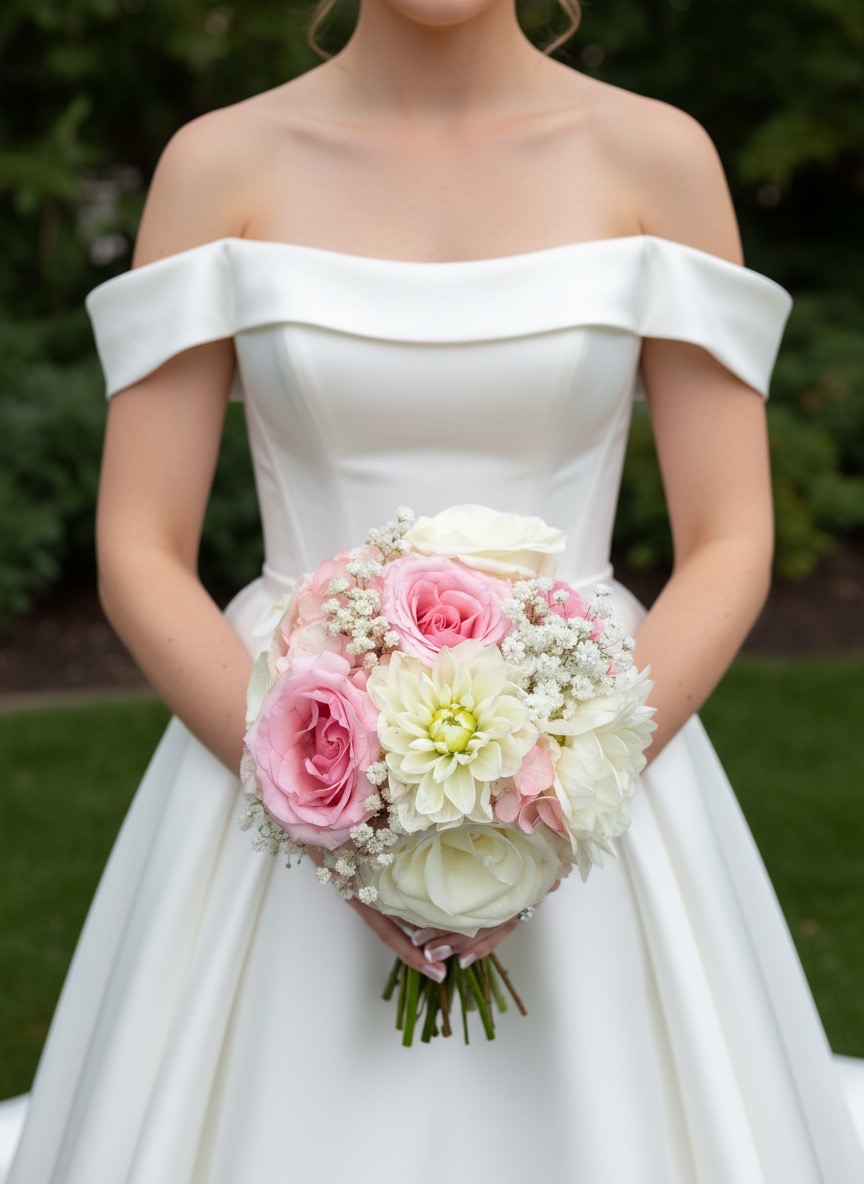
The Problem With Twelve Stems
A bride sat across the worktable last spring with a Pinterest board of forty saved images, each one heavier than the last. Garden roses stacked on peonies stacked on ranunculus, stems doubled until the bouquet in every photograph looked less like a composition and more like an argument. She wanted all of it. We build one thing here: the case for less.
The eleventh stem ruins the composition. Not because it is unattractive on its own, but because it crowds the tenth, and the ninth, until the eye has nowhere to rest. A wedding bouquet is not an inventory of favorite flowers. It is a single held shape, built with restraint, carried down an aisle in front of a hundred people who will remember the silhouette long after they forget which variety of garden rose filled it.
This guide walks through how we build that shape — the sequence we actually follow in the workroom, stem by stem, from the first sketch to the final wrap. It is the same process behind our approach to floral composition for wedding work more broadly, applied to the single object a bride holds for six hours.
Begin With the Silhouette, Not the Flowers
Most florists start with a flower list. We start with a shape drawn on paper — round, cascade, hand-tied asymmetric, or the low clutch that has become the request in nine consultations out of ten this season. The silhouette determines everything that follows: stem count, mechanics, even which varieties will hold their heads at the angle the shape requires.
A round bouquet built for a cathedral aisle needs a different density than a loose, one-sided cascade meant for a beach ceremony where wind will do half the styling. We measure the dress — sleeve length, neckline, train — before we measure the flowers, because a bouquet photographed against the wrong silhouette reads as mismatched no matter how well it is built.
Once the shape is set, we build a stem count around it. A compact six-inch clutch runs eighteen to twenty-four stems. A fuller nine-inch round runs closer to thirty-five. Anything past that and the hand can no longer close around the stems without strain — a detail no one mentions until the third hour of a reception.
The Discipline of the Focal Bloom
Every bouquet needs a bloom the eye returns to. We use garden roses for this more often than any other flower — Mondial for its density and deep, almost bruised red; Vendela for the ivory that photographs true under any light; Quicksand for the color that shifts from apricot to mauve as it opens over the course of a day.
The mistake most home arrangers make is choosing three or four different focal-weight flowers and giving each equal space. The result competes with itself. We choose one focal variety, sometimes two if the palette calls for contrast, and build every other stem in support of it. Peony reads as a second focal flower in April and May when it is in season regionally; the rest of the year we reach for garden rose varieties bred to hold a peony-like face without the six-week window.
A focal bloom earns its place by facing forward, at the bouquet's visual center, slightly higher or lower than mathematical center depending on the shape. This is the one place in the composition where symmetry is a mistake — dead center reads as static, off-center reads as considered.
Building in Layers: Structure, Texture, Movement
Beneath the focal bloom sits the structure — usually lisianthus, whose ruffled, papery petals fill volume without adding visual weight. We use it the way a tailor uses interfacing: present in nearly every bouquet, credited in almost none.
Movement comes next, and it comes from stems that break the outline. Clematis vine, trailing jasmine, or a single loose stem of sweet pea pulled slightly outside the bouquet's edge tells the eye the shape is alive rather than clipped into a sphere. We add no more than two or three of these per bouquet — past that, the silhouette we built in step one starts to dissolve.
Texture closes the layer. Dusty miller for its silvered, matte leaf against the shine of a rose petal. Eucalyptus, usually seeded or parvifolia rather than the cider-gum variety florists overused a decade ago, threaded low and tight rather than left to spill. Each textural element earns its place by contrasting with what sits next to it — smooth against rough, matte against gloss — never by simply adding more green.
Color Without Apology
A wedding palette works when it commits to two or three families and lets the rest of the arrangement build tension inside that range. We see couples arrive with five colors circled on a swatch card, and we spend the first fifteen minutes of consultation removing two of them.
Warm palettes — blush through terracotta — read well against most venues and most skin tones, which is part of why they remain the most requested range in our books. Cool palettes, lavender through plum, demand more discipline in lighting and photography but carry a formality that warm tones cannot match. We wrote at length on how these decisions get made in our piece on color theory in wedding floral composition, which walks through the pairing logic in more detail than fits here.
Whatever the palette, one rule holds: the darkest and lightest values in the bouquet should sit no more than two shades apart from the rest of the arrangement. A single near-black dahlia dropped into an otherwise pale, blush composition reads as a mistake, not a statement — unless every other choice in the day has been built to support that contrast on purpose.
The Discipline of Negative Space
The instinct, especially under pressure to justify a bouquet's cost, is to fill every gap. We do the opposite. Negative space — the small gaps of visible stem or air between blooms — is what keeps a composition from reading as a solid mass of color from ten feet away.
This is the hardest discipline to teach a new designer in the workroom. The temptation to add one more stem into an open pocket never fully goes away; it has to be trained out, arrangement by arrangement, over a season or two. We cover the underlying principle in our guide to the essential elements of a timeless floral composition, which treats negative space as load-bearing rather than decorative.
A bouquet with proper negative space photographs with depth — light falls between the blooms and creates shadow, which is what separates a professionally built arrangement from a grocery-store bunch in every photograph a wedding photographer takes that day. Density is not generosity. It is, more often, a failure of nerve.
Materials That Hold Through an Eight-Hour Day
A bouquet that looks composed at 10 a.m. and wilts by the first dance was never finished — it was only assembled. Every stem entering our workroom is conditioned first: cut at an angle under water, stripped of foliage that would sit below the waterline, and hardened off in a cooler held between 34 and 38 degrees for a minimum of four hours, often overnight.
Garden roses in particular need this step or they will bow at the neck by early afternoon — a failure we see constantly in arrangements built same-day without conditioning time. Lisianthus and clematis, both thirsty stems, go into individual water tubes if there is any gap of more than ninety minutes between building and ceremony.
For the wrap itself, we use waxed floral tape under ribbon rather than wire alone, which lets the bouquet flex slightly in the hand rather than snapping at a stress point during photographs. The Royal Horticultural Society's guidance on cut-flower postharvest care confirms what our workroom has learned by repetition: hydration before the event matters more than any product applied during it.
The Rehearsal: Why We Build the Bouquet Twice
Every bridal bouquet in our studio gets built twice. The first pass happens roughly a week out, using stand-in stems close in size and color to what will arrive from the flower market. This is where we test weight in the hand, check that the mechanics hold the shape without wire showing, and photograph the result against the dress fabric if the bride has left a swatch.
The second build happens the morning of, with the actual stems, usually between 5 and 7 a.m. depending on ceremony time. Nothing from the rehearsal build is reused — it exists purely to catch problems before they reach the bride's hands. We have caught mismatched rose openness, an unbalanced silhouette, and once, a fragrance combination that read as overwhelming in a small indoor chapel, all during rehearsal builds rather than on the day itself.
This two-pass process costs us time we do not bill for separately. We consider it the difference between a bouquet that is finished and one that is merely delivered. For couples building out a full day of arrangements around this same standard, our guide to composition for centerpieces follows the identical logic at table scale.
Common Mistakes We See at Consultation
Most missteps in a wedding bouquet trace back to decisions made months before the flowers arrive. The patterns repeat enough across seasons that we now walk every new client through them directly:
According to the Society of American Florists, wedding work remains one of the most complaint-prone segments of the floral industry precisely because these upstream decisions go unexamined until the week of the event, when there is no longer time to correct them.
What the Bouquet Does After the Ceremony
A bridal bouquet has one job during the ceremony and a different one after it — tossed, preserved, or simply set down and photographed on a hotel bed the next morning before the flowers are composted. We build every bouquet knowing it has this second life, however brief, because the way it holds up in that first quiet morning-after photograph is often what a bride remembers longest.
Preservation has become a more common request over the past few seasons — pressed petals, a freeze-dried version of the full bouquet kept under glass, a single garden rose from the arrangement dried and framed. We treat these requests the same way we treat the wedding day itself: fewer stems, chosen carefully, kept rather than displayed in excess. For couples marrying near Lake Tahoe or elsewhere across our California service areas, we coordinate preservation timing directly with the photographer so the bouquet is documented before the first petal drops.
The bouquet a bride carries down the aisle is, in the end, a small object doing a large amount of work — holding a palette, a season, a family's history in flowers, and a silhouette built to be looked at without asking to be. Most guests will not be able to say afterward what was in it. They will only remember that it was right.
Considered
How many flowers should be in a wedding bouquet?
It depends on the silhouette. A compact six-inch clutch typically runs 18 to 24 stems, while a fuller nine-inch round bouquet runs closer to 35. Past that range, the bouquet becomes difficult to hold comfortably for a full ceremony and reception, and the composition tends to lose its shape.
What is a focal flower in a bouquet?
The focal flower is the bloom the eye is drawn to first, usually the largest or most saturated in the arrangement. Garden roses such as Mondial, Vendela, or Quicksand are common choices because they hold their face and color well. A bouquet should generally have one focal variety, not several competing for attention.
How far in advance should a wedding bouquet be built?
Most florists condition stems 12-24 hours before building, then assemble the final bouquet the morning of the wedding. A rehearsal build roughly a week out, using similar stand-in stems, is used to test the mechanics and silhouette before the real flowers arrive.
How do you keep a wedding bouquet from wilting?
Condition every stem before building: cut at an angle under water, strip foliage below the waterline, and harden off in a cooler between 34 and 38 degrees for at least four hours. Thirsty stems like lisianthus and clematis should go into water tubes if there is a gap of more than 90 minutes before the ceremony.
What is negative space in floral design?
Negative space refers to the small visible gaps between blooms and stems within a composition. Rather than filling every gap, leaving intentional space creates shadow and depth, which reads as more composed and professional in both person and photographs than a densely packed arrangement.
Should bouquet colors match the invitations?
No. Paper and fabric reflect light differently, so a bouquet color-matched to invitation swatches often looks mismatched against the dress in person and in photographs. The dress, not the stationery, should determine the bouquet's palette.