5 Essential Elements of a Timeless Floral Composition for Luxury Weddings
A bride sat across the worktable last spring with a moodboard forty images deep — peony from one wedding, a clematis-laden arch from another, a centerpiece she'd saved because of the anemones alone. Everything was beautiful. None of it belonged in the same room. The work of the next hour wasn't adding to that board. It was taking away — narrowing forty images to five flowers, three tones, one shape that could carry a ballroom of two hundred without competing with itself. That is the actual discipline behind a timeless floral composition for luxury weddings: not more, considered.
36 min read · Les Fleur Company
Why Restraint Is the First Skill of a Timeless Floral Composition
Most first consultations start the same way — a client naming flowers she loves rather than a shape she wants. Garden roses, ranunculus, peony, all in one sentence, no sense yet of how they'll sit together. The florist's first job is not to say yes. It's to ask what the arrangement needs to do — hold a long table, anchor an altar, sit low enough for guests to see across it at dinner.
A composition planned around volume ages badly in photographs. Ten years on, an overfull centerpiece reads as a moment in floral fashion — the way certain wedding trends date the year on the invitation. A composition planned around shape and restraint reads the same in any decade, because the eye is responding to proportion and line, not to how many blooms were used.
This is the case for restraint as a technical decision, not an aesthetic preference. The eleventh stem in an arrangement built for nine doesn't add fullness. It ruins the composition — breaks the silhouette the first ten stems worked to establish. A florist who understands this will stop cutting before a client thinks the vase looks full, because fullness and correctness are not the same measurement.
The keyword worth holding onto through the rest of this piece — timeless floral composition for luxury weddings — is really a description of that stopping point. It is the arrangement that knows when to stop.
Element One — Silhouette: The Shape the Arrangement Must Hold
Every composition has an outline before it has flowers. Round, cascading, asymmetric, horizontal — the silhouette is decided first, on paper or in the hand, before a single stem is cut to length. Skipping this step is the most common reason arrangements read as improvised rather than composed.
A round, compact silhouette — the classic bridal bouquet shape — relies on even distribution and a tight, disciplined outline. An asymmetric or cascading form does the opposite work: it draws the eye along a diagonal line, using longer stems of clematis, sweet pea, or trailing amaranthus to pull weight to one side. Both are correct. What's incorrect is a shape that wavers between the two because stems were added without reference to the outline already established.
For tablescapes, the silhouette question changes to elevation and spread — a low, compote-style arrangement versus a tall, structural piece on a raised stand. The choice isn't stylistic alone; it's practical. Guests need sightlines across a dinner table, which is why the most functional wedding centerpieces sit under 14 inches or clear 30, with almost nothing correct in between.
Decide the shape. Then decide the flowers that will hold it.
Element Two — Negative Space: The Discipline of Leaving Room
Negative space is the part of the composition most clients don't ask for and most florists have to defend. It is the visible air between stems — the gap the eye rests in before moving to the next cluster of bloom. Without it, an arrangement flattens into a mass, and a mass, however expensive, reads as generic.
Space is not absence. It is placed with the same intention as a stem of garden rose. A well-built composition alternates density and openness — a cluster of Vendela roses close together, then a pocket of air, then a single stem of lisianthus positioned to catch that gap. The rhythm is what separates a composed arrangement from a full one.
Clients occasionally ask for an arrangement to be fuller mid-build, worried that visible gaps mean the piece isn't finished. This is the moment a florist earns the fee — holding the line, explaining that the gaps are structural, not incomplete. An arrangement filled to erase every gap loses its silhouette entirely; it becomes a sphere of color with no point of entry for the eye.
Negative space matters even more at scale. A ceremony installation viewed from thirty feet needs larger, more deliberate gaps than a low centerpiece viewed from eighteen inches — proportion applies to space exactly as it applies to material. Composition, in the end, is as much about what a guest doesn't see as what she does.
Element Three — Material Selection: Naming Every Stem Before You Cut It
A composition built from "flowers" rather than named varieties is a composition built on guesswork. Garden roses alone span dozens of cultivars with different bloom sizes, petal counts, and vase behavior — Mondial opens into a dense, cabbage-like bloom; Quicksand carries a warmer, antique tone that shifts as it opens; Vendela stays closer to ivory and holds its shape longer once cut. Specifying the variety, not just the flower, is what separates a composed brief from a vague one.
Line, focal, and filler material each do different structural work. Clematis and sweet pea establish direction and movement. Peony and garden roses carry visual weight as focal blooms. Lisianthus fills the middle register with a softer, ruffled texture that photographs well against denser roses. Dusty miller and eucalyptus — silver-green, textural — hold the composition together at the edges, softening the transition between bloom and vase.
Every one of these materials has a handling requirement, and ignoring it is the most common cause of an arrangement that looks correct at 9 a.m. and wilted by the reception. Garden roses in particular are sensitive to temperature swings and need 12 to 24 hours of conditioning — hydrating cuts, cool storage — before they're workable. A florist who skips conditioning to save a day of lead time is trading longevity for convenience, and it shows by the toasts.
The material list, then, is not a shopping list. It's an engineering document — five or six named varieties, each doing a specific job, none of them interchangeable with a同 substitute pulled in at the last minute because the market ran short.
Element Four — A Narrow Palette: Color as Restraint, Not Decoration
The instinct to add more colors comes from the same place as the instinct to add more stems — a fear that less will read as less. In practice, a palette narrowed to three or four tones reads as considered; a palette built from six or seven competes with itself in every photograph, and wedding photography is unforgiving about competing color.
A disciplined palette usually anchors on one dominant tone, one supporting tone, and one accent used sparingly — a handful of stems, not a third of the arrangement. Ivory garden roses and blush peony as the dominant pair, dusty miller for a cooler undertone, a single thread of lavender worked through as the accent rather than a feature. The accent color should appear like punctuation, not like a second sentence.
Photography is the real test of a palette, more than the arrangement viewed live. Colors that read as distinct to the eye in a room can flatten or clash under different lighting — string lights warm every tone toward amber, and a palette with too much variation loses definition entirely once photographed under that light. A narrow palette holds its shape under any lighting condition a reception throws at it.
Seasonal availability also disciplines the palette by necessity. Peony has a six-to-eight-week window; a couple marrying outside that window is choosing a different palette whether or not they've said so yet. Working with the season, rather than against it, is usually what produces the more considered result — the flowers that are actually correct for the month, not the ones forced in from elsewhere at cost to both budget and bloom quality.
Element Five — Proportion: Scaling the Composition to the Room and the Body
An arrangement correct in isolation can be entirely wrong once placed. A compote overflowing with garden roses that looks generous on a worktable can read as modest inside a ballroom with 20-foot ceilings — and the same arrangement would overwhelm a farmhouse table seating eight. Proportion is relative to the space, not an absolute measurement.
For bridal bouquets, proportion is relative to the body. A bouquet scaled for a five-foot-two bride photographs differently than the identical design scaled for someone six inches taller — the same stem count reads as generous on one frame and overwhelming on another. Fittings exist for exactly this reason, and skipping one is a common and avoidable mistake.
Room proportion follows a rough but reliable rule: ceiling height and table length should inform arrangement height and spread before flower choice does. A reception hall with 12-foot ceilings can support a tall, structural centerpiece without overwhelming the sightlines; the same design in a low-ceilinged tent reads as top-heavy and closes in the room rather than opening it.
How the Atelier Builds a Composition, Stem by Stem
The work rarely starts with flowers. It starts with a sketch — a shape on paper, a rough note of dimension, sometimes nothing more than a line indicating direction. Only once the silhouette is settled does the material list get built against it, variety by variety, quantity by quantity, priced and sourced before a single stem arrives at the studio.
Conditioning happens in the 24 to 48 hours before install — stems re-cut at an angle, hydrated in cool water, stored at a controlled temperature away from ethylene-producing fruit or foliage that shortens vase life. This stage is invisible to a client and is very often the difference between an arrangement that holds through an eight-hour reception and one that begins wilting by the first course.
Building the composition itself is slow, deliberate work — the mechanics laid first (chicken wire, floral frog, or foam depending on the piece), then structural line material, then focal blooms placed to establish the silhouette's high points, then the filler and textural material worked into the remaining gaps with attention to where negative space should stay open. A florist working quickly is usually working badly; the best pieces are built in an unhurried sequence that respects each stem's placement before moving to the next.
What a client sees on the day is the final ten percent of a process that started weeks earlier with sourcing calls to growers, sometimes months earlier with a variety reserved specifically for that wedding date. The composition on the table is the visible end of considerable invisible work.
The Mistakes Couples Make When Briefing a Florist — and What to Ask Instead
The most common mistake is briefing with images instead of intention — forty saved photos with no throughline, leaving the florist to guess which element in each image actually mattered. A stronger brief names a feeling, a few real flowers, and a budget, then trusts the florist to build the composition around it.
A second common mistake is treating flower count as a proxy for value. A couple who asks for "more" in every conversation is usually asking for a feeling of abundance that a well-composed, restrained arrangement can deliver more effectively than an overfull one — abundance is a visual effect, not a stem count.
A third mistake is under-budgeting for peony, garden roses, or other premium, seasonal stems, then asking the florist to "make it work" with a lower-cost substitute at the last stage of planning. This produces the most visible kind of compromise — a photograph where the palette or texture doesn't match what was originally approved.
Questions worth asking a florist during a consultation:
A florist who answers these clearly, specifically, and without hedging is one who has actually done the work before.
Heritage in the Work: Building a Composition That Holds Through an Eight-Hour Day
Heritage in floristry isn't nostalgia. It's the practical case for materials and techniques that have proven, over decades, that they hold — the rose that keeps its shape through a long reception, the mechanics that don't shift when a bouquet is carried down an aisle and back. A composition built for a single photograph is a different discipline than one built to survive a wedding day in full.
Garden roses bred for cutting — Mondial, Vendela, Quicksand among them — earned their place in bridal work because growers and florists tested them across seasons and found they held. That kind of proven material is what heritage means in practice: not tradition for its own sake, but a track record of performance under the exact conditions a wedding day creates.
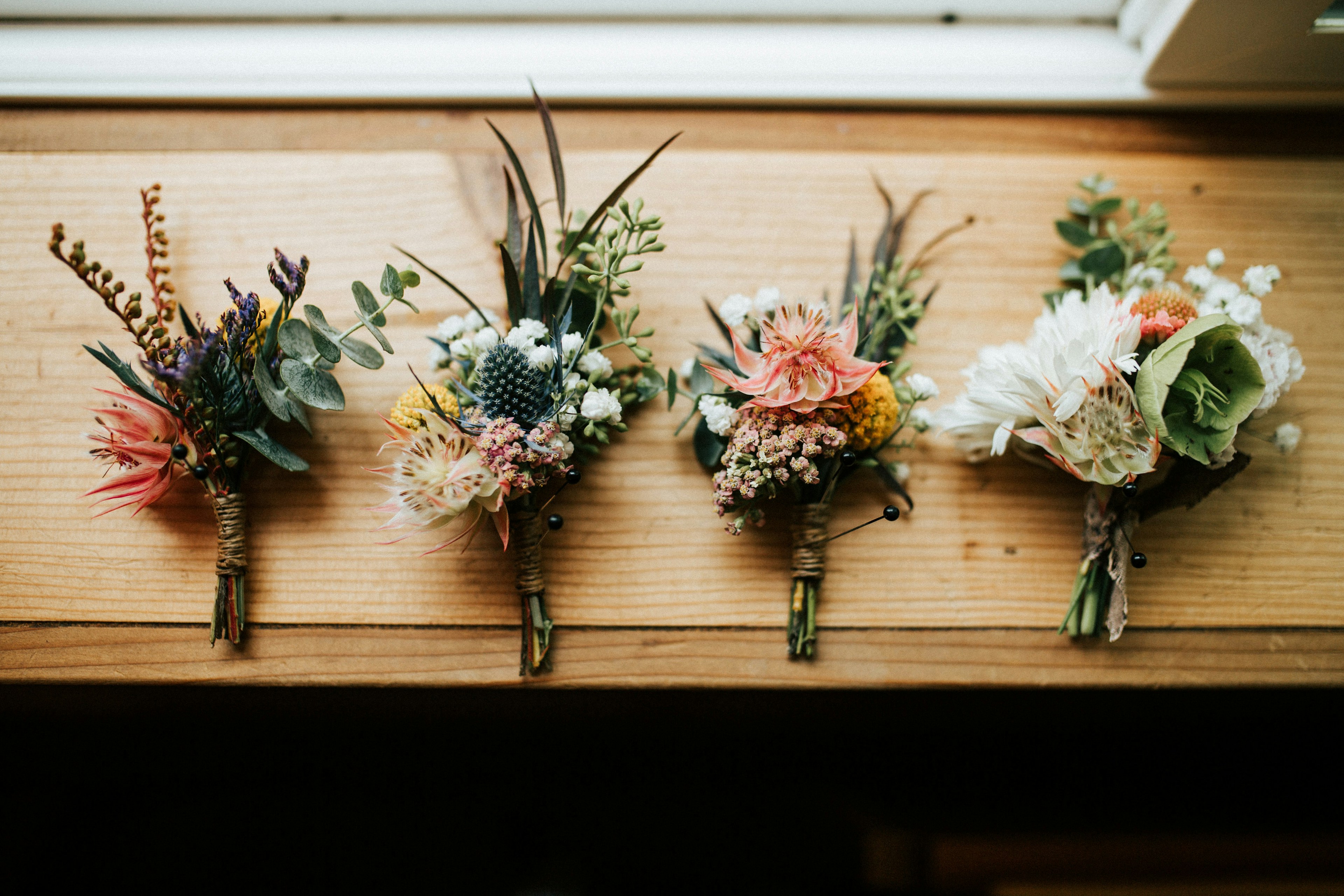
The same applies to technique. Mechanics that have been refined over generations of floral design — proper hydration, correct wire gauge for a boutonniere, the right foam-to-water ratio for a large installation — exist because they were tested against failure and adjusted. A florist who skips them in favor of a faster method is trading proven reliability for convenience, and a wedding day is the wrong place to discover the trade was a bad one.
A composition that holds its shape from the processional through the last dance, without intervention, without a guest noticing the flowers at all because they were simply doing their work — that is the actual measure of a well-built arrangement. Not the first photograph. The eighth hour.
Considered
What makes a floral composition look timeless instead of trendy?
Restraint. Trend-driven arrangements chase color combinations, novelty blooms, and volume that date within a season. Timeless work relies on classic silhouette, a narrow palette, and materials — garden roses, peony, lisianthus — that have held their place in floral design for decades and photograph the same in ten years as they do today.
How many flower varieties should be in a wedding centerpiece?
Between four and six is typical for a considered arrangement. Fewer than four can read thin; past seven or eight, the composition starts competing with itself. The count matters less than the discipline — every variety should earn its place, not simply add volume.
What is negative space in floral design?
Negative space is the visible gap between stems and blooms — the air the eye moves through. In a disciplined composition it is placed deliberately, giving the silhouette room to read clearly rather than filling every inch with flower, which flattens the arrangement into a mass.
How far in advance should a couple book a florist for a luxury wedding?
Nine to twelve months for peak season, particularly if the design calls for peony, garden roses, or other stems with short, weather-dependent windows. This allows the atelier to source specific varieties and hold a fitting rehearsal for large-scale installations.
Do wedding flowers need to match the venue exactly?
No — they need to hold their own without competing. A composition matched too literally to a venue's existing palette disappears into the room. The stronger approach is proportion and restraint: a palette that complements the space and a scale suited to the room's size.
Why do some wedding florals wilt faster than others?
Handling and hydration matter more than the flower itself. Garden roses and peony are especially sensitive to temperature and require conditioning — hydrating cuts, cool storage, careful transport — in the 24 to 48 hours before the event. A rushed conditioning window is the most common cause of an arrangement that fades by the reception.