Wedding Floristry for the Discerning Couple
A bride once handed back a bouquet sample during a fitting and said, quietly, that it felt like nothing. Not wrong — nothing. The color was correct. The shape matched the inspiration photograph she'd carried in for three consultations. But the stems had no weight to them, no resistance when she turned her wrist, and she could not have named why it troubled her. It troubled her because a wedding bouquet is held for six hours, not photographed for six seconds. It has to survive touch.
31 min read · Les Fleur Company
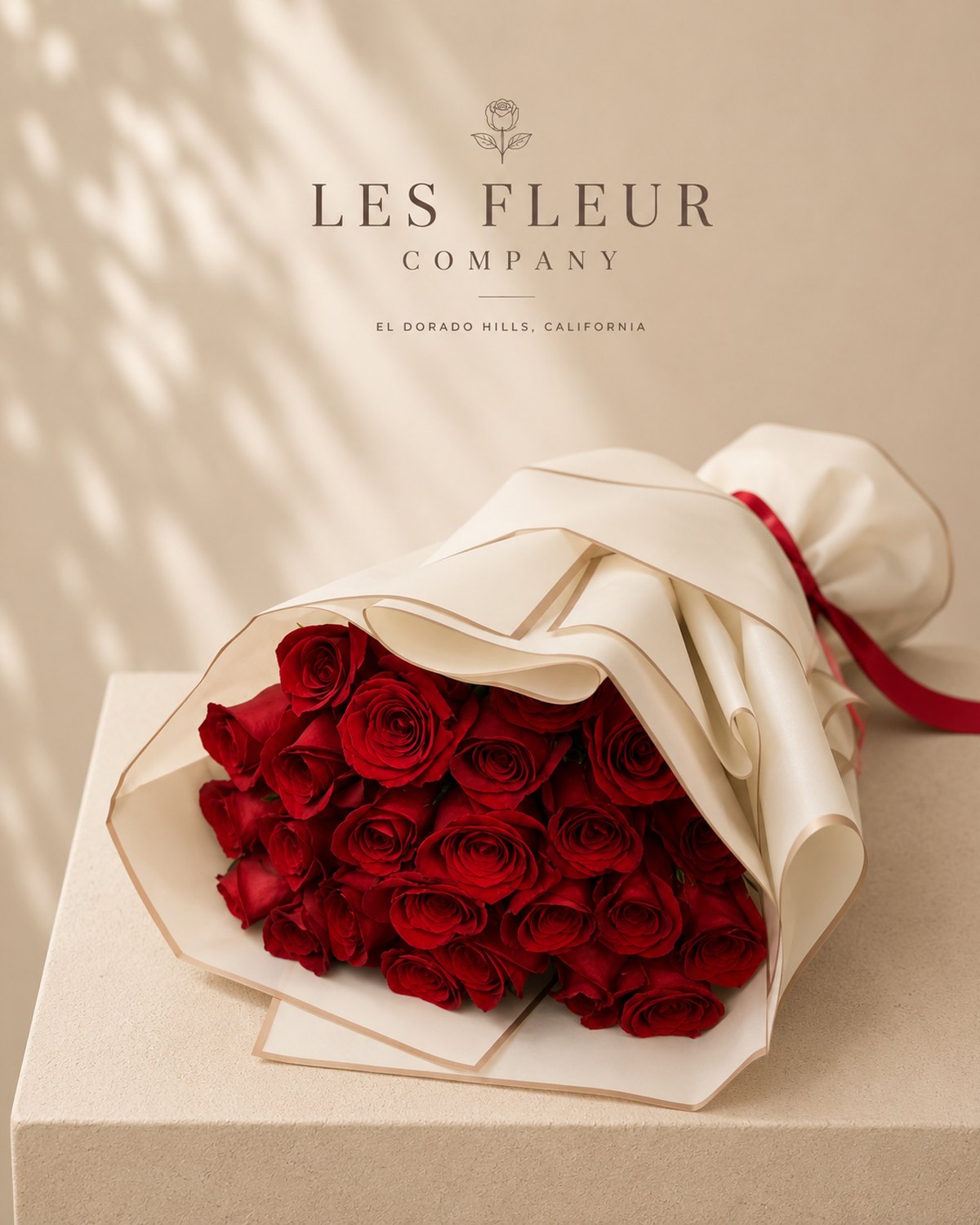
The Ceremony Begins Before the Ceremony
Most florists ask about color first. We ask about touch first — what the client wants to feel when they close a hand around the bouquet, whether the groom's boutonniere needs to survive a car ride with the top down, whether guests will be seated close enough to a centerpiece to smell it or only close enough to see it. These are not romantic questions. They are engineering questions disguised as taste.
A discerning couple usually already senses this distinction, even without the vocabulary for it. They've been to weddings where the flowers looked correct in every photograph and forgettable in the room. The disconnect is almost always the same: the arrangement was built for a lens, not for the ninety people standing three feet away from it for four hours.
Texture is the first casualty of a photograph-first process. Garden roses get swapped for cheaper, flatter varieties because the difference doesn't register on a phone screen. It registers instantly in the hand. A tactile approach refuses that trade before it's offered.
What Tactile Means in Practice
In the studio, tactile design means every stem is chosen for two qualities at once — how it reads and how it behaves. A clematis vine trailing from a bouquet is not there because it photographs well against white silk. It's there because it moves when the bride walks, and that movement is part of the composition, not an accident of it.
This changes the working order. Color gets discussed after texture, not before, because a palette built on paper rarely survives contact with what's actually available and durable that week. We start with a texture study — rough against smooth, dense against airy — dusty miller beside a Vendela rose, eucalyptus against peony. Color settles into that framework rather than dictating it.
It also changes what gets handled during a consultation. We bring cut stems to the table. Clients touch petals, run a thumb along a leaf's underside, hold a test bouquet at arm's length and then close to the chest. That thirty seconds of contact tells us more than an hour of talking about "romantic" or "organic," words that mean something different in every conversation.
The result is not more expensive. It's more deliberate. A bouquet built this way typically uses eight to fourteen stems, not the twenty-plus that padding produces when a design leans on volume instead of restraint.
Composition Before Color
The eleventh stem ruins the composition. This is not a figure of speech in the studio — it's a working limit. Past a certain point, every additional bloom subtracts from the arrangement rather than adding to it, because negative space is doing as much work as the flowers themselves. A crowded bouquet reads as anxious. A disciplined one reads as decided.
We've written before about the specific mechanics of this — the five recurring elements that separate a composed arrangement from an abundant one, covered in more depth in our piece on the essential elements of a timeless floral composition. Silhouette, line, focal weight, negative space, and material honesty — in that order, roughly, though they're rarely separable in practice.
Color still matters. It's simply the fourth or fifth decision, not the first. A palette chosen before anyone has asked what's in season, what will hold through an outdoor June reception in the Sierra foothills, or what the venue's existing stonework already contributes to the room, is a palette built to be renegotiated later — usually under time pressure, usually at cost to the couple.
The Consultation Nobody Photographs
The most useful hour of any wedding floristry engagement happens before a single stem is ordered, and it's the hour least likely to show up on a website. It's a working session — samples on the table, swatches from the linens, a walkthrough of the venue's light at the actual hour the ceremony will happen, not midday when everything looks flattering.
We ask about the room before we ask about the flowers. A stone chapel with north-facing light behaves nothing like a glass-walled reception hall at golden hour, and a composition that reads as rich in one will read as muddy in the other. This is studio work, not showroom work — the kind of process detail we've documented in our notes on atelier workspace design, where the physical conditions of making the arrangement shape the final result as much as the design brief does.
Couples sometimes arrive expecting to choose from a catalog. What they get instead is closer to a fitting — questions about how the bouquet will be carried, whether there's a receiving line, how long the centerpieces need to hold before anyone eats. The answers change the design more than the color palette does.
Sourcing and the Honest Stem
A rose grown in a climate-controlled greenhouse and shipped overnight is not the same material as a garden rose cut two days before the wedding from a grower who knows the variety's habit. Both are called roses. They do not behave the same way in a bouquet, and they do not age the same way over a six-hour reception.
We work primarily with growers who can tell us when a stem was cut, not just when it arrived. This matters more than it sounds like it should. A Mondial garden rose conditioned properly can hold structure through a full evening; a rushed, poorly hydrated stem of the same variety will show stress by the toasts. The difference is invisible on a spec sheet and obvious in the hand three hours in.
Sourcing this way has a cost, and we don't soften that. It also has a limit — some varieties simply are not available in October in Northern California, no matter what a client saw on a European wedding blog in February. The honest answer, given early, is worth more than a substitution discovered the week of the wedding.
Texture Studies: Materials We Reach For
Every studio has a working vocabulary of materials it returns to, not because of trend but because of behavior — how a stem holds water, how it ages, how it sits against its neighbors. Ours includes:
None of these is chosen for how it performs in a single photograph. Each is chosen for how it performs across an evening — held, brushed against, leaned over, packed into a car at eleven at night and still intact the next morning for the couple's portrait.
Season as a Constraint, Not an Obstacle
The USDA's plant hardiness data makes plain what any florist already knows in practice — a stem available in one region in April may not exist locally until June, and forcing the calendar rarely produces a better arrangement, only a more expensive one. Treating season as a design constraint, rather than an inconvenience to override with imported stems, tends to produce more honest work.
Color follows from this. We've written at length about building a palette that responds to what's actually available rather than to a reference photograph pulled from a different hemisphere's growing season, in our piece on color theory in wedding floral composition. A palette built around late-summer dahlias and eucalyptus will simply not exist as a February palette, and no amount of budget changes that fact — it only changes how far the stems have to travel, and how tired they look on arrival.
The couples who plan around this constraint, rather than against it, tend to end up with compositions that feel more settled. Not because they compromised, but because the design was never fighting the calendar in the first place.
Installation Day: What Travels and What Doesn't
An arrangement that looks finished in the studio at 6 a.m. is not the same object that arrives at a venue at noon, three hours in a van, unloaded in September heat. Installation logistics are design decisions, not afterthoughts, and the couples who understand this early tend to have fewer surprises on the day.
Structural questions get answered before aesthetic ones: how far is the drive, what's the ambient temperature at load-in, does the venue allow early access for conditioning on-site. We've handled enough intimate, travel-heavy weddings to know that a composition built without these answers is a composition built to fail quietly, somewhere between the studio and the aisle — a problem addressed directly in our guide to crafting bespoke compositions for intimate weddings.
Centerpieces built for a table that won't be bumped behave differently than a processional arrangement carried down an aisle. We build each piece for its actual handling, not a generic standard — heavier mechanics for anything mobile, lighter structure for anything stationary and viewed rather than touched.
Heritage: What the Photographs Show a Decade Later
The real test of a wedding composition isn't the first thirty minutes after installation — it's the anniversary photograph a couple pulls out a decade later and still recognizes as themselves, not as a trend from the year they married. This is the argument for restraint over abundance: an arrangement built to a passing aesthetic dates quickly; one built on proportion and material honesty tends to hold.
This is also, practically, why we favor garden roses and structural greenery over anything chosen purely for a momentary trend. A Quicksand rose in a well-proportioned bouquet reads the same way in 2026 as it will in 2036. A bouquet built around a viral color-drenching technique reads, within a few years, like a dated photograph of itself.
Couples rarely ask about this directly during planning — the anniversary is not on the mind at the tasting. But it's worth raising once, plainly: the arrangement should be something the couple wants to have chosen, not just something that photographed well that particular season.
The Budget Conversation
Budget conversations go better when they start with specifics rather than a number pulled from a magazine. A useful starting framework: bridal bouquet and boutonniere typically run 8–12% of total floral spend, ceremony structure 20–30%, and reception centerpieces the remaining majority, scaled by table count and labor hours rather than stem count alone.
We've supported weddings across very different budget ranges, from intimate ceremonies in the Sierra foothills to larger installations at destination venues — the working principles documented across our regional pages, including Lake Tahoe wedding floristry, stay consistent regardless of scale. What changes is stem count and labor hours, not the discipline behind the design.
The most common budget mistake is deciding on a total number before deciding on priorities — asking a florist to hit a figure rather than asking what matters most (the bouquet, the ceremony arch, the reception tables) and letting the number follow. A florist who understands this will tell a couple plainly where the money does the most visible work, and where it does the least.
A wedding bouquet held for six hours owes the bride more than a good angle. It owes her something that still feels like something by the time the night is over.
Considered
What does "tactile" mean in wedding floristry?
It refers to designing for how an arrangement feels and behaves — its weight in the hand, the give of a garden rose against lisianthus, how eucalyptus moves in a draft — rather than designing only for a photograph from one fixed angle. Touch, humidity, and movement become design decisions alongside color.
How far in advance should we book a wedding florist?
For a considered, atelier-level composition, nine to twelve months out is standard, particularly for weddings during peony season (April through June) or around major holidays when stem availability tightens. Six months is workable for smaller, less material-intensive weddings.
Why do some wedding flowers wilt faster than others?
Wilt rate depends on the stem's water uptake, the ambient humidity, and how it was conditioned before the event. Garden roses like Mondial hold longer than more delicate varieties; anything cut and shipped without proper hydration will show stress within hours regardless of price.
Should our wedding flowers match our photographer's aesthetic?
They should complement it, not dictate it. A composition built only for a camera often reads flat in person. The better approach is to build the arrangement for the room and the hand first, then trust that a competent photographer will find it.
How many flower varieties should a bridal bouquet include?
Most disciplined bouquets use three to five varieties, not eight or ten. Restraint reads as intentional; a crowded bouquet reads as indecisive. One dominant bloom, one supporting texture, and one line element is usually enough.
What is the biggest mistake couples make when planning wedding flowers?
Choosing color before texture and season. A palette pulled from a photograph with no regard for what is actually in bloom, or how it will hold through a six-hour reception, forces the florist into substitutions the couple never approved.