The Preserved Rose as a Piece of Furniture, Not a Souvenir
There is a preserved arrangement in a certain kind of home — under a glass cloche on a sideboard, slightly faded, slightly dusty, positioned near a framed wedding photograph. The couple knows exactly which day it came from. The guests who visit the house do not. To them, it reads as something that has been kept because it could not be thrown away: a sentiment, not an object. A record of something that mattered, held past the point of its usefulness.
30 min read · Les Fleur Company
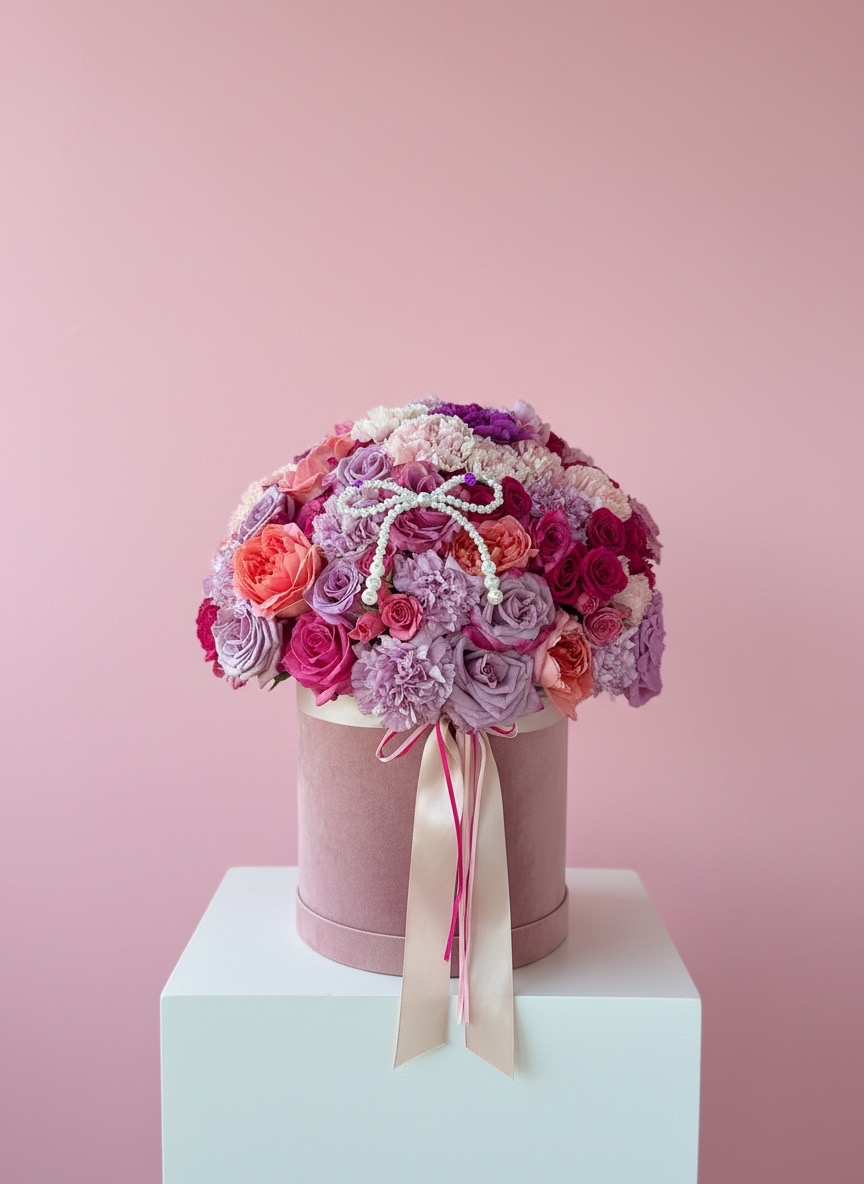
The Souvenir Problem
Most preserved roses exist because someone did not want to let the flowers go. The impulse to keep the wedding arrangement, the birthday roses, the flowers from a particular afternoon is real and recognizable. But preservation undertaken in the service of sentiment rather than intention produces a specific result: an arrangement that reads as past-tense. One that is oriented toward a memory rather than toward the room it now inhabits.
The distinction determines everything about how the piece is made. A rose preserved as a souvenir is preserved after the fact — dried from whatever condition it was in at the end of the event, placed back in the vessel it occupied that day, kept for what it means rather than for what it is. A rose preserved as a permanent object is treated differently from the beginning: selected for its preservation qualities before the event takes place, processed at the precise moment of peak bloom, and composed for its life as an object in a room rather than as a record of a single occasion.
These are different processes. They produce different objects. The difference is visible from across the room.
What Furniture-Grade Permanence Actually Means for a Preserved Rose
The comparison to furniture is not casual. A piece of furniture is purchased or commissioned with the understanding that it will occupy a room for years, possibly decades. It is expected to hold its weight in a space — to carry presence, to read as intentional, to age in a way that adds to rather than subtracts from its quality. The chair that was well-made in 1970 reads differently in a room than the one poorly made last year. The object's age becomes part of its authority.
A preserved rose arrangement can carry the same expectations when it is made for them. A Vendela rose that has been correctly identified as a strong preservation candidate, freeze-dried at peak bloom, and placed in an appropriate vessel in the right position in a room will hold its form and its color across a decade or more under normal interior conditions. The ivory tones will shift slightly warm over time. The silhouette will settle into its final shape. This is not decay. This is the object arriving at its permanent form — the same kind of aging that makes an old piece of pottery or turned wood more rather than less itself.
The preserved arrangement treated as furniture is made with this endpoint in mind. It is placed not where the wedding flowers were, but where an object of this scale and silhouette belongs in the current room, in the current light.
The Methods — What the Process Determines
Not all preservation methods produce the same object. The method determines color, texture, structural integrity, and longevity. Understanding the difference is not a technical exercise — it is a design decision made before the first stem is processed.
Freeze-drying is the method that produces the most complete preservation. The flower is processed in a commercial chamber at temperatures between -30°F and -50°F over a period of two to four weeks. Moisture is removed through sublimation — from solid ice directly to vapor — which means the cellular structure of the bloom is preserved rather than collapsed. The result retains three-dimensional form, original color, and surface texture at very close to the state the flower was in when it entered the chamber. Properly processed roses can hold their form for fifteen to twenty years under correct interior conditions. There is no other method that approaches this standard.
Glycerin preservation replaces the water in the stem and petals with a glycerin solution absorbed over one to three weeks. The result is a flexible, slightly translucent petal that resists brittleness. The color shifts — typically toward deeper, darker tones — and the bloom loses surface detail and the quality of dimensional depth. Glycerin-preserved roses have their uses, but they do not read as a fresh rose held in time the way a freeze-dried specimen does. Three to five years is the typical lifespan before significant darkening.
Silica gel drying draws moisture from the bloom over seven to fourteen days by surrounding it in silica granules. Color retention is better than air drying and form is partially preserved, but the result is more brittle than freeze-dried work and more prone to petal loss in handling. The three-dimensional integrity does not survive intact.
Air drying has appropriate uses — for dried grass installations, for honesty, for certain foliage. For a preserved rose arrangement intended to occupy a room with presence for years, it is not a preservation method in any meaningful sense. Color bleaches significantly within six to twelve months. The form collapses as the cellular structure dries unevenly. An air-dried rose does not age — it declines.
For the preserved rose treated as a permanent object, freeze-drying is the only method. The others are alternatives when the standard cannot be met, not equivalents.
The Varieties That Preserve
Not every rose is a candidate for furniture-grade preservation. The variety determines how the bloom responds to the freeze-drying process, and the difference between a reliable preservation rose and a poor one is not a matter of degree — the results are structurally distinct.
Vendela is among the most reliable. Its large, full bloom and pale ivory petals hold their form through the chamber process with minimal shrinkage. The slight warm tonal shift that develops in a preserved Vendela rose over time reads as arrival — the object deepening into itself — rather than as degradation. Mondial, with its high-centered bloom and clean white petals, preserves to a similarly clean result. It holds its geometric form and is less prone to the mild translucency that affects some varieties at the petal edge.
Heritage garden roses — the cupped, full-petaled varieties rather than commercial hybrid teas — preserve with more variation but can produce objects of considerable presence. The multi-layered petal structure creates visible depth in the preserved bloom that a hybrid tea does not carry. A preserved Juliet or Caramel Antike has complexity that survives the process. The preservation does not flatten it; it holds it there.
What does not preserve well: spray roses, which are too small to hold significant three-dimensional form once processed; heavily petaled varieties bred for fragrance over structure, which tend to collapse inward; and any bloom that was not at peak condition when it entered the process. Preservation captures the state of the flower at the moment of processing. It does not correct for a bloom already in decline.
Placement and the Room
A preserved rose arrangement treated as furniture occupies a specific position in a room — one determined by scale, silhouette, and light conditions, not by the occasion it came from.
The souvenir arrangement goes where the memory lives: on the sideboard near photographs, in the bedroom where it is visible from the bed. These are not wrong places for a sentimental object. They are the wrong places for an object with presence, because they ask it to be read in relation to other sentiments rather than on its own terms. The arrangement that is positioned for what it means is positioned against itself.
Direct sunlight is the primary threat to a preserved rose's color integrity. It accelerates photodegradation of the petal pigment — compressing the tonal shift that would naturally occur across ten to fifteen years into two to three under consistent exposure. The result reads as faded rather than aged. North-facing surfaces, interior positions away from window light, and rooms where natural light is diffused rather than direct are the correct conditions for an arrangement meant to last. This is not a difficult condition to meet; it is simply a decision that needs to be made at placement, not after the damage has occurred.
The vessel is part of the object and part of the placement decision. A matte ceramic in a neutral sand, stone, or mushroom tone allows the preserved rose itself to carry the composition — the vessel cooperates without contributing its own color. A glass vessel makes the mechanics of the arrangement visible and can create awkward reflections that compete with the bloom. The vessel is a color and weight decision as much as any material in the piece.
What the Atelier Process Produces
There is a direct-to-consumer preserved rose market — processing kits, mail-order services, preserved arrangements sold off the shelf — and it produces a recognizable result. The rose that is shipped after the wedding, processed from whatever condition it arrived in, returned in a provided vessel, is a souvenir regardless of the preservation method used. It was not made as an object with presence in a room. It was made as a keepsake, and it reads as one.
The atelier process produces something different because the decisions that shape the outcome are made differently — and earlier.
Selection happens before the event. Specific varieties are identified for their preservation qualities alongside their event qualities, conditioned and brought to peak bloom at the timing the preservation window requires. For a wedding commission, the preservation brief exists alongside the floral brief. The stems being preserved and the stems being arranged are sometimes the same material; sometimes they are separate decisions. They are always considered together.
Processing happens at the correct moment — not after the event day, not from stems that traveled through a reception at room temperature for eight to ten hours before being pulled. A Vendela rose cut at peak bloom and transferred directly to the freeze-drying process produces a categorically different preserved object than one that completed a full evening of service first. The cellular state at the moment of processing is what the object holds. There is no correcting for it afterward.
Composition happens after processing: the preserved stems are arranged as they would be in a fresh commission — with attention to silhouette, negative space, scale relative to the vessel, and the position the piece will occupy in the room. They are not simply returned to the container they occupied on the event day. They are composed for their permanent life, which is different work than composing for a single afternoon.
The Case for the Rose That Keeps
The preserved rose understood as furniture rather than souvenir changes what the object is for. It is not for remembering. It is for occupying a room with presence across a span of time that no fresh arrangement can hold.
There is a kind of object in a well-considered home — a piece of studio pottery, a turned wooden bowl, a botanical specimen pressed in a frame — that holds its position without demanding attention. Guests register it without stopping at it. It carries the room. It is not the most prominent thing in the space; it is part of what makes the space read as whole, as having been considered over time rather than assembled at once.
A preserved arrangement made with this intention can occupy that position. Not because of which day it came from, but because of what it is: a rose, at its best moment, held there by a process precise enough to keep it. The form that took weeks to grow and hours to process, held in that state for the next fifteen years in a room that will change around it while the rose remains.
Commission that object with the same consideration given to anything else made to last. Identify the variety for its preservation qualities. Establish the processing brief before the event, not after. Compose for the room the object will inhabit, not for the occasion it came from. Then place it away from the light, and leave it there.
The arrangement that was made for permanence will still be in the room a decade from now, slightly warmer in tone, fully settled into its shape. The one that was kept as a souvenir will be in the cabinet, beside the photograph, waiting to be explained.
Considered
How long do preserved roses last?
Properly freeze-dried roses can hold their three-dimensional form and color for fifteen to twenty years under normal interior conditions — away from direct sunlight, in stable humidity. Glycerin-preserved roses typically last three to five years before significant color shift. Air-dried roses begin losing color and structure within six to twelve months. The method determines the lifespan as much as the care does.
What is the best method to preserve roses?
Freeze-drying is the method that produces the most complete and long-lasting result. The process removes moisture through sublimation at -30 to -50°F over two to four weeks, preserving cellular structure rather than collapsing it. The bloom retains its three-dimensional form, original color, and surface texture at very close to the state it was in when it entered the chamber. No other method approaches this standard for permanence.
Are preserved roses worth it for a wedding?
A preserved rose commission is worth it when the intention is permanence — an object that will occupy a room for years with presence, not a keepsake stored in a cabinet. The process requires advance planning: variety selection for preservation quality, processing at peak bloom, and composition for the piece's life as a permanent object. Treated as furniture rather than as a souvenir, a well-preserved rose arrangement is worth the investment.
What rose varieties preserve the best?
Vendela and Mondial are the most reliable candidates for furniture-grade preservation. Vendela's large ivory bloom holds its three-dimensional form through freeze-drying with minimal shrinkage and develops a slightly warm tone that reads as intentional aging. Mondial preserves to a clean, geometrically held result. Heritage-style garden roses with multi-layered petal structures — Juliet, Caramel Antike — preserve with visible complexity but with more variation in results.
How do you display preserved roses at home?
Preserved roses hold longest and read best in indirect light, away from direct sun exposure. A north-facing position or an interior surface without sun reach preserves the original color for the longest period. Place the arrangement at eye level with clear space around it — it is an object with presence, not a piece of decor to be grouped. A matte ceramic vessel in a neutral tone allows the composition to read without competition.
Why does sunlight damage preserved roses?
Direct sunlight accelerates the photodegradation of the pigments in the preserved petal. In a freeze-dried rose, the color shift that would naturally occur over ten to fifteen years — a slight warming of ivory tones, a subtle deepening of blush — is compressed into two to three years under consistent sun exposure. The result reads as faded rather than aged. Indirect or diffused interior light is the correct condition for a preserved arrangement meant to last.