Floral Trends for Elegant Weddings
A bride arrives at the atelier with a folder of screenshots — sixty, maybe eighty images pulled from an account she does not remember following. Ranunculus stacked three deep. Installations that would need scaffolding. A palette that reads well on a four-inch screen and would drown a sixty-top reception hall. This happens most weeks. Translating a trend board into a room that holds two hundred guests for six hours is not a matter of taste. It is a matter of restraint, and it is where floral trends for elegant weddings either earn their keep or collapse under their own ambition.
32 min read · Les Fleur Company
The Season Governs the Palette, Not the Trend Report
Every trend report circulates roughly twelve months ahead of the weddings it describes, which means it is written before anyone knows what the growers will actually have. Season decides availability before any editor does. Peonies run April through June. Dahlias run August through October. Ranunculus, February through April, with a short second window in fall in cooler climates. A couple who insists on peonies for a November wedding is choosing between a 30 to 40 percent import premium on stems flown from South America or a substitution that does the same work for less.
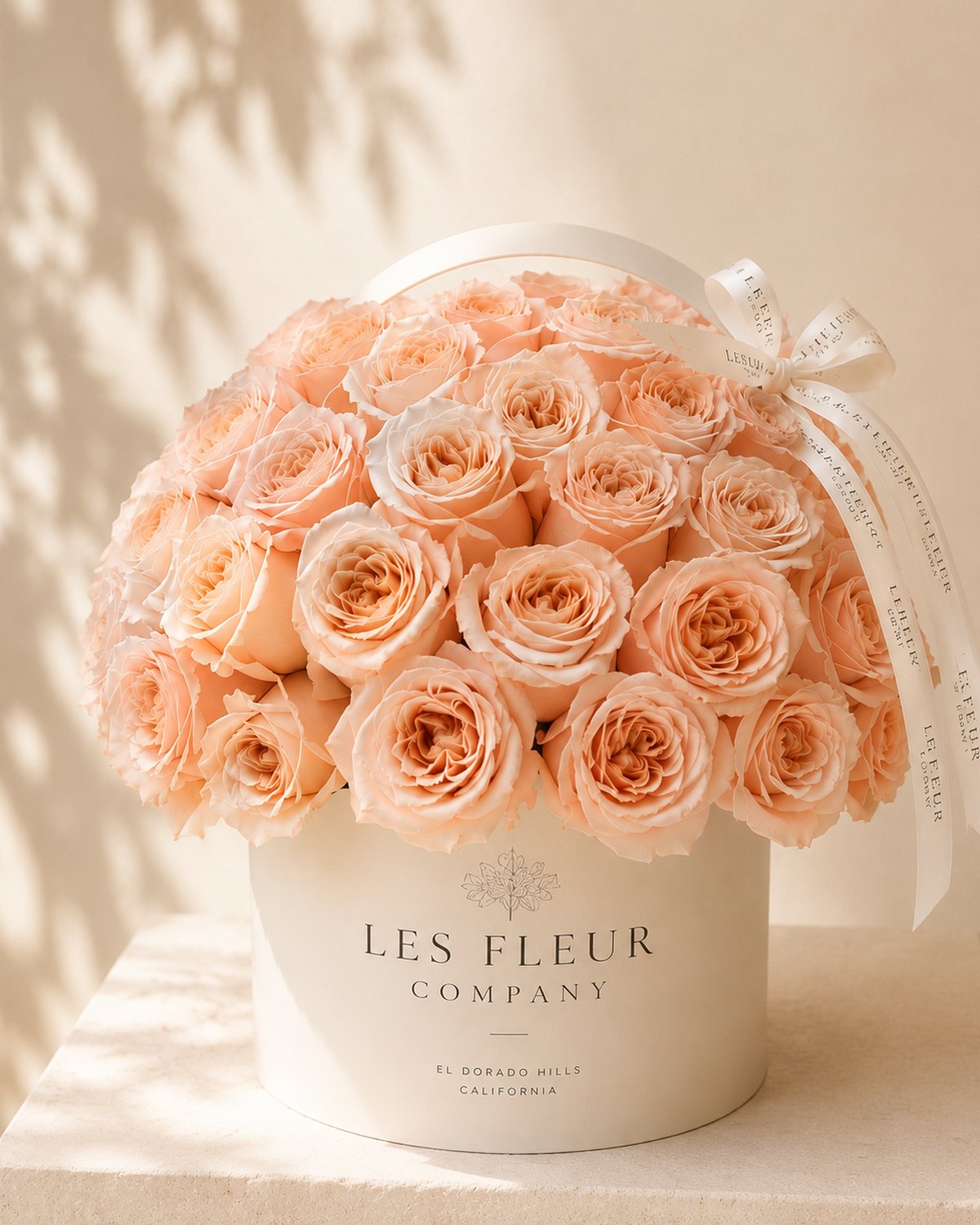
The substitution is usually a garden rose. Quicksand and Mondial both carry the density and the loose, cupped form that peonies are known for, without the fragility. Vendela, paler and more restrained, does similar work in a monochrome palette. This is not a compromise dressed up as a choice — it is the more disciplined decision, because it works with the room instead of against the calendar.
Couples planning around a fixed date benefit from asking their florist, early, what will actually be at peak that week. A consultation built around the essential elements of a timeless floral composition starts here, with what the season offers, not with a screenshot.
Garden Roses Over Uniform Blooms
The uniform hybrid tea rose — the kind sold in dozens at a grocery counter, every petal identical, every stem the same length — has fallen out of favor in considered floral work. What has replaced it is the garden rose, with its irregular outer petals, its looser center, and its willingness to look slightly undone. This is not an aesthetic accident. It is the same discipline that governs the rest of a composition: restraint, not repetition.
Mondial gives density and a warm ivory cast. Quicksand shifts from blush to apricot within a single bloom, which reads as richer in low reception light than any single-tone flower can. Juliet, when it is available, carries a soft peach that photographs closer to natural skin tones than most florals — a detail that matters more to a bride than she usually expects going in.
Stem count discipline matters here as much as variety selection. A bridal bouquet built from garden roses rarely needs more than eighteen to twenty-two stems to read as full; beyond that, the arrangement stops being a composition and starts being a mass. The eleventh stem, as we tell clients often, is usually the one that ruins it — the one added for insurance rather than for the shape.
The Return of Structure: Armature and Line Work
Floral foam — the green block known in the trade as oasis — has been the default mechanic for decades because it is fast. It is also single-use plastic that does not biodegrade, and it limits an arrangement to whatever water the block can hold over a six-hour reception. Much of the industry, including our own practice, has shifted toward chicken wire and reusable armature instead.
The mechanical shift has changed what is possible structurally. Chicken wire, shaped into a dome or a grid and set inside a vessel, allows stems to be placed at angles a foam block cannot support — the long, reaching lines that define an installation rather than a centerpiece. Eighteen-gauge wire, floral tape, and reusable frogs do similar work for smaller pieces.
The trend toward visible structure — an arch built on a welded steel frame, a suspended installation anchored to rigging rather than hidden foam — is as much a sustainability decision as a design one. Reusable mechanics also hold up better across a full wedding day, from a ten a.m. ceremony call to an eleven p.m. reception close, which matters more to the arrangement than any single stem choice.
Monochrome and Tonal Palettes
A monochrome wedding palette is often misread as a single flower repeated across every arrangement. Done well, it is closer to the opposite — one color family expressed through several textures and several values, so the arrangement has depth without relying on contrast to create it.
A blush palette, for instance, might run from pale Vendela roses at the lightest end through Quicksand garden roses at mid-tone to a deeper lisianthus or dusty pink dahlia at the base. Dusty miller, silvered and matte, breaks up the density without introducing a competing hue. Eucalyptus does the same work in green.
The discipline required for a tonal palette is harder, not easier, than a mixed one. Every stem has to earn its place in the value range, and there is nowhere to hide an off note. Couples drawn to this approach are usually the ones who have already read the color theory behind sophisticated wedding palettes and want a room that photographs as composed rather than curated.
Dried and Preserved Elements as Permanence
Dried lavender, preserved eucalyptus, and bleached bunny tail grass have moved from a niche, boho aesthetic into considered wedding work — not as a trend in themselves, but as a case for permanence inside an event that is, by nature, temporary.
The appeal is practical as much as sentimental. A bundle of dried lavender tucked into a bridal bouquet holds its form and its scent for years, long after the fresh stems have been composted. Preserved eucalyptus, treated with a glycerin solution rather than simply air-dried, keeps its flexibility and its color for six months to a year, which makes it useful for installations that need to survive a full day of handling without wilting.
The mistake couples make is over-relying on dried material for cost reasons and ending up with an arrangement that reads as brittle rather than intentional. The better use is as an accent — five or six stems of lavender worked through a fresh composition, not a bouquet built entirely from dried stock. Used this way, it is less a trend than a quiet argument for the rose that keeps.
Scale: The Move Toward Fewer, Larger Gestures
Ten years ago, a considered wedding budget was often spread evenly across twenty identical low centerpieces, one per table, plus a modest arch. The current shift is toward concentration — one or two large gestures instead of many small, repeated ones.
A single sculptural installation over a sweetheart table, or a suspended arrangement above the dance floor, can cost as much as eight to ten conventional centerpieces combined. Couples are choosing it anyway, because a room remembers one striking gesture longer than it remembers twenty adequate ones. The remaining tables might carry simple bud vases or a single stem cluster, letting the one large piece do the work the whole room used to share.
This is not an argument for spending more. It is an argument for spending differently. A couple working with a fixed floral budget of, say, twelve thousand dollars, is often better served by one arch, one bar backdrop, and modest table work than by twenty matching centerpieces that no single guest will remember individually. The negative space left around a single strong gesture is doing as much work as the flowers themselves.
Color Trends for the Coming Season
The palettes moving through considered weddings this season lean deeper than the pastel-forward years just behind us. Deep plum and aubergine, paired with garden roses in a lighter tone, are appearing at fall and winter events. Butter yellow, once considered a difficult color to work with, is returning as a warm neutral rather than a statement hue. Sage and terracotta continue from prior seasons but are being used with more restraint — as an accent within a composition rather than the full palette.
None of these hold up as a rule independent of venue. A deep plum palette reads as rich against the stone and low light of a Lake Tahoe mountain chapel and can read as heavy inside a bright, glass-walled San Francisco venue with afternoon sun. A couple planning a wedding at one of the venues in our Lake Tahoe portfolio is working with different light and different stone than a couple planning in the city, and the palette should answer to the room before it answers to the season's color forecast.
The practical takeaway: treat seasonal color trends as a starting point for a conversation with your florist, not a fixed order. Bring the venue's finishes — stone, linen, existing greenery — to that conversation before the Pantone chip.
What Doesn't Change: The Fundamentals Beneath the Trend
Every trend discussed here sits on top of the same handful of fundamentals, and those fundamentals are the part worth protecting regardless of what the coming season favors. Silhouette. Negative space. Proportion to the room. A bouquet that photographs beautifully in isolation but overwhelms a five-foot-two bride is a failure of proportion, not a success of trend.
Negative space in particular gets sacrificed first when a couple chases fullness as a proxy for luxury. An arrangement with visible air between its stems reads as more considered than one packed dense from edge to edge, in the same way a sparsely hung gallery wall reads as more deliberate than one covered floor to ceiling. This is the throughline across every composition our atelier builds, detailed further in the five elements behind a masterful floral composition.
Trends will keep shifting on a roughly two- to three-year cycle. Silhouette, scale, and restraint do not shift, because they are not stylistic choices — they are the mechanics of how an arrangement reads across a room rather than a screen.
Choosing Trends That Suit the Room, Not the Feed
The most useful question a couple can ask before adopting any trend is whether it will still work at eight p.m. under the venue's actual lighting, not at ten a.m. in a florist's studio with north-facing windows. A pale, tonal palette that looks refined in daylight can go flat and gray under warm incandescent bulbs. A deep, saturated palette can read as muddy under fluorescent tent lighting.
A site visit with the florist, ideally at the same time of day the ceremony or reception will actually happen, resolves most of these questions before they become expensive mistakes. It is a step many couples skip in favor of a Pinterest board, and it is the single most useful hour in the entire planning process.
A short list worth bringing to that visit:
Most florists welcome this conversation. It saves the atelier from building something beautiful in isolation that fails the room it was built for.
Working With Your Florist on Trend vs. Timeless
A considered floral atelier books nine to twelve months ahead for peak season dates, May through October, and longer for florists who limit themselves to one event per weekend rather than stacking several. That early booking window is not just about calendar availability — it is what allows first access to seasonal blooms rather than last-minute substitutions.
The process itself typically runs through two or three consultations: an initial conversation about palette and scale, a mockup of the bridal bouquet and one centerpiece roughly two to three months out, and a final walkthrough the week of the event. Couples who bring reference images to that first conversation get more out of it than couples who bring none — the images are useful as a starting vocabulary, not as a literal order sheet.
The florist's job, in that process, is to translate what the client is responding to in a photograph — density, color, looseness — into something that will hold up in their specific room, on their specific date, built from what the season actually offers. That translation is the atelier's real work, distinct from the arranging itself, and it is worth understanding as its own craft, detailed in the atelier's approach to expertly curated arrangements.
A wedding is one day. The composition built for it should still make sense the morning after, in a photograph taken years later, once the trend that inspired it has already passed.
Considered
What wedding flowers are trending right now?
Garden roses (Mondial, Quicksand, Vendela varieties), lisianthus, and tonal monochrome palettes are leading considered weddings this season, alongside dried elements like lavender and preserved eucalyptus used for permanence rather than novelty. Ranunculus and dahlias remain popular but only within their natural season.
Should I choose trendy wedding flowers or timeless ones?
Choose the arrangement that suits your room, season, and light before you choose what is trending. A trend that photographs well on a screen can still fail in a reception hall for six hours. The safest approach is a timeless silhouette built from whatever the current season does best.
What percentage of a wedding budget should go to florals?
Most florists, including our atelier, see florals run 8 to 12 percent of total wedding budget for a considered event. That figure shifts with installation scale — a single large ceremony arch can cost as much as ten scattered centerpieces.
Are floral installations replacing centerpieces at weddings?
Many couples are now allocating budget toward one or two large sculptural installations — an arch, a suspended piece, a bar backdrop — rather than identical arrangements on every table. It is a shift toward fewer, larger gestures rather than repetition.
Is floral foam still used in wedding arrangements?
Less than it was. Many ateliers, including ours, have moved toward chicken wire and reusable armature for structural work, both for the mechanics they allow and for the environmental case against single-use foam.
How far in advance should I book a wedding florist?
Nine to twelve months ahead for a considered wedding, longer for peak season dates (May through October) or for florists who limit their calendar to one event per weekend. Booking early also secures first access to seasonal blooms rather than substitutions.